Posts

Showing posts with the label health

Health and wellness week one

Image
Monday week one was a brief course introduction, determining the attendance, and an introduction to Moodle and the textbook.  Wednesday opened with a review of the term start health and wellness survey . I then moved on to the chapter one slide deck but only made it through slide 23 of 36.  Because Friday was dedicated to measuring BMI, slides 24 to 36 were pushed back to Monday week two. Monday will open with a meditation and then finish the first slide deck prior to moving into chapter two in earnest.  The Tanita body composition scale, now over two decades old, is up front. The electrical socket there was too loose for the transformer prongs, but the electrical connectivity held. A tape measure was the only height measuring device. Heights were done in feet and inches, weight in pounds, because that is what the students actually know. One young man had gained two inches since his last height measurement, another had gained three inches. Had centimeters be...

Managing a healthy weight

Image
Chapter six includes a look at essential fat versus storage fat. This seemed to be a good time to follow up on the term start BMI measurement with a full body fat measurement. This worked better than I expected. Perhaps the students have become more comfortable with me and with the course than they were in the first week.  I posted a Tanita chart off of their Asian site for reference. This activity required 50 minutes, so only the last ten started into the chapter content. 

Mind body harmony

Image
Week two in the health science course focused on mind body harmony. As the textbook included a special focus on meditation, the class engaged in simple a breath focused meditation on Monday and Wednesday. To date the course has had three surveys as a way to stimulate self-reflection among the students. Week one featured a general health and wellness survey. Week two had a mind-body harmony survey. Week three the textbook focused on the management of stress. Each week is driven by a slides presentations, videos are used to soak up extra time at the end of the week. Monday of week three opened with a review of survey results to date followed by a brief meditation where the students were to imagine a stressor and then to feel their emotional response. The exercise was intended to teach the students that emotional reactions are choices their mind is making. That their emotions may currently control them, but that they can reach a place where they can see...

Health and tackling the rising tide of NCDs

Image
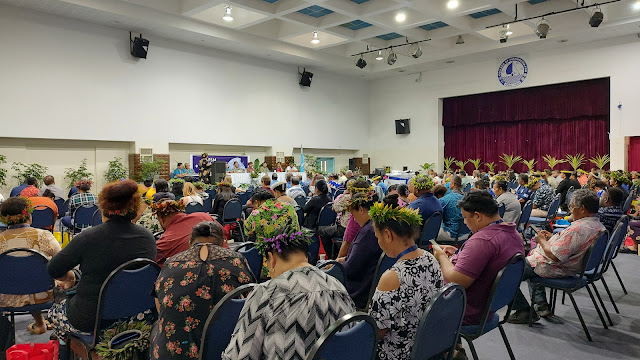
I wandered in near the end of a panel presentation at the national health summit. I was only there to pick up a participant in the summit. As I waited  I heard the challenges of deciding where to focus health sector funding and efforts - whether to focus limited funding on primary care, tertiary care. or nutrition to tackle the rising Non-Communicable Disease crisis.  Since attending health meetings over two decades ago I never hear the need to promote and fund aerobic exercise, the single most effective long term NCD prevention strategy. Twenty years of speakers calling for nutrition education and training more nutritionists has not stemmed the rising tide of NCDs. Nutrition is obviously important but has not been a solution.  The complication is that exercising in public is culturally problematic for many here. Including my culturally traditional wife. After twenty years of encouraging her to workout, ten years ago she began working out: at an indoor fitness center. She...

Healthy relationships survey results

Image
Two surveys were given to a convenience sample of 19 young adults aged 18 to 25. The sample included 10 females and 9 males. The first survey examined sexual values among the sample. The second survey examined attitudes about love. Some questions may have been misunderstood, the respondents were all working in their second language. Other questions undoubtedly carry meanings and implications that will be interpreted differently as a result of cultural factors.  The respondents were asked to strongly agree (1), slightly agree (2),  slightly disagree (3), or strongly disagree (4) with nineteen statements. The respondents had strong consensus agreement for the following statements: 3. Concern over sexual performance is quite common. 9. The quality of a sexual relationship is usually parallel to the quality of the partners' relationship in general. 17. Most people who are intimate with each other find it relatively easy to talk openly and honestly about the intimate deta...

Heart rate data in statistics class

Image
The second student presentation in MS 150 Statistic occurs during the fourth week of the term. The presentation could theoretically use any set of data, the students are to use the statistics covered during weeks two and three in their presentations. During week two and and three measures of middle and spread were covered along with boxplots and histograms. Fourth week in the fall term usually lands around Pohnpei liberation day marking the day control of the island passed from the Japanese to the Americans after world war two. Liberation day is a time of inter-municipal athletics. Baseball, softball, volleyball, basketball, table tennis, swimming, track and field. This term is no exception with liberation day track and field events falling on Tuesday of the fourth week. In part as a result of this the presentation data has tried to center on a simple, easy to measure health metric, heart rate. The students first obtain their resting heart rate per minute by counting their pulse fo...
Image
A convenience sample survey of social media, tech usage, and stimulant preferences was given to students in MS 150 Statistics at the College of Micronesia-FSM. The survey was administered via a modified Schoology quiz that was used to pose options as multiple choice questions. The quiz and questions carried zero points, there were no right or wrong answers. The social media survey seeks to understand where the students are "living" in terms of social media. FaceBook remains the dominant social media presence for the students in MS 150 statistics. Small underlying sample sizes make the trends harder to interpret, but in general adoption of cell phones and specifically smart phone outpaces tablet and pad adoption by students. The laptop data remains highly variable term-on-term. Betelnut edged out coffee for the two most recent terms. The fall in the number of students reported no stimulant usage is an artifact of a small sample size spring 2017. The spring 201...

Sexual harassment survey results

Image
A sexual harassment survey of 24 questions was distributed to a convenience sample of 46 students in a college statistics class. The 46 students surveyed included 24 females and 22 males. The course has 60 students enrolled, predominantly listing their state of residence as Pohnpei. The unmarked blue sliver is a single student from Chuuk. The survey was anonymous, thus there is no way to determine the actual state breakdown for the 46 students surveyed. The students were asked, "Which of the following do you believe is sexual harassment? (mark all that apply)" The prompts are listed in descending order from those prompts which obtained the most marks to the least marked items. Of note is that even forced sexual acts were not deemed sexual harassment by all 46 respondents. The survey did not seek to determine whether some students might have been separating sexual harassment from criminal sexual activity such as rape. Prompt Total n=46 Being forced to do something ...

Local food and healthy bodies

Image
The United States Navy educational goal for the islanders of the Trust Territory in 1949 was for the islanders "to learn to live a healthy, happy life in one's own environment." So reported a Life magazine article of 25 April 1949 . In a four page color spread at the center of the multipage article, Life magazine included images of dancers. Including adult men from Pohnpei performing a canoe dance. © Life magazine/Time Inc. These men certainly look healthy and span a wide range of ages. Paintings and photographs from the nineteenth and early twentieth century all suggest the same: Micronesian peoples were healthy, strong, muscular, thriving on local food, local agricultural practices, and local fishing. The past couple weeks I have been visiting the hospital as a stream of descendants of those healthy ancestors flows into the surgery bays for amputations due to diabetes. Others being treated for the many maladies that obesity and dietary choices have brought on. In...

Notes from the Northern Pacific Environmental Health Association Strategic Planning Meeting

Image
These are my own rough and unofficial notes from the Northern Pacific Environmental Health Association Strategic Planning Meeting held on Pohnpei in May 2014. There was a need identified to bring key actors together to develop a strategic plan. Environmental health touches on many areas – waste management, water, climate change, occupational safety. Consultants in health adaptation for climate change, specialists on vector borne diseases, specialists who advocate community based approaches. Environmental health has a WHO definition . Includes human health, quality of life, that are determined by chemical, physical, biological, social and psychosocial factors in the environment. Assessing, correcting, controlling, and preventing those factors in the environment that can potential affect adversely the health of present and future generations. Environmental health addresses all the physical, chemical, and biological factors external to a person, and all the related factors impac...