Posts

Showing posts with the label mathematics

What is 120 plus 12?

Image
"What is 120 plus 12?" I asked the student. The student and I were measuring the circumference of a hoop that exceeded the length of the 120 inch tape measure. The student had chosen to measure the circumference and to use inches. The tape measure was 12 inches short of the circumference, the student was holding the tape measure showing that the gap remaining was 12 inches. The student looked up from the measurement in hand and said nothing. I waited.  Students in a prior term timing the period of a hoop. The period of a hoop is linearly related to the diameter. "Just add the 12 to the 120, what is 12 more than 120?" The student looked at me blankly. I waited. After twenty seconds, the student asked, "I can use my cell phone calculator?" The student pulled out their cell phone and obtained 132.  "You couldn't do that calculation in your head?" I asked. The student indicated that they could not.  ❖ "Plummeting math scores prompted lawmake...

Preassessment, Gen Ed 3.2 numeric information in graphic forms, and math placement

Image
An anonymous preassessment briefly looked at some of the graphical mathematical skills the students have in my fall 2025 courses. The preassessment also asked a few basic linear calculations. The preassessment was sent via a link in an email to the 137 students in my courses for fall 2025. The survey was completed anonymously, remotely, and unsupervised. 36 students responded to the preassessment.  The students were in both mathematical and non-mathematical courses. The survey asked some math course background questions, and then presented the following questions. The survey included images for graphical questions.  Which of the points is at the coordinate (3,1)? What is the slope of the line on the graph? Enter the slope as a decimal value. What is the y-intercept of the line on the graph? Which line on the graph matches the data in the time versus distance table? If a person is running at 2.58 meters per second, how far will they go in 3600 seconds? Do not include the unit...

Desmos regression tool

Image
Demos graphing calculator on the web (desktop, laptop) includes a regression tool. The tool is not yet in the mobile app. To use the tool on a mobile device use the mobile browser to open: https://www.desmos.com/calculator The regression tool works with tables. The tool is an icon at the upper left side of the table. The tool opens as a linear regression. Other regression options are available. To the right of the equation is an icon that copies the equation out to a new line. Editing that to f(x) notation results in a function that accepts inputs. Note that the above was done on mobile device using the mobile browser, not the Desmos app.  The graph above was autoscaled using the autoscale on the table.

Desmos geometry

Image
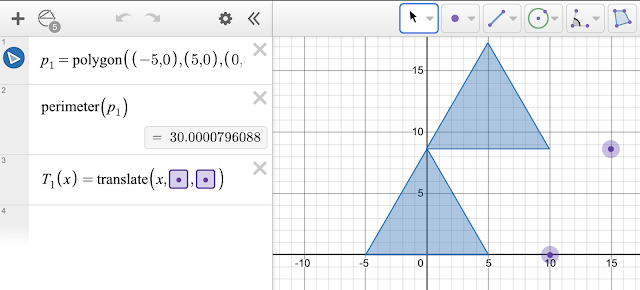
I never know quite what to do with the advances in mathematical tools, I just know that mathematics education stands at the edge of vast new technical capabilities. One of the tools I actively use, Desmos graphing calculator, has released a new version of their geometry calculator.  Desmos geometry Drag a purple dot on the graph to move the translation of the triangle around the graph. A more advanced demonstration is of maximizing the area inside a rectangle for a fixed perimeter done by Desmos. Maximize the area of a rectangle Drag the blue dot C until the maximum value for the area appears. How does that relate to the red coordinate displayed along the parabola? These tools open not only whole new ways to explore mathematics, these tools provide the capability to explore things that one could not previously explore. Such as an analysis of the conduction rate of water in celery xylem in a botany course laboratory. Celery conduction rate analysis But the students did not cut their...

WolframAlpha, ChatGPT, and Desmos 3D

Image
For the above expression WolframAlpha offers the result seen above, choosing to simplify only by removing the cube root of 64.  Further down WolframAlpha offers the more simplified result seen above, but with the caveat that x and y must be positive. Yet the this is an odd root expression. Negatives "under the radical" are not imaginary.  I asked ChatGPT to weigh in on this. As seen above ChatGPT, known to sometimes commit mathematical errors, concurs that x and y do not have to be positive.  I then asked ChatGPT to simplify the same expression and ChatGPT went straight to the correct answer with no caveats. I say that round went to ChatGPT.  Desmos 3D visually demonstrates that both x and y can be negative.  All of the above screenshots are from a budget cell phone. There is deeper question underneath this single example. In algebra classes students are still being taught to simplify expressions suc...

Pre-assessment of linear equations knowledge from graphical data

Image
Five students in SC 130 Physical Science were given a pre-assessment of their understanding of linear equations which focused on the interpretation of graphical and tabular presentations. Four of the five students had completed MS 100 College Algebra, the remaining student had completed MS 099 Intermediate Algebra.  Three students either left questions blank or provided wrong answers to every problem. Two students successfully answered six and eight of nine questions respectively. These are bright young students who have had at least twelve years of mathematics including high school algebra and collegiate math courses. The one student in MS 099 Intermediate Algebra was the student who answered six of nine correctly. In some sense, that the level of mathematics did not predict success is an indictment of the failure of the mathematics curriculum to teach mathematics. And when asked if they like math class, only two students responded that they did. Most students are only all too hap...