Posts

Showing posts with the label Nuventive

Learning outcomes from Moodle to Nuventive

Image
To move learning outcomes from Moodle to Nuventive requires first having set up outcomes in Moodle. Setting up outcomes is optimally done prior to the start of the term. That said, outcomes can be created and attached to any assignment that has not yet had submissions.  In order to set up learning outcomes in Moodle, a rating Scale must first be set up. Scales are set up from a submenu on the Grades tab from the course home page.  Use Add a new scale to create a rating scale. Give the scale a name. Once used anywhere else in Moodle, the scale cannot be edited. This is why the scale is grayed out above: the scale is in use.  The scale is a comma separated list of words. Keep each rating short, the rating words will populate a drop down list.  The ratings must be in order from lowest rating to highest rating . Under the hood, Moodle, with default admin settings, will assign one point to the first rating, two points to the second rati...

Moodle and Canvas learning outcomes assessment usage and reporting

Image
In Instructure Canvas outcome rating scales can be set to custom values. This allows the use of rating scales that can be used to mark assignments. In addition, Canvas permits outcomes to be added to rubrics, allowing assignments to be graded by the outcome rating. Learning outcomes scales In Canvas a custom 5-4-3-0 was deployed which produced 100%-60%-60%-0% when used in a rubric to mark an assignment.  Setting up a scale in Moodle In Moodle the rating scale is automatically set to be monotonically increasing from one (or zero). This produces a 25%-50%-75%-100% scale if the scale is left at the default start of one. Moodle does not directly include outcomes in rubrics, although one could conceivably add pseudo-outcomes as criterion.  Canvas Speed grader side panel on the left, Moodle Grader side panel on the right In Canvas outcomes can reside directly in the rubric and, at the instructor's option, contribute to the grade for the assignment. In Moodle learning outcomes cannot...

Adding links or images to Nuventive Improve results including charts produced by Instructure Canvas

Image
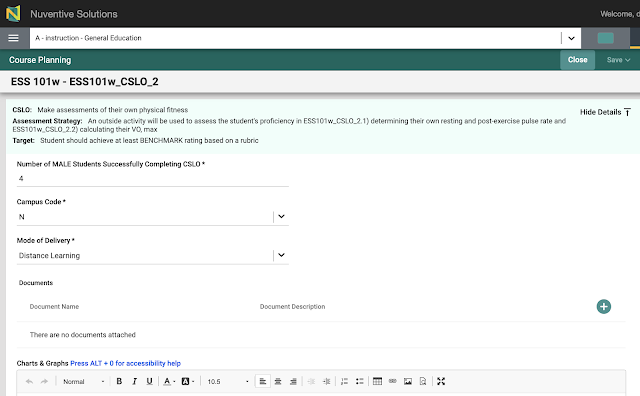
In the past under TracDat there was a way to attach a linked document, a URL, as evidence supporting a result posted to TracDat. In Nuventive Improve this can still be done, but the process is a little different. When entering a course student learning outcome result there is a rich text editor available further down the page.  Clicking in the text area below Charts and Graphs activates a rich text content editor. A link can be copied and pasted directly into the editor. Another option that this enables is to include a screenshot of the Instructure Canvas Learning Mastery Gradebook summary chart. One can upload the Canvas learning mastery chart screenshot to Nuventive. This chart comes from the Learning Mastery Gradebook in Canvas which is populated when faculty use outcomes from the institutional bank of course learning outcomes or course learning outcomes they have added to their course: There are steps in this process omitted above. One has to first make a screen shot of the cha...

Canvas learning mastery export to Nuventive TracDat input

Image
As the Nuventive team has noted , Nuventive Improve does not retrieve data from the Instructure Canvas learning management system directly. While this was deeply disappointing to me personally as this means double data entry will have to done by faculty to get data into TracDat, my knowledge of Canvas and spreadsheets provided me with a path to reduce the amount of manual counting on my fingers work my courses would involve. Note that this process works as shown below if a faculty member is using course learning outcomes from the institutional bank of course learning outcomes in Canvas as outlined in a video on how to import course learning outcomes for use in rubrics and question banks. Start from the Gradebook and use the drop down menu to switch to Learning Mastery. The values seen in the columns are the outcomes results, on a five point scale calculating using a decaying average. In a rubric outcome achievement is deemed to be optimal, sufficient, suboptimal, or no evidence th...