Saturday, January 31, 2009

Running to the point, Nett point
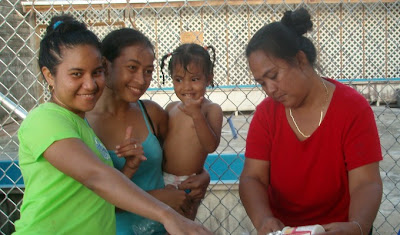
An evening picnic at Nett point to celebrate a third birthday provided an opportunity for an evening run capped off with a swim and barbecue dinner.


After finishing up marking a batch of papers, I ran to Dausokele bridge about four kilometers out from home. Then I walked up the Paliais side of Nett point, a densely populated area with dogs that are not accustomed to runners. After passing the Mendiola home, last on the road, I continued running the final leg out to the point.


January winds have put a chop on the lagoon. Two small lagoon islands, Lenger on the right, shine in the evening sun. I pulled off my running shoes and dived into the Pacific ocean. Now that is January running that suits me!

Swimming is a survival skill, and that means swimming in currents and waves. Children are scattered from the dock at the point on out towards the east end of the airport runway. One of mine is in farthest group out. Based on the distance to return against the prevailing current, the swimming lessons were well worth the nominal cost.
Posted by Picasa

Friday, January 30, 2009

Social networking sites, faculty, and Micronesian student opinion

As a member of a technical team from 1996 to 2000 one of my tasks was to explore new technologies and to assist the Division of Natural Sciences and Mathematics in adopting those technologies. When I first connected to the Internet in 1996 a colleague said to me, "There is nothing useful on the Internet, it is an academic waste of time. Gopher has everything you need."

Gopher was pre-Internet system based out of the University of Minnesota that provided on line access via menu commands to academic resources across the nation. Indeed, in 1996 there was nothing of significant academic value on the Internet, Gopher was still the place to be. Nowadays few remember Gopher or its search engines Archie and Veronica. New technology in education is like that, rejected at first as a complete waste of time and then embraced, typically by a new generation of instructors who grew up with the new technology.

Recent studies have shown that 30 percent of Facebook users and 32 percent of MySpace users are older than 45. College administrators and faculty are contributing to this fast-growing group. Building interpersonal relationships among students, academicians and administrators has the potential to alter perceived power relationships by making faculty and personnel seem more accessible.
[Using Social Networking Sites as Student Engagement Tools]

In an informal convenience sample survey of 57 students in a statistics course at the College of Micronesia-FSM national site, 42 students (74%) responded "yes" to the question "Do you want faculty to use social networking sites?" Nine of the 57 (16%) responded "no" and the remaining six left the question blank.

Given the concern over the potential for a "creepy treehouse," the survey also sought to explore whether students were comfortable with having faculty active in social networking sites. Discussions with a non-randomly selected focus group prior to the survey indicated that "creepy" was not a well understood word in the ESL environment of the college. The focus group suggested using the word "weird." Thirty-four of 57 students (60%) responded "no" to the question "Does having faculty on social networking site seem weird?" Sixteen
(28%) responded "yes" and seven left the question blank.

While discussion currently centers on whether faculty should use social networking sites such as FaceBook, my own intuition is that time will render this question irrelevant. In the late 1980s I used an email precursor called Free Educational Mail or FrEdmail for short. At that time only a few early adopter educators were using FrEdmail and many of my colleagues felt the project was of limited educational value and use. Today no academic argues that email is irrelevant to academia and student-faculty interaction.

Today's students are tomorrow's faculty. With an estimated 83% of our students using social networking sites, there will be a day when 83% of the faculty are socially networked. The question will not be whether a faculty member should exist in "social networking" space but rather how to behave ethically in this brave new world.

Speaking to a student using Bebo I noted that she enjoyed a freedom on Bebo that will be unique to her generation. I was thinking of the articles that refer to social networking sites as student spaces. I realize that this is a transitory phase, a produce of the newness of the technology. The student asked why her freedom on Bebo was unique to her generation.

I explained, "One day you may be a parent. Your children are likely to use Bebo, or MySpace. You will be able to interact with, watch, and monitor your children. Now you are free, your parents are not on Bebo. Your children will have you looking over their on line shoulder."

"But my mother uses Bebo," responded the student.

Recovering from my surprise I asked, "Can't she read everything you are writing? Or do you 'block' her?"

"No, I do not block her," responded the student. I thought for a moment, searching for the correct terminology in what for me is a new world.

"Did you, have you 'friended' her?" I say with some uncertainty.

The student laughed, "No, of course not!" Ah, so children will not block their parents, but they might not "friend" them either. The "rules" are already being sorted out by thousands of such interactions on social networking sites by students, faculty, parents, and children. Social networking and other Internet spawn are already having an impact on both academia and the academics who inhabit the hallways and classrooms. Academic conferences now includes sessions on the utility and benefits of using social networking sites.

Education rarely meets a technology that it does not co-opt. Eventually the social networking fad will become part of the social fabric of campuses. Social networks will be a part of the future university and college experience. And, to my own surprise, our students at the college want to be able to interact with faculty in a world in which they spend so much of their time. This is the place, judging by the amount of time and energy spent by our students in these cyberworlds, students feel comfortable. That said, our students remain a little nervous about faculty members joining them on line with eight students responding yes to both of the two questions asked on the survey. Yes, they want faculty on line in social networking space and for eight, yes, that will that will seem weird. For thirty-two other students (56%), however, they want faculty on line and that will not seem weird.

Pohnpei Traditional Plants ethnobotanical garden

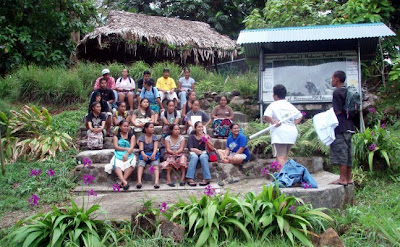
The ethnobotany class visited the Pohnpei traditional plants garden as an introduction to the unit on the healing plants of Micronesia.


Each term there is a perceptible decay in the plant knowledge of the students. This term appears to have hit a new low in devolution. The loss of plant names and uses was pervasive across the class. In a change from prior terms, the few local plant names that were known by students were plants known by students from Chuuk state. The Pohnpei state students seemed broadly at a loss of ability to name a number of different plants.

The future hopes of retaining ethnobotanical knowledge rest on a thin line of a few students. A deep concern for the culture and traditions and their retention has led to what might be called a "tough love" approach to teaching and learning. This field trip included some educational tough love. As the noted educational theorist Paulo Freire once said while speaking to educators at the University of Illinois, "education is love." Love for both for a subject matter and for the students with whom one hopes to entrust that most priceless of possessions, knowledge.
Posted by Picasa

Dropping golf balls on the job

While "dropping the ball" usually connotes a failed effort, a missed opportunity, or a lost chance to win, in physical science golf ball dropping can produce remarkably accurate estimates of the acceleration of gravity.


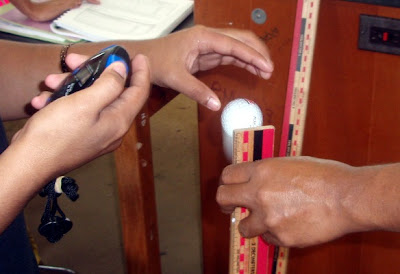
The golf balls are dropped from heights ranging from 50 cm to 300 cm. The drop time for each height is measured five times, and then the average of the five drops is calculated.


Done right, the science laboratory is all about working effectively as a team and discussing results. Learning happens.


The one dropping has to time to eliminate reaction time errors. The data is first graphed as time versus distance, producing a parabola. As the students only know how to run a linear regression using the LINEST function in OpenOffice.org Calc, the students square the time and then make a separate plot of the time squared against the distance dropped. With careful measurements, this produces a straight line the slope of which is one-half g.

The laboratory guide also includes calculated the percent error based on the textbook value for g. Although the course is guided in part by constructivism, the course does not pretend that no one else has ever done science on the planet.


Posted by Picasa

Thursday, January 29, 2009

Social networking sites and the student affairs mission

As I recently noted in my blog, FaceBook is considered "the dark side" that wastes student's time. As a student affairs and support services person, however, if 83% of your students are "hanging out" in one place, then that is where you want to be. A study of 453 colleges found that over half now use social media in their admissions strategies. Colleges are increasingly turning to these technologies to engage with student and provide support services. The Student Affairs Collaborative blog provides a guide to using FaceBook as a part of the student affairs mission. As noted by Diverse Education, "...colleges and universities have started thinking about how to harness the connective power of SNS to further engage students in academic life."

In the articles cited above issues of the propriety and privacy are often discussed. This issue will ultimately be moot. If today 83% of our students have a social networking presence, then in fifteen years 83% of our staff will be staff with a social networking presence. The issue will not be whether or not to have a presence, that will be water under the bridge. The issue will be how to interact ethically on those sites
(with apologies, the ethics guidelines for using social media are themselves on a social media site).

Tuesday, January 27, 2009

Computing on the dark side

I suppose I am working on what many of my colleagues currently perceive to be the "dark side." I argue that education never met a technology that it did not like. The Gutenberg press is said to have led to textbooks and the very concept of public education. Radio quickly led to education programs via radio. Television led to educational programming including PBS. Videotapes returned control to the teacher on what was shown when. Computers brought software and programs, networks have provided whole new ways to communicate with students.

Given the results of the survey I ran, clearly my students are in cyberspace. 83% use a social networking site, typically MySpace or Bebo. The collegiate market stateside is, however, clearly on FaceBook. When Blackboard sought to partner, they partnered with FaceBook. FaceBook is also being used a student service and support tool, When news media market leader CNN sought an inauguration day partner, they too chose FaceBook. Anecdotally, articles that discuss academic use of social networking sites more often cite FaceBook by name (Online Social Networking on Campus, Professor as Open Book). Discussions of faculty and student interactions also often center on FaceBook. A FaceBook group even promotes a code of ethics for faculty.

Given that Twitter and blogging appeared to be non-starters for my students, I decided to dip into the dark side and explore FaceBook, while seeking ways to link up MySpace and Bebo users.

The first serendipitous discovery was that within three hours of signing up I had located more than a dozen off-island alumni including some UB-only alumni. I suddenly understood, "grokked" to use a word invented by sci-fi author Robert Heinlein, the tremendous power of these systems for an alumni organization. I also learned that each is a separate walled garden, a silo, and that one would need an account in each major player. But with that, lots of alumni could be found.

I am pushing myself up a steep learning curve - learning the ins and outs of an interface that has clearly evolved and now has its own language. The first few hours have been filled with trying to understand why someone was writing on something called my wall, learning to upload photos, and getting my Twitter feed and blog to cross-load into FaceBook. I was also absolutely blown away by reconnecting with friends I have not seen in years, some not since 1978. The power of these things left me literally dizzy. Seeing friends for the first time in thirty years - recognizing in their faces that which I see in my own mirror, older faces. At least they look wiser for the years, I feel as foolish as ever.

With only a basic one-day worth of understanding under my belt, I am now exploring how to use this productively in supporting my students. One obvious path is to set up a closed group for a class with myself as admin. This will probably be the initial experiment.

Post-script: FaceBook turned five just after I wrote this article. David Coursey at PCWeek wrote an excellent article on the fifth anniversary of FaceBook.

Sunday, January 25, 2009

Where Micronesian college students are found in cyberspace

This term I have been seeking new ways to connect to my increasingly tech-savvy and tech-equipped students. This note looks at the ways in which the students have chosen to interact using technology. The study is an informal study consisting of a convenience sample of students in MS 150 Statistics. The study seeks to provide preliminary information on the ways and cyberspace places that our students choose to connect to their world.

Questions asked


1. If you have a cell phone, about how many text messages do you send per day?
2. Do you Twitter? [http://twitter.com/danaleeling]
3. Do you blog? [http://danaleeling.blogspot.com]
4. Do you have a MySpace, FaceBook, Bebo, or other social networking Site? If yes, which one?

The questions appeared on quiz three given in the A204 computer laboratory on 23 January 2009. The students were working at Internet connected computers. The web addresses were provided so that students who did not understand questions two and three could access the site to clarify the meaning of Twitter and blog. Questions two and three were based on anecdotal reports of use of these two technologies by instructors and their classes in colleges in the United States.

Email

The college issues email addresses to all students. The informal survey did not probe email use, although anecdotal evidence suggests that email is an important means of communication among students.

Cell Phones

In an earlier survey of 44 students in the statistics class, 17 voluntarily shared their cell phone number. This indicates that at least 39% of the students possess a cell phone. This term I also have a cell phone, 922-1858, and I have already been receiving calls for homework help on my cell phone. Preliminarily, the students appear to be more comfortable calling my cell than my home phone land line. My guess, and the guess of others I've asked, is that the cell phone is seen as a "safer" way to get a hold of me. Calling my home phone "risks" getting someone other than me. There is a sense of privacy and confidentiality in reaching out to my cell number.

In a follow-up survey of 54 students in the same statistics class, 40 reported sending text messages (74%). Bear in mind that students could report sending text message and not own a cell phone, I have observed students loaning a phone to a friend to send a message. The students were asked to self-report the number of text messages sent per day. The following statistics derive from 38 who reported the number of text messages they sent per day.

Minimum: 1
Maximum: 100
Mode: 5
Median: 12
Mean: 18

The maximum is not necessarily as unusual as it might sound. A similar informal study spring 2008 also had a self-reported maximum of 100 text messages per day. In that study the second most prolific text message user reported sending 60 per day, the study this term the second most prolific reported sending 90 per day. High volume text messaging is infrequent but does occur.

Cell phone technologies and text messaging may be a useful communications tool for faculty.

Twitter


Students have often noted that they came to my office, but I was not there. Unexpected events sometimes pull me away from my desk. I thought I might be able to use Twitter to update students on my location, especially when I am in my office.

Elsewhere Twitter is a widely used and useful tool for maintaining contact. Last fall a science team studying the genus Ponapea utilized Twitter while on Pohnpei to update partners and interested parties on their work in progress. The team also blogged from Pohnpei. When President Obama became President-elect, the secret service asked that he no longer use his Twitter account due to security reasons. A recent incident where an aircraft landed on the Hudson River was noted by CNN to have first been broken as a news story by Twitter, not by traditional news channels.

Twitter on Pohnpei is not as powerful as Twitter elsewhere. In many countries one can Twitter to and from cell phones. Cell phone "twittering", however, does not appear to be possible at this time here on Pohnpei, although I am continuing to research options to Twitter from a cell phone (the term is "send and receive tweets").

Of 54 student respondents, only one reported that they use Twitter. Twitter is not currently a useful communication technology for contact with students.

Blog

Blogging is clearly an important emerging communication tool. Blogs have become an important venue through which opinion and, to a lesser extent, news is being moved globally. For tech early adopters, blogs are where almost all new technologies are first reported. Presently my own blog contains primarily personal content and is not geared to an academic support mission.

Of 54 student respondents, only three report having a blog. This does not appear to be a way to connect with students at this time. The area not explored is whether students would check on a blog that was part of a course and was required reading for the course.

Social Networking Sites


Social networking sites are clearly the dominant cyberspace location of choice for our students. Of 54 students, 45 report having a social networking site (83%). Nine students reported having more than one social networking site - coincidentally the same as the number of students who have no social networking site. MySpace and Bebo are the dominant favorite choices of our students, with no student reporting having a FaceBook site. FaceBook clearly has not made the inroads into our college population that it has in the United States. When CNN sought to partner with a social networking site for the recent presidential inauguration, CNN chose FaceBook. Out here, FaceBook is a non-starter.

The following is the break-down of social networking sites for our students. The sum exceeds 54 due to some students having more than one social networking site:

MySpace: 32
Bebo
: 17
Tagged
: 3
Yahoo
: 2
"and many more"
: 1
WAYN
: 1
"All
": 1
Mycoconut
: 1
Flixster
: 1
FaceBook
: 0

The "and many more" is likely a reference to the three listed in the question and would imply a FaceBook user, as would the response "all." As the two students did not specifically mention FaceBook, I opted not to count these as users of FaceBook or the other two listed social networking sites. WAYN is a newer vehicle, "Where Are You Now?" I am unclear on the meaning of the two "Yahoo" entries as I am unaware of a Yahoo branded social networking site.

The nine multiple site users include seven who access two sites (MySpace and Bebo are the typical pair), one who accesses three sites, and one who accesses five social networking sites.

I have heard reports of courses setting up a FaceBook or MySpace homepage as a base for discussions and assignments. Clearly social networking sites are a dominant means of communication with 83% usage exceeding even the most optimistic projection of cell phone penetration. If one is going to go where the students are located, then one is going to have to go to MySpace or Bebo. I suspect that one can Twitterfeed updates on one site to another site, hence one could build in one location (MySpace) and find ways to have students pick up alerts on their Bebo and other sites that the MySpace site has been updated. Alternatively, one could use FaceBook and send feed alerts to the more popularly held MySpace and Bebo. I have read of FaceBook course sites more often than MySpace course sites, conceivably FaceBook may have better course management tools.

[Post-script: The Social Network Challenge: MySpace or FaceBook: How well do you know your audience? ]
Conclusion

The students at the college are increasingly tech savvy with broad use of social networking sites being their dominant hang out location in cyberspace. Text messaging by cell phone and, anecdotally, email are important potential means of communication with our students.

I would be remiss if I did not mention faculty websites. The survey did not ask questions on use of faculty websites as few faculty have active web sites at this time at the college.

Education eventually goes to where the students are located. Finding ways to utilize the cyberspace tools that our students are already employing is a challenge for any modern institution of learning.

Saturday, January 24, 2009

Balls, plants, and flowers

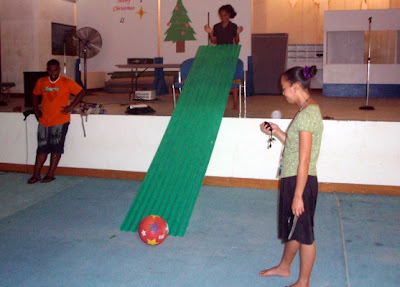
The physical science students run a basic laboratory in which a ball is rolled. The ramp provides a mechanism for rolling the ball at a repeatable speed. The typical version of this experiment involves timing the ball to fixed distances from the bottom of the ramp. The laboratory leads to a linear regression.


The problem I have with the traditional method is that this makes distance the independent variable and time the dependent variable. The correct graph would be distance versus time, the slope of which is the pace not the speed. Physics typically graphs time versus distance, thus the slope is the speed.

While many instructors simply time to fixed distances and then graph the dependent variable on the x-axis, this does not work well when OpenOffice.org Calc or Microsoft Excel are the graphing tools. These packages cannot support multiple x-axes. Since we also roll the ball from half-way up the ramp, there is a need to have distances for pre-specified times.

The students use their sandals to mark where the ball was at one second, two seconds, three seconds, and four seconds. Then a tape measure is used to determine the distance to one second, two seconds. This creates an x-axis with common times for different ball speeds and ensures that time is the independent variable.

This version was conceived by me while sitting on the beach berm in Piyuul, Kosrae, during Christmas break 2007.


The ethnobotany students give presentations on the botany of seedless vascular plants. The seedless vascular plant lecture was at one time a 90 minute lecture that put the 3:30 P.M. class students to sleep. Nothing was learned. Having the students do mini-presentations means that less material is covered, but no one is sleeping.


A flower as large as one's head! A new variety of Hibiscus chinensis on the island. The flower is flatter than the typical H. chinensis and provides a nice, clean example of K5C5A8G5.
Posted by Picasa

Wednesday, January 21, 2009

Inaugural lunch

I took Shrue out for our own inaugural lunch at a restaurant with what I consider a better view than that from the statuary room. Continental 956 can be made out climbing out picture center.


While I may occasionally feel a twang of homesickness for the four seasons, winters like the current one remind me that one can always visit the four seasons, but on one need not necessarily live there.

Yesterday when I went out the door on my evening run I knew Shrue was headed to Yoshie. Two blocks out I found a red rubber band in my shoe. It had fallen into the shoe at home, but I did not feel it for the first 600 meters. So I ran down around the back way to Yoshie, put the rubber band on her side view mirror, and then took off from home a little over two kilometers away.

I deemed the run a "race the rubber band" run. I sought to beat the rubber band home. Fortunately Shrue lingered long enough at Yoshie for me to "beat the rubber band home."

Tuesday, January 20, 2009

Teeth cleaning

Four years since my last dental teeth cleaning I finally got around to slotting an appointment. The process is complex. Appointment slots open once a month on the first business day of the month. When the slots are full for that month, then no more appointments can be made for that month. Thus the process involves two visits to the dental clinic.

Having gone too long a time between cleanings, I felt sure I would be riddled with decay. Turns out that my teeth are the only thing on my aging frame that are holding their own. The hygienist gave me a clean bill of dental health - no cavities. I owe a debt of gratitude to Florence for having passed along strong enamel. Now my previously coffee stained teeth gleam in the tropical sunshine. Cleaning up the halitotic plaque will also be appreciated by my students.

Monday, January 19, 2009

Jasmine

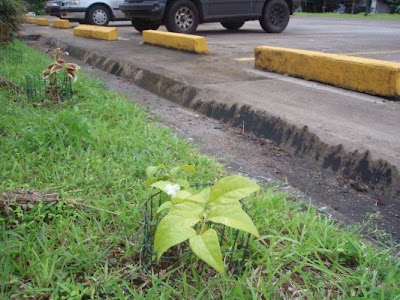
The attempt to add flowers on campus, a rather pathetically insufficient effort on my part thus far, has had its first bloom in the area behind the south faculty building. The concept back there is to have small bushy plants that produce the types of flowers favored by students for placing behind their ear - jasmine, tahitian gardenia, and other small fragrant flowers. The collection is meager at best, but at least the jasmine has bloomed.


I also attempted to transplant a Lycopodiella cernua - an effort I estimate has a 95% chance of failing due to the unusual growth habit of this plant - and a Spathoglottis plicata Philippine ground orchid. Both are now on the small grassy knoll to the east of the A classroom building. Conspiracies concerning the origin of the grassy knoll abound. Grassy knolls have had a bad name since 1963.
Posted by Picasa

Sunday, January 18, 2009

Sunday wear


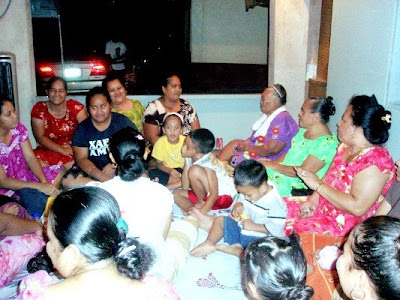
After a muddy day in Kitti immersed in the culture of Pohnpei, the kids were back into Sunday wear for Saturday evening's commemoration of "bomb day." The day marks the loss of two Lelu residents when an errant bomb dropped during World War II killed them.


Milly and her cell phone are joined at the ear.


All of the flowers out in the garden.
Posted by Picasa

Harvey Segal

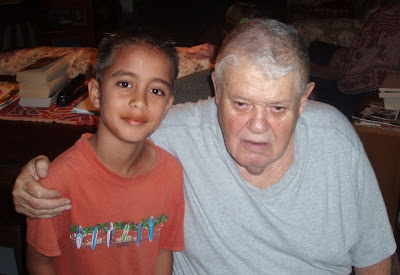
The interview assignment was to interview someone who had done something important during World War II, an odd request in a nation with arguably only a single living World War II veteran and few local elders who date from that era. Harvey is 81 and served on the USS Providence (CL-82). The USS Providence was in the Caribbean headed for Japan when the atomic bombs were dropped and the war came to an abrupt end.


The Providence was redeployed to the Mediterranean where along with two other ships they "showed the flag." The rest of the American fleet was busy shuttling troops home from Europe. Harvey spoke of visiting a number of ports. In Alexandria harbor were British fleet ships. After a few days ashore of captains boasting to other captains, the captain of the Providence opted to take the Providence out of harbor without a pilot and at flank speed. Harvey notes that the ship went hard aground on a reef and it took days of "washing" the boat with the prop wash of other ships to free the Providence. With both propellers damaged, the Providence had to limp and lurch to the nearest dry dock at Gibraltar - the other end of the Mediterranean. Harvey noted that insurance does not cover damage when you decline a harbor pilot.

Harvey also spoke of his youth in Boston. He attended the Harriet A. Baldwin elementary school, an odd foreshadowing of the future. The Baldwin sisters, reputed by Harvey to have been related to the school's namesake, were important figures in the history of Harvey's future home of Kosrae. He remembers going to Boston Red Sox games and to seeing Ted Williams up at bat.
Posted by Picasa

Friday, January 16, 2009

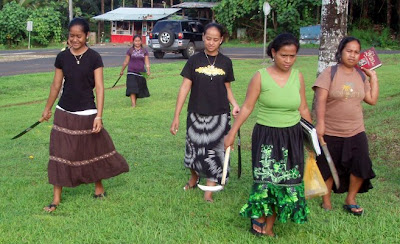
Women with knives and books

College co-eds headed to class with their textbooks is a common site on any college campus. At the College of Micronesia-FSM, these co-eds head to class armed with grass sickles and machetes.


The ethnobotany class worked in the Palikir Ethnobotanical Learning garden at the college. The class toured the garden getting acquainted with the collection and being quizzed on the names of the plants in their own local languages. At other colleges an instructor might only have to cover the Latin binomial, common uses, and a local name in a single language, here there are five major language groups with uses that differ for each group.

When no Pohnpeian could recall the local name for Calophyllum inophyllum, I deliberately suggested rekich. As the Pohnpeians practiced rekich, the Chuukese began laughing. I used this to illustrate the loss of language, of devolution, and the impossibility of recovering a word once lost. Then I covered isou and ituc.

Posted by Picasa

Thursday, January 15, 2009

Physical science lab one

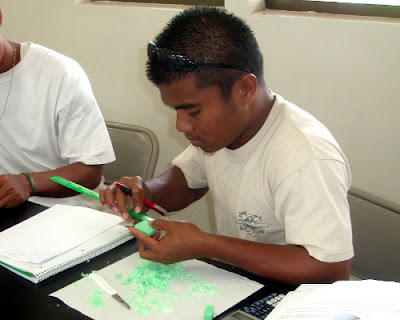
Physical science lab one: the slope of soap.


Georgies measures his soap slab above. Arleen masses a slab of Ivory soap below. The green soap is denser than water, the Ivory is less dense than water.

Posted by Picasa

Wednesday, January 14, 2009

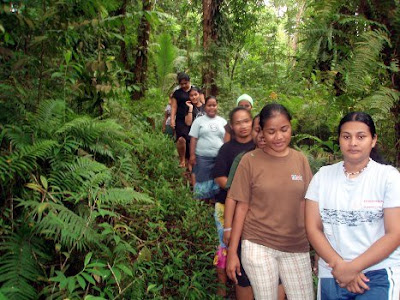
Ethnobotany SVP hike

The SC/SS 115 Ethnobotany students hiked into the muddy, rainy, steamy wet valley of the ferns. This term the hike added Psilotum nudum that I noticed while hiding from my physical science students.

Posted by Picasa

Tuesday, January 13, 2009

My son, following in the family footsteps?

My prodigal son spends a quiet evening at home practicing the ancient family tradition of...


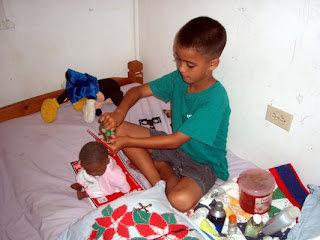
hairdressing My son, the hairdresser, fully equipped with all the supplies of a modern hair stylist. The red tub is hair gel, my son often slicks his own hair with gel. The blue bottle is cologne. On a Sunday he envelops himself in a cloud of the mist so dense that open flames are a hazard to him. The last time I used cologne was the previous century, maybe this is a skip generation trait. He also has coconut oil, baby oil, and scented skin lotion. Along with hairdressing skills, he is developing into a capable masseuse using Efficascent massage oil.

Sunday, January 11, 2009

Aengani Kenye Waguk Mongkeya

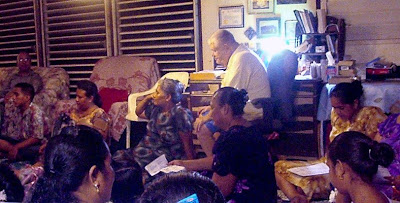
Kosrae Congregational Church group two visited Kenye Nipinyuck Waguk Mongkeya. Kenye was born in 1922 and is one of the oldest Kosraeans. The group held service and sang Christmas songs for Kenye.


Josaiah Waguk with Inac Kenye. Josaiah shared her family tree with the gathered group.


Inac Kenye claps along with a marching song. At 87 she remains alert and can see and read without glasses.


This past week I did get a picture of an area I cleaned during the break, opening up the left corner so that it can be seen from the west lot of the gym in Palikir.

Posted by Picasa

Friday, January 9, 2009

[health] Focus shifts from obesity to exercise

One of these days I will likely fall over dead from a heart attack while running. I suppose the murmuring in the memorial service will be, "...and he was always running, little good that did him!"

"Notwithstanding all the studies, [Dr. Steven] Blair and other fitness proponents realize there are no guarantees. Heart attack rates inevitably climb with increasing age. Exercise is recommended, but it isn't a cure. There are no cures for heart disease. Blair knows he's just one errant heartbeat away from a newspaper headline: "Fitness expert dies on the run." The first sentence of the story almost always includes the word "ironically," as if Blair and friends believe running will help them live forever. They don't. They know the facts: Everyone dies, and some die while running." - Are Marathons Dangerous?

I often share news about fitness and health, more so after Forbes named the Federated States of Micronesia as the second most obese nation on the planet. While there are quibbles about the choice of metric and exact cut-offs for obesity among Pacific islanders, this nation is experiencing a health catastrophe as a result of non-communicable lifestyle diseases related to consuming more calories than are burned.

What caught my eye is a shift in thinking in the field of health and fitness.

"Reams of research have shown that excess body fat increases mortality rates, but Blair is banking on his morning runs to protect him. His own findings offer much hope. Evidence from the ACLS [Aerobics Center Longitudinal Study] indicates that the fit-but-fat are nearly as healthy as the fit-of-normal-weight. In other words, regular exercise offsets many of the dangers of being overweight. For that reason, Blair believes American public-health leaders should stop screeching from the rooftops about obesity and instead switch their message to the benefits of exercise. "When you look at me, you can tell I'm surprised and delighted by the fit-fat finding," says Blair. "But the point is, we're losing the obesity battle. So let's try something else. Let's focus on fitness."
- Are Marathons Dangerous?

The "obesity battle" is also being lost here in the islands. As Dr. Blair suggests maybe the focus needs to change to fitness and exercise. In the JAMA article Cardiorespiratory Fitness and Adiposity as Mortality Predictors in Older Adults the authors found that "fitness was a significant mortality predictor in older adults, independent of overall or abdominal adiposity." In other words, exercise always helps. Runners have long known that exercise alone will not necessarily lead to weight loss, the good news is that even without weight loss, exercise is beneficial.
Fitness, not fatness, is a predictor of longer life.

That said, exercise is no guarantee of good health, or a magic preventative for heart disease. Runners have heart attacks. Given my own family history - the men die of heart attacks in their fifties and sixties, and my own poor dietary choices - I too will one day have a heart attack. Given my diet and family history, however, I should already have had a heart attack. So if you are at that memorial service, do not dismiss my running as having been in vain. I will have already lived longer with a higher quality of life than I would have without the running.

Tuesday, January 6, 2009

Bananas

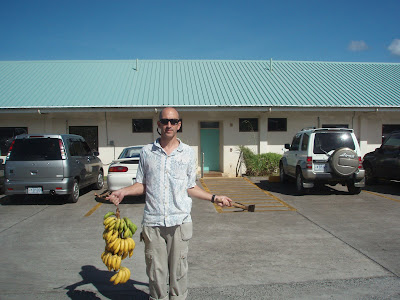
Bananas are bought not by the finger or hand, but by the bunch.


And then hung by the office window with care.

Posted by Picasa

Monday, January 5, 2009

Col no longer allowed to have width attribute in HTML5

The construction:

<colgroup>
<col width="300" />
<col width="70" />
<col width="70" />
<col width="70" />
<col width="70" />
<col width="70" />
</colgroup>

is no longer legal HTML5 nor XHTML5 (see attributes table). I needed pixel level width control for the bubble form used in my Gravic Remark Office OMR test. I prefer to have valid pages, so I needed a work-around to the above XHTML code. I knew that the solution lay in using CSS, and I opted to use CSS 3 which let me use an nth-child construction in the bubble.css file to mimic the above HTML 4.01 code:

table {border:thin solid red;width:655px}
td:nth-child(1) { width:300px }
td:nth-child(2) { width:70px }
td:nth-child(3) { width:70px }
td:nth-child(4) { width:70px }
td:nth-child(5) { width:70px }
td:nth-child(6) { width:70px }

The 655px table width is not an oversight. Although the col widths add to 650, some deep and dark part of the way tables lay out in XHTML versus CSS meant that producing a printed pixel-for-pixel match required setting the table width to the col width sum plus 5px.

Ethnobotany knife box

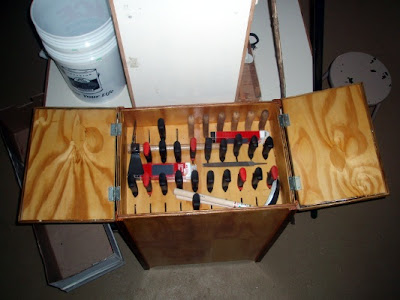
With thanks to the fine cabinetry crew at the College of Micronesia-FSM maintenance division, SC/SS 115 Ethnobotany has a secure and good looking lock box for the class machete collection. The machetes are used to whack razor grass in the Palikir Ethnobotanical Learning Garden.


Today marks return to school for everyone in the household, a rainy Monday - cold by local standards. Yesterday marked the last day of the holiday break. I wrapped up 22 days of running out of 23 days - one day off - with a 1:47:12 effort covering 15.1 kilometers out to Palipowe junction and then out to the airport with a lap of Nett Elementary school.
Posted by Picasa

Sunday, January 4, 2009

Sunday new clothes

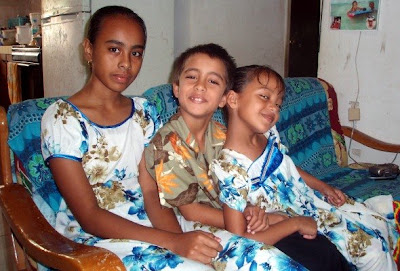
Sunday morning the kids are dressed their best for church, new dresses and shirts for everyone in the new year.


Marking the end of the holiday break, dad busts out his version of Ghanaian nkatia-kwine (groundnut stew) and amoh (rice) balls. No where else on Pohnpei is anyone serving nkatia-kwine, nor mangling the spelling as badly either. Not having the hands of a capable Ghanaian cook, dad heated his hands a little forming the hot rice balls. Ouch.

Posted by Picasa

Saturday, January 3, 2009

Aengani Harvey

Kosraen Congregationalist church marching group two visited Professor Emeritus Harvey Segal. Harvey has been active in education and teacher education in Kosrae and Micronesia since 1964. Many of the singers are former students. After singing everyone enjoyed Kosraean soup and pastries while sharing memories with a revered mentor and professor. As noted by a group leader who was in first grade when Harvey organized the second Utwe Elementary school fair, Harvey is a living legend among Kosraens.

Posted by Picasa

Friday, January 2, 2009

Scanner, Ubuntu 8.10, and a MAPP

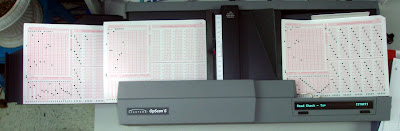
Today was a day spent on technical matters. Tried to get the new Scantron to work to no avail. The sheets are jamming just behind the scan head. This appears to be the same problem as the old Pearson scanner.


While I prefer fill in the blank tests, there are times when one wants to run a quick affective domain survey. Those are times when an OCM can really shine.

The division of mathematics and natural sciences computer laboratory computers are now running Ubuntu Intrepid Ibis 8.10, the screenshot demos gCalc running on Intrepid.


I also put together the very beginnings of a repository for the manual of procedures and policies. The section I am proposing on campus environment led to this policy wonk effort.
Posted by Picasa