Laboratory fourteen functions as a laboratory practical for the physical science course, a chance to show that mathematical analyses can be applied to any physical system, and an opportunity to have some fun while doing science. The course is all about science as doing, exploring, engaging. Science as a process and measurement, as discovery. The course hopes to ignite, or reignite a spark of excitement and fun in science. The students are all non-science majors, many of whom have learned negative attitudes towards science. Science was either a lot of memorization or just plain hard. This course seeks to remedy that. There is a "let's go find this out" approach to everything. Not what you know, but what you can show.
In laboratory fourteen the students were asked to determine the mathematical relationship, if any, between the diameter of a hula hoop and the rate of rotation for the hoop.
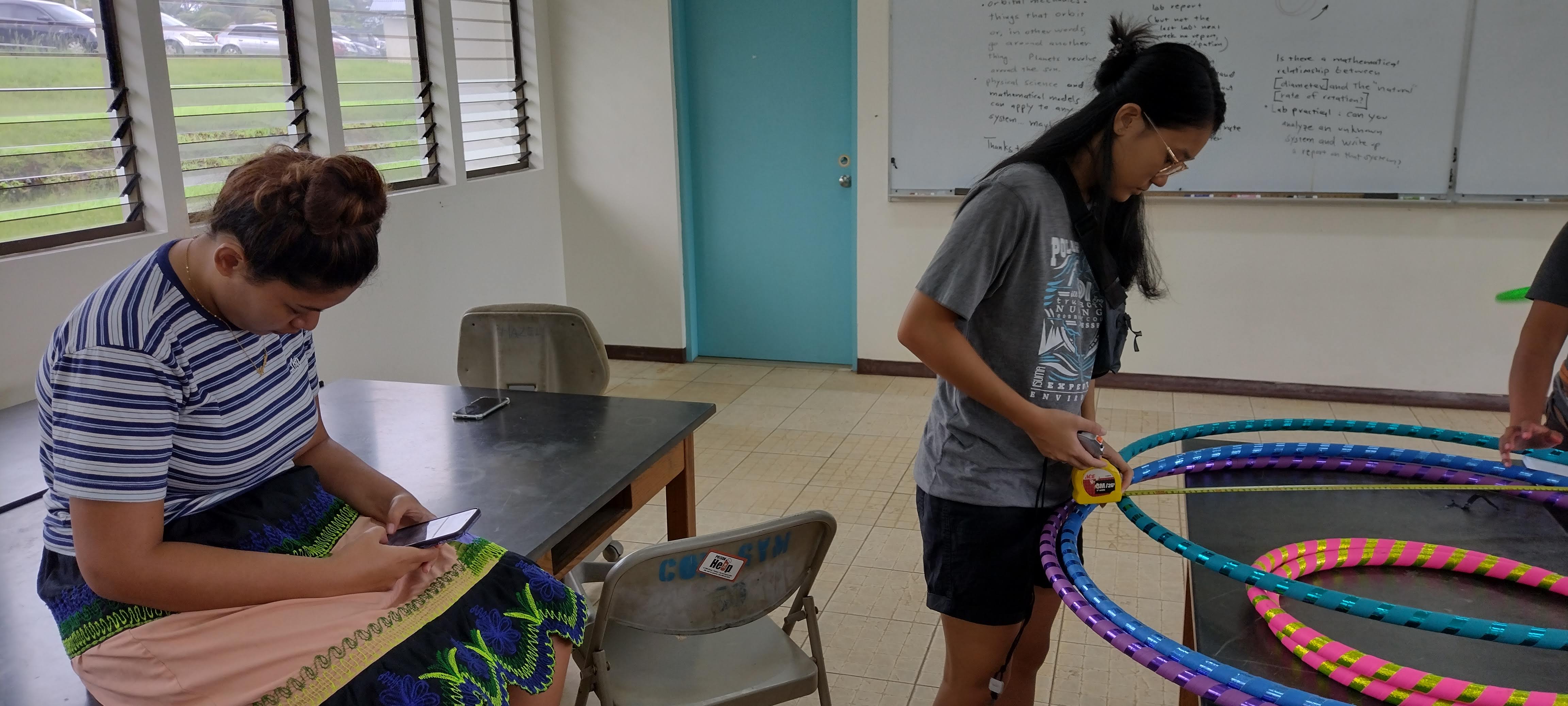
Renay hoops while Darla times
The board behind Renay shows the introduction to the laboratory. I am still working to find what the minimal scaffolding required will be. I do not want to overly channel the students.
Renay
At the same time, too little scaffolding could be overly frustrating for the students - the task set will be too vague to lead to data that can be analyzed.
Renay
This laboratory also hinges on whether the lab partners have one who can hoop. With thanks to my students back in the fall of 2021, I learned how to hoop well enough to demonstrate the basic technique for waist hooping.
Adelina hooping
Adelina hooping. Science lab can be fun! The green hoop, at 97 cm in diameter, is the smallest of the hoops. Unfortunately there are only roughly three sizes at present: 97 cm, 103 cm, and 107 cm. The class could benefit from a few more hoop sizes.
Richard
Some of the women have hooped before, but few to none of the men have hooped.
Renay with a good, flat spin
Adelina measures and Jessie May records the measurements
One group's data. The diameter varies depending on whether the group measures the inside diameter, outside diameter, or a midline diameter.
Adelina
Renay and Adelina measure the blue hoop diameter, Richard watches
Data including the diameter, time duration in seconds, and number of spins. This is what I mean about scaffolding. Once this was written down, one group was looking at graphing diameter versus spins, but spins are just an arbitrary number related to how long the hooper was able to hoop. Here I pointed this out to group and suggested they look for a rate of rotation. In the morning class I went specific and recommended rotations per second, or, effectively, Herz. This does lead to a negative relationship, which was perhaps a tad bit of a curve ball as this introduces a non-zero y-intercept, something most of the labs avoided during the term. The students are not well prepared to think in terms of a non-zero y-intercept, which makes this particular harder to analyze.
The class included little hoops called doughnuts, plus the child's hoop. The child's hoop, however, is too small for an adult to waist hoop, and that introduces arm hooping. But arm hooping appears to work differently from waist hooping. In the 8:00 section I instructed the students to horizontally arm hoop the little ring. Which is difficult - one has to bend over and try not hit themselves, or use an overhead horizontal arm hoop approach.
In the 11:00 class I removed the "rotations per second" specification from the board and left that an open choice as to how to measure the rate of rotation.
I also put away all of the non-waist hoops. This makes the domain very small, but keeps the exercise limited to waist hoop data.
Bethlyanne clearly had prior experience
Bethlyanne
Leipolanda
Leipolanda was perhaps the most experienced and capable hooper of the day. She could hoop with minimal motion at a consistent rate without any apparent limit.
Leipolanda
Saya timing and graphing, Donnalynn recording
Saya, Donnalynn, Leipolanda, Bethlyanne
Saya and Leipoland measuring
Blossom
Malika had hooped as a child and quickly regained her abilities
Malika
Data in the 11:00 section, this group figured out the rotation rate formula on their own
A closer look at the board at lab end. I remain uncertain what the proper amount of scaffolding is for this laboratory. I want the lab to have an open, exploratory feel. The downside is that the students may, as one group did, fail to realize that they needed to combine spins with time to get a rotation rate. Specifying the rotation variable would also allow specifying use of the rotation period, rather than the rotation rate in Hertz. The period may be a direct linear relationship. Or closer to direct, as the slope will be positive. One could argue zero diameter has a period of zero and an infinite rate of rotation (bigger hoops produce slower rotation rates, smaller hoops rotate naturally faster).
Manual marking of an essay type question on a quiz or test in Moodle can be done student by student but that process involves a lot of clicking and scrolling as one has to open each student's submission. There is a bulk marking screen available. In the test or quiz click on Results. At the upper left side is a stealth drop down list menu under the word "Grades" that includes the option "Manual grading." Choose manual grading. On the far right click on the blue "grade all" hyperlink. That will open up a all of the submissions for question one on a single page. One can now mark all of the question one submissions manually for all students in the course.
The application of image recognition technologies as the back end to botany apps is providing increasingly relevant search results. Over the recent winter break I began looking at whether the apps now available might be useful to the ethnobotany class here on Pohnpei. Some apps had a more regional focus in the past and were better at north american or european plants. Pohnpei has a both unique indigenous plants and many introduced plants from around the world - a challenging environment for any image recognition system. A student working with a plant identification app for the first time My criterion was that the app had to be appropriate for use in my classroom. The app could not contain advertising and the app had to be free, my students typically do not have the ability to pay for an app. The app would also have to be fairly small as my students often use phones with limited memory and processing power. I settled on PlantNet and was impressed with the ability of the a...
The Google Statistics add-on for Google Sheets can display multiple boxplots in a single chart. The key is the layout of the data. One column should be the variable by which the data is to be grouped, the other column should be the data to be box plotted. Set up the Statistics add-on with the data to be plotted as the variable, and the grouping column as the "by" variable. In this image I had deselected all but the boxplot option, the result was the appearance of the Moment, Standard errors, and Confidence intervals options. The default is apparently a 95% confidence interval for the mean. The result is multiple boxplots on a single chart with a common scale. The new tab that is created also quotes 95% confidence intervals for the mean. Note that as of 2018 the Google Statistics add-on cannot be found by search in the add-ons. In addition, as of May 2018 the add-on no longer verifies, possibly due to the add-on not having been updated since August 2017. One may ha...




Comments
Post a Comment