Sunday, July 31, 2011

Sunday

Dressed and ready for church on the Sunday eve before term start.
 Angela has come up from Kosrae to attend college.

Friday evening past my son and I went out of an evening run about town. This was a second run. An earlier run two and half weeks prior had seen his then new shoes from a local store disintegrate in a short four kilometer run. Knock-offs from Asia are not real shoes. This time he went out in serious ASICS shoes from Road Runner Sports

In town we stopped to pick up a bottle of water. In front of us two young boys put down a C note and bought a six pack of beer, a pack of cigarettes, and two aging take-out cheeseburgers. I asked my son what disease would get them first in twenty years - alcoholism, lung cancer, or diabetes. The health problems of Micronesia are not the health problems of Africa. Almost all diseases here are self-inflicted.


While I did get in some badminton during the week, a dog bite the prior Saturday left me in poor condition for running during the brief one week summer break.


A week later the wound is still in the process of healing. Being down from running left too much time for sakau. 


Saturday, July 30, 2011

Farewell luncheon for Jean Thoulag

On Friday 30 July the college held a farewell luncheon for Vice President Jean Thoulag, one week after a thank-you dinner for former president Spensin James. This is indeed a time of transitions for the college.
 Kathy Benjamin, Sven Mueller, and Shrue Lee Ling.
 Jean Thoulag and Richard Womack
 Director Office of Admissions and Records Joey Oducado
 Comptroller Danny Dumantay
 Pelma Palik, Morehna Rettin-Santoa
Jean Thoulag, Jon Berger, and Spensin James. Jon Berger is stepping down as well after ably heading assessment, the entrance test, and working as the college's accreditation liaison officer.
 Director Technical Programs Grilly Jack
 Interim President Ringlen Ringlen
 Maggie Hallers and Chair Business Joseph Felix Jr.
Emliana and Gordon Segal

I printed and presented one of the earliest digital photographs still extant at the college, including an image of Jean who was then coordinator of the Title III grant. The page was produced for use at a job fair at PICS in March 1998.

Friday, July 22, 2011

Summer end assessment

What follows are a few rambling notes to myself, data I may want to access at some future date. Placing the data here makes the data retrievable either by sequential access from the blog archive, using a label or tag, or via a restricted search.

The item analysis of the MS 101 Algebra and Trigonometry final examination:

q topic n p
1 Evaluate exponential functions 25 96%
2 Solve exponential functions 23 88%
3 Calculate compound interest 22 85%
4 Calculate continuous interest 23 88%
5 Calculate best fit log function 25 96%
6 Evaluate logarithmic equation 24 92%
7 Solve logarithmic equation 24 92%
8 Evaluate exponential decay 14 54%
9 Solve exponential decay 22 85%
10 Identify coordinates on a circle 24 92%
11 Calculate trig function 25 96%
12 Interpret coordinates based on trig calculation 22 85%
13 Calculate trig function 25 96%
14 Interpret coordinates based on trig calculation 16 62%
15 Calculate trig function 24 92%
16 Interpret coordinates based on trig calculation 16 62%
17 Calculate trig function 25 96%
18 Interpret coordinates based on trig calculation 16 62%
19 Determine wavelength from graph 24 92%
20 Determine the amplitude from graph 24 92%
21 Write trigonometric wavelength function 17 65%
22 Calculate inverse trig function 22 85%
23 Calculate inverse trig function 13 50%
24 Solve using Pythagorean formula 17 65%
25 Determine Pythagorean triple from a single member 21 81%
26 Evaluate projectile equation 18 69%
27 Solve projectile equation 20 77%
28 Solve projectile equation for angle theta 23 88%
29 Calculate dot product 16 62%
30 Calculate cross product 18 69%
31 Solve two non-lin equations in two unknowns 16 62%
32 Calculate magnitude of a vector 25 96%
33 Calculate vector angle 25 96%
34 Identify Pythagorean solid 18 69%

where q is the question number on the final examination, n is the number of students out of 26 who answered correctly, and p is the percent answering correctly. The syllabus and notes on the use of WolframAlpha in the course are also available. Average performance was 81%,

Performance by course learning outcome in SC 130 Physical Science aggregated from an item analysis of a 56 question final examination:

SLO Sp 08 Fs 08 Sp 09 Fa 09 Sp 10 Su 10 Fa 10 Sp 11 Su 11
CLO 1 0.54 0.57 0.55 0.49 0.65 0.68 0.29 0.82 0.74
CLO 2 0.61 0.62 0.51 0.30 0.64 0.76 0.34 0.63 0.66
CLO 3 0.52 0.72 0.57 0.65 0.72 0.63 0.35 0.57 0.63
CLO 4 0.50 0.38 0.53 0.47 0.53 0.71 0.10 0.70 0.55
Overall 0.54 0.57 0.54 0.49 0.63 0.70 0.27 0.65 0.63

Summer 2010 and new final examination structure was introduced. While performance was high in the summer, fall 2010 performance levels collapsed against historic norms. The final examination structure introduced summer 2010 was retained spring and summer 2011. Performance levels recovered to slightly above the historic norms. The collapse fall 2010 remains unexplained.

Five question topics that were tested on the first test and which covered a core area of SLO 1.2 were retested on the final examination. Strong gains as measured by an item analysis were seen in these areas from test one to the final. At the start of the term no more than ten students were successful on any one question, by term's end no fewer than fourteen were successful.  Student gains in graphing, obtaining and interpreting slopes saw strong improvement.


term start term end
Question topic n corr perc n corr perc Δ%
calculate slope from line on graph 15 10 0.67 16 14 0.88 0.21
density as equal to slope 15 7 0.47 16 14 0.88 0.41
infer effect of density 15 10 0.67 16 15 0.94 0.27
calculate density from measurements 15 8 0.53 16 14 0.88 0.35
calculate mass from density and volume 15 10 0.67 16 16 1.00 0.33
plot data on graph 15 15 1.00 16


draw line through data points 15 14 0.93 16


calculate slope from line on graph 15 11 0.73 16


The high performance on the last three questions above on the first test of the term and subsequent demonstration of these skills during the term led to their intentional omission on the final examination. The students could plot data coordinates and draw a line through the points even before they began the course.

The last question on the final examination asked the students to "write a paragraph on whether you believe that nature is mathematical. Is nature mathematical? Support your answer with specific evidence."

There were five categories to the answers provided by the students. The number preceding the category is the number of students who answered that way.
2 Yes, based on doing the experiments in the class.
5 Yes, based on the cosmological theories presented in videos shown the last week of class
5 Yes, based on other examples, usually examples of numbers in life such as the price of food stuffs
1 No, cosmological theories are incomplete and some are untestable (string theory)
2 No, nature is theistically determined
1 No answer given.

Wednesday, July 20, 2011

PEC and Utwe fest

Mixon Jonas of Malem Elementary school, Kosrae, covered School Improvement Plans during a morning session at the Pacific Educational Conference.
Sueleen along with other teachers from Kosrae in the session.

Of the two vials hovering on the boundary between two liquids, the one on the right has more fluid than the vial at the bottom. This activity led off an excellent session on inquiry based, guided discovery science learning. Getting a group of teachers to provide observations - not theories or inferences - is difficult. Many wanted to leap to concepts of density and specific substances.


 Dr. Thomas Scarlett providing some methods scaffolding after an inquiry session.
In the evening PEC again hosted all delegations for a dinner at the FSM-China Friendship center. Dancers from Madolehnihmw were a highlight of the early evening.


I ducked out of the PEC evening dinner to catch the tail end of the Kosrae Congregational Church Utwe July festival that apparently commemorates the forced move of the Utwe people from Utwe to Utwe-ma by the Japanese during World War II.


Vice President Alik Alik addresses the gathering.

Tuesday, July 19, 2011

Vernacular Language Benchmark Results Grade 3

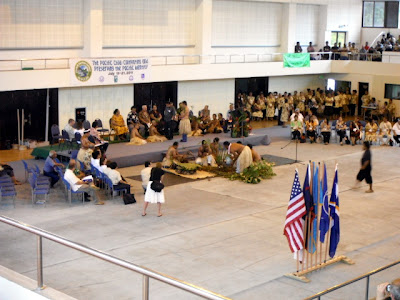
The Pacific Educational Conference opened with a formal sakau ceremony and the honoring presence of traditional leaders including Nahnmwarki Madolehnihmw, Nahnmwarki Sokehs, Isonahnken U, Isonahnken Sokehs, Isonahnken Nett.


Later in the day Mr. Linter Kihleng presented the results for the grade three vernacular language benchmarks. In Pohnpei local language is taught until third grade, then the students begin a transition to English. "First language first" is the policy of the FSM. 

The results indicated that there has been little change in L1 proficiency over the past three years, and that on the order of only one-third of the students are proficient at a third grade level in their language. This is a matter of especially grave concern as post-transition there is, at present, no specific courses on local language grammar and vocabulary.
Click to enlarge. Percentages do not add to 100% due to rounding

I missed the sample size for 2008, but for 2009 the sample included 874 third grade students while in 2010 there were 778 students.

Pohnpei DOE is developing vernacular language student learning outcomes for grades four and five; six to eight, and a third bank of outcomes from high school students. This effort, however, consists only of student learning outcomes. The full curriculum and support materials are yet to be developed.

While Mr. Kihleng traces the current effort back to the 1996 FSM economic summit, I am aware that efforts to teach local language and culture were being made in 1978. 

The first trial edition of materials developed for the project "Preservation of Ponapean Culture" (PPC) are dated 24 May 1978. That unit was prepared for 7th and 8th grade project teachers at the target schools of Sapwalap, Temwen and Wapar. 

I was told by someone involved in the project that the project was never fully deployed. The materials were so popular that most copies apparently disappeared from offices before ever getting into classrooms. 

Loss of language and the interconnected loss of culture dates back at least thirty years or more. Coincidentally the 1970s are also the time frame in which people recall that life style diseases such as diabetes first appeared.

The above data and my own experience in ethnobotany class is that the erosion is real, is serious, and is ongoing. A formal curriculum of local grammar and vocabulary classes through senior year of high school are a necessity to survival of the full flower of the Pohnpeian language. Kalahngan, all errors are mine and mine alone.

Nihco

When I came home Monday evening, two children ran from the house dressed to swim screaming, "Papa Dana!" Apparently they had gotten it into their head that I would take them swimming when I got home from the college. And I did do just that.

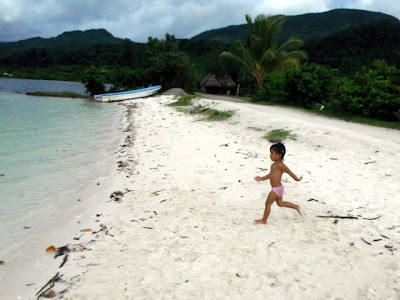
 Arrival at the beach means a full tilt headlong run for the water.
 Or a more measured short-stepping trot.
The middle one does not call her aquatic activities swimming. She calls them "walunga" which means "drowning." Which she means quite literally. She consumes vast quantities of the Pacific ocean until she reaches the point of "wotlac." This does not seem to bother her. Explaining to her that humans do not breath water makes no perceptible dent in her misconception that water is a source of oxygen.
Happiness is playing in the water until the wind makes one shiver.

Clouds

Ice bow in cirrus


Sunday, July 17, 2011

Favorite labs

Favored labs summer 2011 in SC 130 Physical Science were laboratories one, nine, and ten. Students liked lab one because the predictability of the soap was a surprise and because some did not realize that Ivory soap floats. Laboratory nine attracted the interest of one student because they liked walking and clapping. Laboratory ten was favored for having beautiful colors.

Disliked laboratories included seven, nine, ten and thirteen. Seven was noted to be confusing. Nine was noted, as in the past, as being a long tiring walk under the hot sun. Ten attracted the most dislikes with students finding it not exciting, uninteresting, and one noting that the colors they see are different from the colors other students see.

Three students claimed to like all of the labs and dislike none.

Thursday, July 14, 2011

Sitting Comfortably in School

Should our children be sitting comfortably in school? is an opinion piece published in the BMJ that thinks outside of the usual boxes. In a nation with an epidemic of lifestyle related diseases, a situation that has been declared a health emergency by PIHOA, thinking outside of all boxes to address the desperately poor state of nutrition and physical fitness is necessary.

Years of nutrition education, health education, PE methods, public health campaigns, and public service messages have not seen any change in the steady erosion of health for the residents of these islands. Whatever we are collectively doing is not yet improving the health indicators. As Rita Mae Brown noted, "Insanity is doing the same thing over and over again and expecting a different result."

I recall lecturing while running during Joggling class back in 2002 to 2004 and noticing that running students do not fall asleep during lectures. At the time I joked that I ought to teach statistics in the same manner - on the run.

Ethnobotany class content is often delivered while hiking in the forest or walking through a garden.

Aristotle's "Peripatetic school" is a reference, albeit possibly legendary, to Aristotle's teaching while walking or pacing about, with his students at times following him around.  The walking lecturer trailed by students.

Modern education seems to be modeled on the industrial production line. Spend a year sitting in a seat, then move to the next station, the next grade, for further sitting. Even within the school day, students move in factory-based batches from class to class, moving only in between the stations we call classes.

We tend to train students to sit for six and more hours a day.

What does a less sedentary education system look like? What do teaching and learning look like? Or is this a bridge too far for education?

Sunday, July 10, 2011

Navy Pacific Partnership Band

In a farewell performance on their summer tour 2011, the Pacific Partnership band out of Honolulu played a last full member gig at Spanish wall ball park on Sunday evening.


 A rainy morning and afternoon gave way to cloudy but rain free skies.


The band played a variety of songs that ranged back into the 80s and up to the last decade. The songs were what I think of as party songs - danceable, popular, with a beat.


The boys joined me while the girls did evening service at the Kosrae church. I made a short video of their rendition of Black Eyed Peas Let's Get it Started, and when I got home the video really connected with the youngest. He lit up when he again saw the band playing, much more so than he had done at the field. The wall behind the boys is the over one hundred year old Spanish wall that encircled the settlement of Santiago de la Ascension during the time of Spanish rule in then Ponape.


The lead guitarist made the best of an awkward layout for a band that probably usually plays much closer to their audience. 


Earlier in the day the youngest one was again reading his favorite book - Nemo. For him there have been only two films of merit. Nemo and Gnomeo.

Saturday, July 9, 2011

Of pride, honor, service, and running

Thursday evening the house saw a rare simultaneous presence of my children and their summer break chums. Usually one or another is out and about slumbering over with a friend, or one is here for the night with their friend. Having all in the house at one time is rare.

The next day, Friday, my son and his friend joined me at the college in order to attend a presentation by the Mission Commander for the Pacific Partnership 2011, Captain Jesse Wilson, at the Media and Instructional Technology Center, College of Micronesia-FSM. Major General Lei-Ping Chang, commanding general of the 807th medical command, was also in attendance and spoke as well, along with the United States Ambassador to the FSM, Peter Prahar. After the presentation there was group photo opportunity in front of the Learning Resource Center.


Captain Wilson spoke of the importance of education in both nation building and in personal opportunities. He also noted that enlistment in the US military from the FSM is higher on a per capita basis than back in the United States. He noted their service with pride, including a member of Rodriguez family serving on the USS Cleveland - a native son. The medical team includes participants from many nations including Japan, Australia, Spain, and France among others. The 807th joined the crew of the USS Cleveland on this inter-branch, international joint mission.


Captain Wilson explained that the mission grew out of the 2004 tsunami in southeast Asia. International military search and rescue teams realized that they needed to practice their missions jointly before the disaster strikes. Captain Wilson quoted Kennedy from his state union address on January 11, 1962, when Kennedy said, "The time to repair the roof is when the sun is shining."

Should disaster ever strike the FSM, the various teams that have assembled this summer now know the lay of the land, have local contacts, and have practiced working together.

In an "and now for something completely different", my daughter in the states sent a package that arrived on Friday. In the box was a Ghana Barbie doll which now adorns my desk. Been a long time since Peace Corps Ghana, but that too is part of who I am today. When I left for Ghana in 1984 I recall being concerned that Ghana would change me. I do not now know why I was concerned, but I was uncomfortable with the thought of change in who I am.


Although I did not recognize it at the time, I was changed by the end of my first week in Ghana. A violently painful bout of antibiotic resistant shigella dysentery had altered my personal world view. I lost on the order of 18 pounds in something like two days. Some of the other volunteers were sure I was going to be a medevac and unlikely to be seen in Ghana again. They were surprised when I showed up - thinner and much lighter - at village based training in Akrofufu. I served the full two years in Ghana, ignoring as minor inconveniences other lesser dysenteries such as giardia.

Saturday morning the Island Food Community of Pohnpei held their annual fun run.Captain Wilson and members of his team joined the fun run along with students from the Upward Bound program here on Pohnpei. Getting to run with a US Navy Commodore was a real privilege and honor. Not something I get to do. Not something most jogglers probably ever get to do!


I know I teach because I do not know how to not teach. On the uphill up the former one-way to Spanish Wall ball field a runner had dropped to a walk. As I came up on the runner I noted, "Hills are friends." He apparently thought I said something to the effect that getting up hills one sometimes needs help from friends. I explained saying that downhill anyone can run full out, the uphill is where a runner attacks and gains the advantage. The hill is a friend. Hills are friends. Make friends with your hills in life. They are what make you stronger.

My son did very well, trailing me by only a few minutes. Below he has just passed a good friend, Vice President for Administration at the college Joe Habuchmai.


My son ran with his friend - the are both strong 5k runners given their age and that they are not in a formal training program. I try not to push. At best I lead by example, at least as good an example as I can set. I run. I try to eat as healthy as island life and income seem to permit.


I passed the finish line at 29:50, but that was a 30:29 by the time I had done a lap of the Palm Terrace parking lot.  My son and his friend finished in about 40 minutes. I am proud of them for their effort.

Thursday, July 7, 2011

Site Swap Notation

Laboratory fifteen in physical science sought to push the boundaries on the mathematical box for the students. In laboratory one a quote from Freeman Dyson was used to start a journey through the mathematical models that explain physical systems. Dyson calculated how an electron ought to behave. Later someone went into a laboratory and the electron behaved as predicted by the mathematical model.

Salinta

In laboratory two a linear model predicted the location of a rolling ball. In laboratory three a falling ball obeyed a quadratic mathematical relationship. The behavior of a marble rolling off of a banana leaf obeyed a square root relationship. And in laboratory four the marbles knew what to do in order to mathematically conserve momentum. Sound relative depth of an image Ohm's law all exhibited linear relationships.

Sucyang

There are other mathematical relationships that govern physical systems. There are systems that are modeled by exponential and logarithmic functions. The path of a RipStik formed a sine wave on a sheet of paper. There are exotic functions such as the hyperbolic sine and hyperbolic cosine. Some systems are best described by complex variables that include a real and an imaginary component. Many of these systems are beyond the mathematical scope of this course.

Sucyang

The relationships described above are algebraic mathematical models. Much of the mathematics curriculum is centered on algebra in part because algebra is important to describing the physical world. There are, however, other mathematical models, non-algebraic models. This laboratory seeks to broaden the students mathematical horizons by introducing a mathematical model and notation that is not algebraic. In laboratory fifteen the students were introduced to the mathematics of site swaps.

Kemble

In an attempt to connect site swap theory back to the language of algebraic equations, after introducing site swap notation I referred to sequences such as 33342333 as site swap equations. The sequence is a mathematical statement that can be true (juggable) or false (not juggable).

Nayleen

This laboratory continues to provide a fun way to wrap up a term of exploring the mathematics at the core of physical science while expanding the students thinking with a mathematics system like nothing they have ever seen before.

Lavanaleen

One difficulty this term - no student brought three balls. No one even brought one ball.

Tracy

The laboratory is also an end of term enjoyable experience. As the course is not required by any major, the students are primarily from majors other than those in the natural sciences. For many of these students science is a requirement, possibly even a dreaded requirement.

Mary-ellen

I want the students to have the chance to do science, engage in exploring systems, grapple with the mathematical language underneath physical science. I can only hope that the students catch a glimpse of the beauty of science - of even pure science for science's sake.

I want the students to have good memories of the course, to think positively of science and of their own ability to do science. Thus I try to close the laboratory sequence on an upbeat, to paraphrase George M. Cohan, "Always leave them laughing when you say goodbye"