Monday, May 31, 2010

RipStik in the old bowling alley
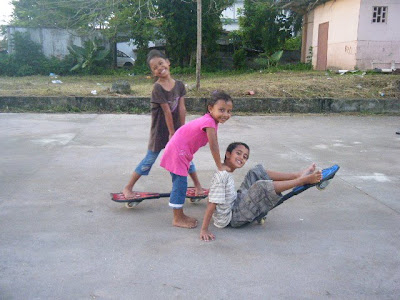
Turns out that the cement pad in Kolonia is the old sub-floor of the bowling alley.
Dad can still fly left wing in RipStik formation. Sort of.
She's got the look...
Three abreast practicing formation flight
My son was watching the x-games the other evening and I noted that almost every event is a "look at me-me-me" event: a solo event on a skateboard, snowboard, bicycle,... Because you can propel the board without getting off, and because you can turn on a literal dime, the caster boards open whole new event possibilities. Formation work like ice dance groups do, ball sports such as basketball - yes, young boys can dribble and ride - or variations on polo and field hockey.
Posted by Picasa

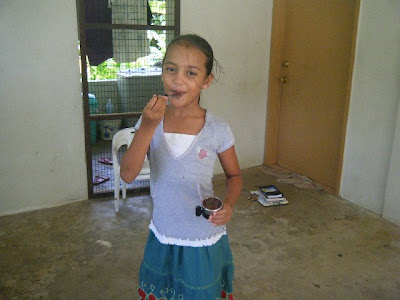
Styling

Styling with pudding
Sleeping with panache
Sweeping while a riding
And unleashing that Kubrick stare
Posted by Picasa

Saturday, May 29, 2010

What teachers and students need to demonstrate

In the article Seeking - and Finding - Good Teaching by Julie Sweetland in The Obama Education Plan: An Education Week Guide, quality teachers are not found by using "hastily scribbled, ill-defined checklists that are the most common form of teacher evaluations - and which often aren't really evaluations at all, but instead a tedious chore that neither administrators nor teachers enjoy, value, or trust. Rigorous classroom evaluations aren't just someone's opinion; they are carefully conducted qualitative assessments that meet research standards for clarity and transparency. They guide trained observers to look for specific indicators of excellent instruction: effective questioning that pushes students to think critically; the ability to foster a positive; productive classroom environments; the use of engaging lessons that draw students into the learning process."

The emphasis on trained observers is mine - training is something I certainly lacked when I first entered a classroom as an observer and division chair a decade ago. In my hand I had while not necessarily an ill-defined checklist, certainly not one that evaluated effective questioning, critical thinking, classroom environment, nor the engagement of the students in the learning process. As a physical science instructor, the concept of "speed of learning" particularly tickled me.

Later Director Berger would develop and recommend the use of an instrument far more appropriate to the task of classroom observation. Overall instructor evaluation would continue to rely on a checklist, albeit one based on a faculty proposal developed circa 2003. 

My design intent hope for physical science class was to create a course that would foster positive, productive classroom environments, use engaging lessons that draw students into the learning process, and push the students to think about the systems they are investigating. 

While my formal evaluations are still a checklist based on form that parallels the 2003 faculty proposal, and as such does not provide specific details, as part of an incentive ceremony I was fortunate to receive a copy of comments made by faculty, staff, and students. Those comments suggest that while there is much to improve upon, my courses are accomplishing some of my design intent. 
  • "He knows how to teach and is able to make his class fun and interesting which also helps the student remembers what they learn."
  • "His teaching is easy to understand and fun."
  • "He is a smart person that teaches us valuable things in a fun way." 
  • "He has been performing outstanding performances and he has a professional teaching style which I admire. I've learned a lot from his classes. He is practical and creative on the courses that he is teaching."
  • "His classes are fantastic."
The above suggests that my courses are, arguably, engaging and have a positive classroom environment. Other assessments that I perform purport to document the learning of course outcomes, content, and concepts. Documenting that I am accomplishing the goals of fostering critical thinking and problem solving in novel situations is slightly more elusive, although laboratory 14 in my physical science course has these goals. 

What students need to demonstrate is, however, not necessarily aligned with what I am asking the student to demonstrate in the above goals. In the Education Week guide one Arkansas employer said in a focus group, "We want somebody who shows up on time, somebody who works hard, and someone who's trainable." (What Does Ready Mean? Lynn Olson, The Obama Education Plan: An Education Week Guide, page 186).

"James E. Rosenbaum, a sociologist at Northwestern University who's interviewed employers about their workforce needs, says, "Employers we interviewed said they were able to redesign jobs around academic skill deficiencies, but not soft-skills deficiencies." Nearly all jobs, he says, "require basic work habits, such as regular attendance, motivation, and discipline, and our schools are not taking steps to improve students in these areas." (page 186)

The article goes on to note that a focus on academic skillls - student learning often as measured by high-stakes tests - may cause a decrease in attention to these potentially more important soft skills.  

If what Rosenbaum asserts is true, that employers can better bridge an academic deficiency than a soft-skill deficiency, then attendance and work habits are important parts of any course. In my physical science course the students write up a laboratory report each week during the regular term using spreadsheet and word processing software. 

Each week the students hand in this report and are marked both for scientific content as well as for control of grammar, vocabulary, cohesion, and organization. The course requires discipline and a sustained, organized effort in order to succeed. The price of this structure is the coverage of less academic content in physical science. 

The result is a course that I hope does include a focus on so-called soft skills. There is, as always, much room for improvement in all of my courses. My students more often than not find jobs abroad. My students must be globally competitive, and the success of our alumni abroad anecdotally provides support for their ability to compete in the broader world. 

While the College of Micronesia-FSM, as is the case with all institutions, continues to seek to improve itself; the college has faculty and students demonstrating the skills they both need to succeed in this partnership that is education. 

Friday, May 28, 2010

Concepts not memorization

When I took on SC 130 Physical Science in the fall of 2007 my intent was to shift from a course with a 108 "fun facts to know and tell" outline to a focus on science as a process, the mathematical models under physical systems, and writing. I shifted from a course that focused on an accumulation of facts to a weekly focus on a central concept in an area of physical science. The laboratories became the focus of the course, concepts moved to the fore and memorized knowledge was de-emphasized.

During the all-too-brief break between spring and summer session, I read The Obama Plan: An Education Week Guide, 2009. In a November 28, 2007, article by Sean Cavanagh titled Scientists Nurture Teachers' Growth, Cavanagh relates the importance of concepts over memorization for Douglas W. Higinbotham, a nuclear physicist with the Thomas Jefferson National Accelerator Facility.

Douglas W. Higginbotham, a  staff scientist who has worked with teachers in the [Academies Creating Teacher Scientists] program, appreciates the role educators play. He remembers how two of his high school teachers - in junior-year chemistry and senior-year physics - helped set him on his professional path. "They were not big on memorization - they were big on concepts," he said, "That really got me hooked." (page 85)

The ACTS program focuses on teachers as scientists. The intent is that these teachers will return to the classroom and taught as they have been taught in the program: treating their students as scientists and using laboratory experiences to explore science.

In an earlier article by Kathleen Kennedy Manzo, U.S. Students Lag Behind in Math and Science, criticism of comparisons using the Third International Mathematics and Science Study (TIMSS) includes the results inability to predict a country's success. According to Gerald Bracy, a Washington based researcher and author, noted that despite the lower TIMMS scores, the United States remains ranked above other nations in global competitiveness and productivity. "...the tests do not necessarily measure such qualities and creativity, ambition, and innovation." (page 81)

Fill-in the bubble testing remains better at measuring memorized content knowledge than getting at the ability to problem solve in a novel scientific situation. 
SC 130 Physical Science will remain focused on science as a process, a mode of inquiry. Not devoid of facts by any means, but without a focus on a wide, broad, but shallow river of memorized knowledge.

Wednesday, May 26, 2010

Attendance

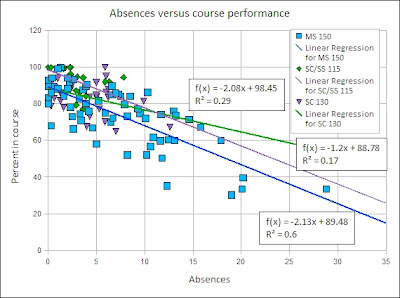
I ran a linear regression to examine the relationship between overall course performance and attendance in MS 150 Statistics, SC/SS 115 Ethnobotany, and SC 130 Physical Science. In the following chart, the number of absences is plotted against the overall course percentage for that particular student.


MS 150 showed the strongest correlation between absences (and thus attendance) and the overall percentage performance in the course with a correlation coefficient R of -0.77. The negative sign indicates that the larger the absences, the lower the performance in the course. The correlation for MS 150 is strong. Bear in mind that correlation is not causation. Attendance, however, may be a strong factor in student performance.

SC/SS 115 had a correlation coefficient of -0.54. This is a moderate negative correlation. Attendance remained important, but less so compared to MS 150.

SC 130 had the lowest correlation coefficient of -0.41. While this is still considered moderate correlation, other factors are likely a larger part of the performance picture. In the case of SC 130 the large number of points concentrated in the laboratories and the laboratory reports is potentially a source of the decoupling of attendance and performance. Attendance is dominated by MWF attendance, but course performance consists of a majority of points from the laboratories which occur only one day a week. Thus absences MWF would not have as strong an impact as a Thursday (lab day) absence. Students appeared to be aware of this and absences were concentrated in the lower impact MWF classes.


Learning assessment reports are also on line for MS 150 Statistics, SC/SS 115 Ethnobotany, and SC 130 Physical Science.

Tuesday, May 25, 2010

Seen around campus and home

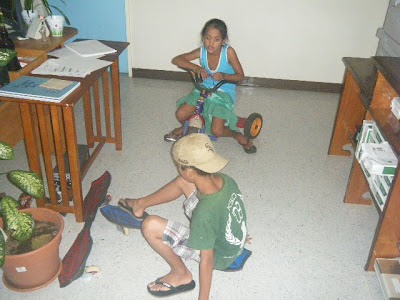
Must be between-term break, children litter the floor of the office.
Must be between-term break, the computer lab sports the new Ambience color scheme from the Ubuntu 10.04 Lucid Lynx upgrade.
Must be between-term break, friends are slumbering over.
Posted by Picasa

Ahser Edward burial

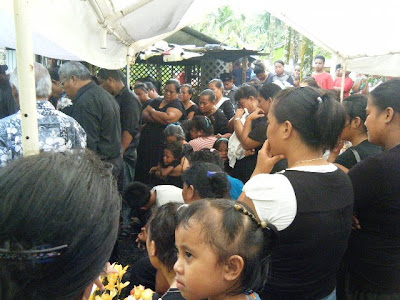
Ahser Edward passed away on Friday 21 May while visiting his home on Pingelap. He was buried at his home in Kolonia amidst great sorrow.
Graveside service.
Ketiner Kenneth with the song book.
President Spensin James. Some of Ahser's children in the background.
Posted by Picasa

HTML5 in service of a course calendar

I am building my SC 130 Physical Science summer calendar in XHTML5. The calendar is a work in progress and will evolve continuously throughout the term. Not all features are operational as yet. The beast is done completely in XHTML5 using SVG to build the first table. This was necessary to get the graphic effects used for the written labs. I am certain this will take some explaining to the students day one - I will print the page out and hand it out as a syllabus and calendar. The effort is probably greater than the payoff, this is a one-off just to see if I could make a concept become a reality in XHTML5. In the same vein as Mark Twain noted, those of us who are not paid to code find a relaxing hobby in coding. The tool used to build the page is nothing more than a text editor, specifically NotePad++ on Windows which color codes the XML making finding errors easier. On Ubuntu Linux I use the Gnome gEdit which also color codes.

Space, Time, Matter

The following is the note I first sent to my physical science students January 2010, there are some provisos in my original blog entry

This particular blog entry is really self-intended, this is my own bizarre filing system so that I can find this again next term. Think of this as a first day hand out, only this hand out goes out via email. In the blogosphere the running joke is that most blogs are read only by the parents of the blogger, an audience of one or two at best. My own pathetic audience count is zero: I am writing as a record for my own future use. Next term, should I live so long, I can copy and paste this into a future email. Thus utilizing the cloud as a filing system. Maybe someday simply teaching in the cloud...

You are receiving this email because you are on the pre-registration class list for SC 130 Physical Science summer 2010. Please pardon me if this is in error or if your plans have changed. I will send this note out again after registration to the final first day class list.

Welcome to physical science! In physical science we study the inanimate world. Physical science includes physics, thermodynamics, earth sciences, vulcanology, geology, meteorology, climatology, sonics, optics, electromagnetism, astronomy, cosmology, and many more fields. There is too much to cover in a single term, and the amount of potential content exceeds what one could learn in a lifetime. Thus this class focuses on process more than on memorized content. Science is a process, a way of exploring the world, not a set of memorized fun facts to know and tell. Science is a way of thinking.

At the core of every science is mathematics, and mathematics will be a regular core feature of the class. Do not be afraid, mathematics is simply another tool science uses. Science often makes math more understandable.

The original and ongoing intent of the course this particular summer is to include a focus on the potential use of physical science in the elementary and secondary school classroom. While this has always been a curricular thread in the course, I hope to emphasize this during the summer. Many of you are either in an education major, the child of a teacher, or will one day be a teacher - even if you do not now plan to do so.


A schedule of the summer term is currently under construction at:
http://www.comfsm.fm/~dleeling/physci/psa2/index.xhtml
The above link can only be "opened" by the FireFox, Safari, Google Chrome, or Opera browsers. The Internet Explorer browser cannot "open" that page. The technical term is that Internet Explorer cannot "render" the page. Most of the computers at the college have and use FireFox.

Here are some observations and questions to ponder about some of the fundamental quantities in physical science. These questions are "rhetorical" questions, that is, these questions do not necessarily have an answer nor is an answer expected.


  • Space is about choice. Forward, backward, left, right, up, or down. You can go any direction. Up to you.
  • Time leaves no choice. Relentlessly marching ever forward into the future. There is no going back. No left time, no right time. No up, no down. Only one direction. No choice.
  • Mass is the mystery. Mass has no direction. Mass has no forward, no backward. No left. No right. No up. No down. Mass simply exists.

  • Space is the questions how close, how far, which way, where am I, how high, how deep, how wide, how long. Space has lots of questions.
  • Time is the questions when, how old, how young. Time has only few questions.
  • Mass is the question how much. Mass has the fewest questions.

  • Space is near, far, over there, here, on, over, under, above, below, big, small, narrow, tall, short, wide, in front, in back, across. Space has many descriptors.
  • Time is now, never, sooner, later, forever, immediately. Time has a only few descriptors.
  • Mass is a lot, a little. Mass has the fewest descriptors.

Everything else is pure energy.

Saturday, May 22, 2010

Samahang Tagalog ATBP sa Pohnpei 5k fun run

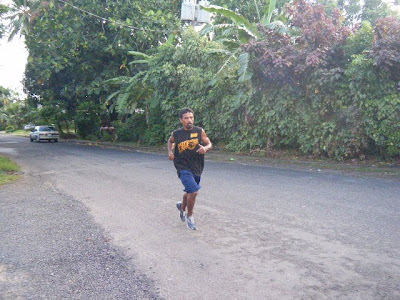
Rendy finished first, something I do not usually get to see, but a spare photographer was on hand this morning.
I was not directly behind Rendy, not even close, although I was the first 50 and over runner across the line in 28:44. For what little it is worth, I was the first (as well as last) joggler to cross the finish line. I have been first in my "division" since I started running and juggling the local 5k runs, an unbeaten record of wins in the division. Being the only joggler on a remote island makes this possible. I finish first no matter when I finish, as long as I finish with all three juggling balls under control. 

That said, I was spurred on this morning by this being the first run for which I had a sponsor. In the spirit of Olympism in Action, the FSM National Olympic Committee provided entry fee support to myself and my two participating children in the event. Many thanks to the Olympic Committee!
My son overheated some in fierce mixture of sun and the saturated morning air. The air is not simply humid, the air is physically wet on this kind of morning. I ran in with him, encouraging him, it is not often that one is sponsored by a National Olympic Committee!  He finished in 40:45.
My daughter forged on to finish in 56:33 with a stubbed and cut toe.


With thanks to Samahang Tagalog ATBP ATBP sa Pohnpei, the Bank of Guam, Western Union, VCS/PWS, Dive Locker, MedPharm, PLEC, Palm Terrace, Caroline Fisheries Corporation, Drops of Life, and Dollar Up!
One of the sponsors of today's fun run, thanks for the rice!
Two more great guys out on the course.


Posted by Picasa

Friday, May 21, 2010

Departures II

Morning service led by Pastor Nena started a day of fond farewells. This is the season of people leaving, the time after graduations when friends and family spread their wings and head off into the sky.
Two to travel, one to Kosrae, one even further.
This gang of three will not be together again for a while to come.
Another voyager headed away from home for the summer.
Posted by Picasa

Thursday, May 20, 2010

Graduation SDA

All ready to graduate in purple.
Lieutenant Governor Churchill Edward was the commencement speaker, seen here congratulating our graduate.
Some of the happy graduates.
Family and friends.
Posted by Picasa

Departures

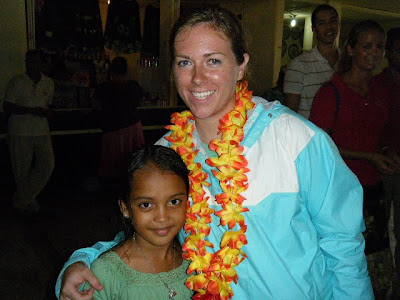
My youngest's teacher for the past year departs Pohnpei to return to big island called North America.
Posted by Picasa

Quezon City and Manila

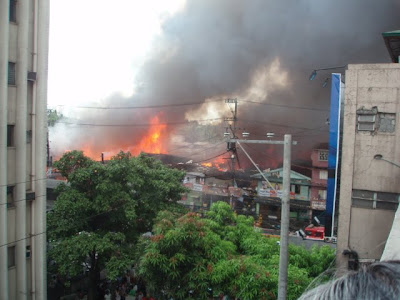
Upon her arrival in Quezon City last fall, two typhoons and the worst flooding in the history of Quezon city struck. This spring I assured her that things would be better. Upon her arrival the shanty town across the road burned, over a thousand homes were lost in the blaze. Quezon City might want to consider paying her to not go there.
Yonis enjoys a meal with Senator Rensper Luey of Pohnpei.
Shrue out and about in Manila.
Lyle was a huge friend, a true peneinei, visiting the girls twice during their month in QC. Lyle and his family treated them to a fine meal at SM Mall. Huge thanks. He also introduced my wife to cassava cake and Buko pie, both of which are actually available at one of the bakeries on Pohnpei. Shrue noted that the cassava cake here on Pohnpei is not as good as that in the Philippines - food is always better at home!
Posted by Picasa