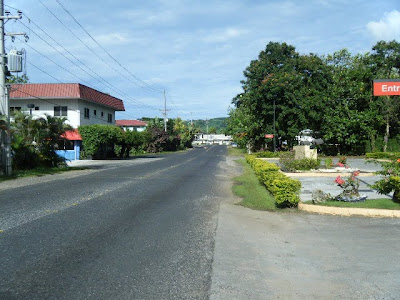
While in Wisconsin I took a camera on a couple of runs. This was made possible by the relative consistency and predictability of the weather there, especially that of precipitation. On Pohnpei, a tropical downburst can occur without any significant warning. Carrying a camera on a run is potentially problematic. This term, however, a FujiFilm Finepix Z33 WP, as in "waterproof" to three meters, permitted me to haul a camera on a typical run to the Nett river and back. Outbound, eastbound headed towards centerpoint, Angie's ahead on the left. The river is at the ridge in the distant background.
Downhill just past the new US embassy is the future home of the Bank of Guam. The river is at the ridge on the left - no mountain too far.
The interior of the island is rainier. The view south from the state hospital.
On the bridge, a view south towards the interior of the island. Hidden behind the trees are the homes of Kamar, Meitik, and Lewetik, Nett.
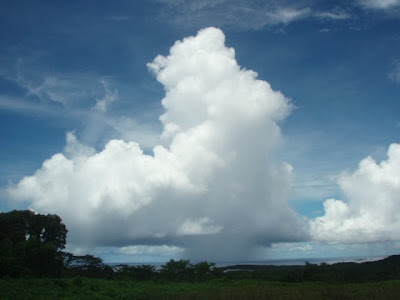
The view northwesterly towards Kolonia. Cumulus builds over the Pacific ocean.
The Dausokele bridge. Every so often, at the right time of the evening and the right time of the year, I get to race the shadows of the trees on the bridge as the sun sets to the west.
Technical note: Images were taken at 10 megapixels and then the camera's own "blog image" feature was used to create 640x480 shots for this blog.
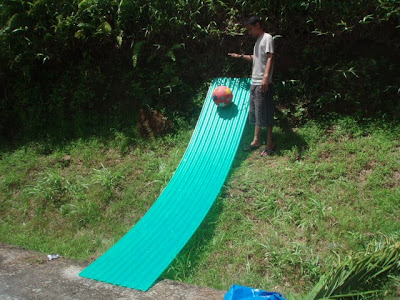
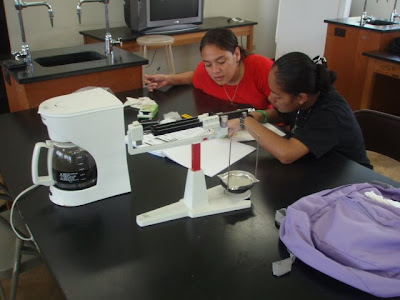
Mason releases the ball from a fixed height. This produces a repeatable speed for the ball, allowing multiple identical runs. Gina holds the tape measure at the "origin" - zero centimeters, from which the timers started their stopwatches. Timers mark where the ball was at one second, two seconds, three seconds, and so forth. Each timer has a stopwatch, each keeps track of the their own "seconds" assignment. The three standing were three, four, and five seconds. In the background the measurements to the time positions are being made. This procedure makes time the independent variable and distance the dependent variable. Clyde and Warren work from chalk marks that denote the location the timer was at.
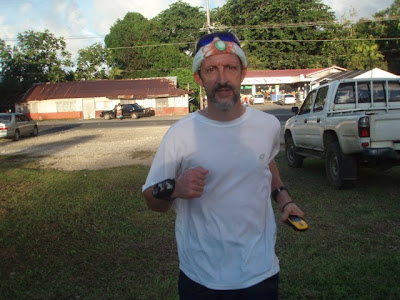
Completed the INS Nakasone half marathon, actually 19.7 km, in 2:06:54. Out of a field of 63 participants I came in 20th. I started out a tad fast, as usual, at 10.1 kph. I would finish at about 9.3 kph, averaging 9.5 kph over the route. I ran in my END Stumptown 12oz. Still unsure if it is the shoes or just my own tightness, but I had arch problems on my right foot about an hour into the run. Still, I finished. No pictures from the support crew at Koahn, no one was there when I passed by inbound at 17:45. Had George carry a sport drink to the U turn-around, that really helped. The August sun was better than the July sun - more shade along the north side of the road. Air felt drier as well. A good run. Ten minutes faster than last year.
In laboratory one, soap, some bars with a density less than one gram per cubic centimeter and some with a density of more than one gram per cubic centimeter, were carved into slabs of various sizes.
Their volume and mass were both measured.
Theodora working on massing a chunk of soap.
The results were then plotted on a scattergraph, one graph for each lab group. The volume on the x axis, the mass on the y axis. The slope was the density of the soap. The graphing was done in the computer laboratory using OpenOffice.org Calc software.
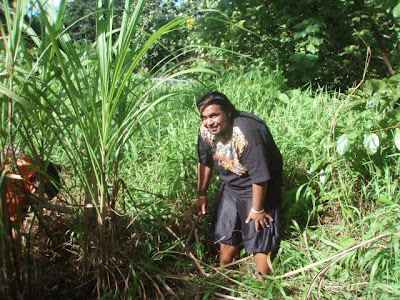
Tlargest SC/SS 115 Ethnobotany course to date with 30 registered students heads towards the forest to see psilotum, lycopodium, ferns, and their allies. Julie, a lone Kosraen in the course, on the extreme right. Posing among the keleu, Kristina, Charlene. No, the hike was not a night hike. The class was deep in a valley under overhanging trees after examining Antrophyum califolium.
A convenience sample of 74 students in the MS 150 Statistics class at the College of Micronesia-FSM Palikir national campus fall 2009 produced the following results:
45 MySpace members 41 Bebo members 13 students who use no social media sites 9 FaceBook members 7 Yahoo members 6 Tagged 4 Ning 6 Other [single memberships each in six other social media sites)
Note that students often have membership in more than one site. The seven who listed Yahoo could conceivably be listing that they have an email account with Yahoo. Six of the seven listed no other social media presence.
MySpace and Bebo remain the lead locations for statistics class students in social media space. Many students belong to both, FaceBook is a distant third. At the start of the spring 2009 term, however, no students reported being members of FaceBook. The students had not heard of FaceBook, as unusual as that must sound to those outside of Micronesia.
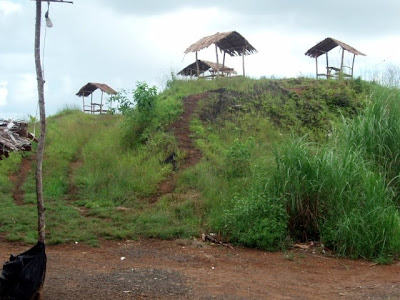
Blue Sunset sakau market in Enipein, Kitti, has added satellite tables up on the nan mal. Not sure I would want to try the descent when pwopwida! Each hut includes a table. This particular hill is burned regularly, maintaining a large clear area. When the wind and rain whip up, these are probably not as desirable a location. On clear, cool tropical nights, however, these would be the perfect place to enjoy sakau. Growing up I learned that children should be seen and not heard. This one seems to be kept behind barbed wire as well! The fence is actually more of an illusion than a reality. Neighborhood children and dogs slip through the fence daily without a scratch. Good fences may make good neighbors, but holes in fences allow the children to play.
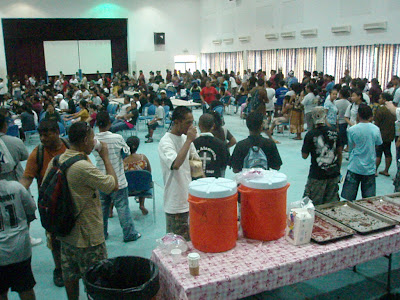
Registration day two at the College of Micronesia-FSM. Random convenience sample statistics: 103 people on an hour long line were then fed serially onto a second line of 110 people, duration unknown at the time of this writing. Counts do not include those who are sitting, they have stood in both lines and await the paperwork process completion, whereupon their name will be called.
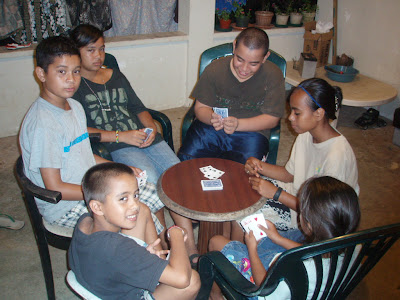
Back in 1995 there were proposals to build a casino and resort in Lukop, Madolenihmw. The project never materialized. Fourteen years later and the idea has been given a new lease on life. Whether or not the project comes to fruition, it seems like the group on my front porch is preparing for future careers at the facility. As a Sunday morning treat, Shrue made a coffee cake based on recipe she learned while in Wisconsin this past summer. The coffee cake was a real treat and reminded everyone of the wonderful summer we had all had. While we at home devoured one pan, another pan went off to church where it was very popular after the service.
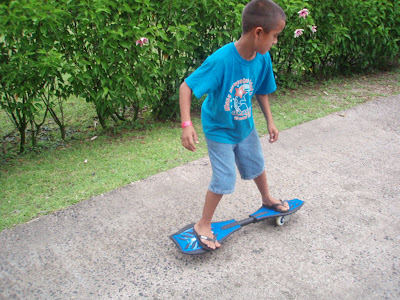
He really wanted a RipStik, a friend had one and he had learned to ride the board last spring. Thus a final shopping item on the trip home was a RipStik. As an instructor I know that a good portion of mastering any field, be the field economics, physcis, or castor boarding, is learning the vocabulary, the language of that field. While trying to pull the nose of the board into the air, he would invariably fall. I asked him what he was trying to do and he said, "A manual." He then explained a manual and a "nose manual."
The word seemed odd, he was I felt trying to do a "wheelie." I figured the local neighborhood kids on this remote island must have either developed their own odd language or have mixed up terms they might have heard.
To my surprise, my son was using exactly the correct term. Now I wanted to know how the "trick" became known as a manual. I realized that RipStiks and Wave Boards were probably borrowing the language of skate boarding. This hunch would lead to the etymology of the term. The trick was originally performed on an elevated, flat pad that had the name "manual pad."
The manual pad was an obstacle and the term originally applied only to wheelies done over an obstacle. A manual pad was typically elevated by 30 to 45 centimeters. Over time the presence of the obstacle was lost as a necessary ingredient, so the wheelie maneuver is now known as a "manual."
Pohnpei is the most remote of locations, hard to imagine how the correct terms seeped through to this location. One question lingers for me, why is the elevated pad called a "manual pad"?
Post-script: "Manual: A balancing trick involving rolling across an obstacle on the back wheels only. The name 'manual' is now often used by skaters when they are doing wheelies - the same trick, but on flat ground. Technically, it's only a manual when done across an obstacle (for example, a manual pad) but this has been largely forgotten - not something that particularly bothers me, because the distinction is meaningless and I prefer the name manual myself, especially when you think about the differences between a manual and wheelie in BMX riding. " - Skateboarding tricks beginning with M
A manual pad is a flat table like surface raised 15 to 30 centimeters above ground level on which tricks were performed. A good friend noted that, "A manual pad is a type of printer that has a flat table like surface. The printing is done manually." - JS. Hence the source of the term!
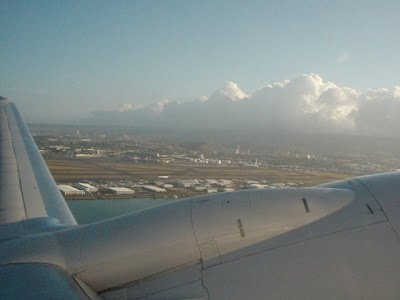
The long journey home involved lots of flying. Four aircraft and seven airports. Exhaustion and jet lag were our companions. But inbetween the long flights were moments of bright beaches, warm water, and meals with family and friends. More photos of this long journey.