Monday, August 29, 2011

RipStik acceleration

In a previous article I shared the use of a RipStik in SC 130 Physical Science to demonstrate linear constant velocity motion. The ability to generate a relatively constant velocity by swizzling at a constant rate on level ground was useful to that demonstration.

This term, as in the past two terms, the non-linear motion of the rolling ball in laboratory two had already set up the concept of curved lines as changing speeds on a time versus distance xy scattergraph. This permitted me to move directly to data gathering for an accelerating RipStik.


I did not achieve the top end that I typically attain, I am uncertain as to why. Prior to class I performed three practice runs with a goal of first pillar-to-pillar time of six to seven seconds. The hope was to hit an acceleration around 0.2 m/s².


My actual run during class suggests an actual acceleration of 0.068 m/s². The chart belows compares the desired accelertion curve against my actual acceleration curve. The time to the first pillar was right on the mark, but my acceleration fell to nearly zero.


A more careful examination of my pillar to pillar velocity indicates that my acceleration was low until the final two pillars.


Raw data:

 
Time (s) Desired (m) Practice run 1 (m) Practice run 2 (m) Practice run 3 (m) Actual run (m) Actual v (m/s) Actual a (m/s²)
0 0


6.8 4.6


9.6 9.2


11.7 13.8


13.6 18.4


15.2 23


0
0


7.78
4.6


13.16
9.2


16.8
13.8


19.37
18.4


21.91
23


23.62
27.6


0

0


5.69

4.6


9.59

9.2


12

13.8


14.22

18.4


16.75

23


0


0


7


4.6


11.27


9.2


14.53


13.8


17.54


18.4


19.06


23


0


0 0 0
7.22


4.6 0.64 0.09
13.13


9.2 0.78 0.02
17.06


13.8 1.17 0.10
20.16


18.4 1.48 0.10
21.91


23 2.63 0.65


Acceleration started off well below the desired 0.2 m/s² and remained below this value until the final two posts. Average acceleration was only 0.12 m/s². The approach of rolling as slowly as possible into the first pillar - essentially a zero acceleration after the initial push-start - in order to clock seven seconds to the second pillar, appears problematic.

I think the idea of a continuously increasing beat remains the most likely approach to producing a constant acceleration. This is likely, however, to cause me to hit my maximum speed sooner.

Sunday, August 28, 2011

On the home front


Wushu demonstration at the college gym. As can be seen on their faces, my son went on to enjoy the evening, my daughter was bored.


A treasure box that was once in the basement of my paternal grandfather's house.


My typical activity on a weekend. Marking papers.


New JBI expansion store.


Searching for mangoes


Up in Dienm Kitti,


Wearing 3D glasses improves one's ability to ride at night.


Boy time.

A badminton tournament started Sunday.


Rolling balls and linear relationships

Fall 2011 laboratory 022 marked the third term of the even "no write up" laboratories. Assessment done spring 2011 indicated that the shift from writing up every laboratory to writing up only odd laboratories did not have a negative impact on the improvement in writing.


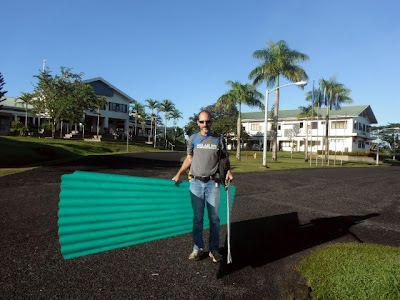
This term I had the Nissan and thus could not transport the roofing sheet to the gym. So I walked it across campus on a very clear day with saturating humidity. The photo makes the morning look lovely but the humidity was so close to saturation that one was instantly lathered up in sweat.


In laboratory 022 the location of the ball at each second is marked by a different student. Then the distance to the timing mark is determined. This makes the time the independent variable and the distance the dependent variable.

As this laboratory is often done in physics, the distance is preset and becomes the independent variable, with a timing determining the time to that fixed distance - such as a photogate on a air track. The ramp permits rolling the ball at a specific velocity that can be repeated. This allows the timing markers to stand near to the correct location for their particular number of seconds. Only a single timer is actually needed, one student calls out the seconds while watching a stopwatch or other digital second timer. This also means that one does not need hundredths of a second.

The ball slowed down both in the morning and afternoon sections, most especially after the first second. In the past 022 has provided an example of linear, unaccelerated motion. This term again, as last spring, the laboratory failed in this respect. The failure, however, was not as problematic for the curriculum as the failure might have been.Using the RipStik, I had demonstrated constant velocity motion on Monday. As a result, 022 became an opportunity to focus on what happens on a time versus distance graph when the velocity is decreasing with respect to time.

On Friday quiz 024 was able to exploit this accidental enrichment. Next week's accelerated motion will also benefit: the student's should be able to predict the nature of the curve for my accelerated RipStik demonstration on Monday. That will lead to a homework assignment to confirm that acceleration occurred. The homework would also be able to include, building on questions seven and eight on quiz 024, the pillar-to-pillar velocity.

The laboratory was wrapped up by graphing the data in the field and discussing the resulting curves on the paper. Ideas such as speed between timing marks were introduced. This term I did not discuss the tangent as the instantaneous velocity. The retreat was running in the gym, filling the lot with cars, and cramping our work space.

Without the computer laboratory second half, the laboratory could use some further enrichment and development to really bring forward the idea of the mathematics as making predictions. Maybe the class could be asked to predict the distance based on the particular release height? The complication is that one would have to work graphically - the data was simply not linear this term.

Tuesday, August 23, 2011

Ethnogardening

Cleaning up the ethnogarden, the leading edge of fall term 2011.
 Lisa works on the ilau, Clerodendrum inerme

RinaRuth contemplates the lemon grass, Cymbopogon citratus

 Neelma Pearl clears Merremia peltata off of Musa spp.

 Maylanda examines uht, Musa spp.

 Cleaning around the oahs, Metroxylon amicarum.

 Barnson rakes.

 Pauleen cleans an unknown plants as Trisha examines the same plant.

Jeanette works around sawaen Hawaii, likely a variety of Colocasia esculenta.

Monday, August 22, 2011

RipStik in Physical Science: Linear Velocity

To demonstrate linear motion while retaining some modicum of attention span from my social media saturated students, I again rode a RipStik along the sidewalk in front of the laboratory. The activity is built around the linear relationship between time and distance for an object moving at a constant velocity. Thus my goal was to retain a constant velocity over the 36.8 meter distance.


In class I only wrote the time and distance data on the board, the following table was constructed later as part of my analysis of whether my speed was fairly constant. 


Pillar Time (s) Dist (m) Vel (cm/s) Acc (cm/s²)
one 0 0

two 3.86 4.6 1.19
three 6.89 9.2 1.52 0.11
four 9.64 13.8 1.67 0.06
five 12.45 18.4 1.64 -0.01
six 15.09 23 1.74 0.04
seven 17.84 27.6 1.67 -0.03
eight 20.47 32.2 1.75 0.03
nine 23.45 36.8 1.54 -0.07

A constant swizzle rate tends to generate acceleration early in the run, and I could feel the increase in the speed between pillars one and three. I started the run prior to pillar one, but only by about three meters, so I had not yet reached a constant speed as I passed pillar one.

During the summer I opted to delay the stopwatch start until the second pillar to provide a seven meter run prior to starting measurements, . This fall I returned to starting with the first pillar as zero. The small variations in speed are visually difficult to see and thus do not impact the finding of linearity for the system.


At the very end of the run I usually run off onto the asphalt walkway. A visitor to campus from Japan was standing in that location, so I had to stop swizzling and jump off immediately after the last column. The visitor had a somewhat bewildered expression on his face as I hurdled towards him.


The small increase in velocity among the first three pillars and the deceleration at the run's end can be seen above. Mid-run my speed held fairly steady, accelerations remained near zero. The overall average speed for the run was 1.57 m/s, with the linear regression best fit slope at 1.61 m/s.

Sunday, August 21, 2011

Assessment of graphing, plotting, calculating slopes

In order to generate and comprehend the mathematical models that live at the core of physical science systems, students have to be familiar with the xy coordinate system, plotting points, graphing lines, calculating and understanding slopes of lines.

Eight questions that focused on graphing skills and which were tested on the first test summer 2011 were presented to the SC 130 Physical Science students fall 2011 on the first quiz of the term. The skills tested focus on student learning outcome 1.2 on the outline.

Twenty-nine of thirty-two students sat quiz one fall 2011. Data from the first test summer 2011 and the first quiz fall 2011 is presented in the table. Percentages are the percent of students answering the item correctly. Summer 2011 the sample size was fifteen students.

Question topic Su 11 Fall 11 Δ%
calculate slope from line on graph 0.67 0.52 -0.15
density as equal to slope 0.47 0.38 -0.09
infer effect of density 0.67 0.66 -0.01
calculate density from measurements 0.53 0.34 -0.19
calculate mass from density and volume 0.67 0.83 0.16
plot data on graph 1.00 0.72 -0.28
draw line through data points 0.93 0.72 -0.21
calculate slope from line on graph 0.73 0.55 -0.18

Overall performance this fall was lower than seen at the start of the summer term. Success rates for these questions do not exist for prior terms, suggesting an academically weaker class than seen this past summer.

Given a line on a graph only half of the students (15) could calculate the slope. Although laboratory one had focused on slope as density, only 11 of these 15 correctly understand that the slope is the density of the material which was graphed.

Given, however, just numbers to directly plug into a given formula, 83% made the essentially arithmetic calculation correctly.

Somewhat concerning was that eight students were unable to plot tabular data correctly on a supplied xy scattergraph - there was only a 72% success rate on this item. Of the 21 students who plotted the data correctly, only sixteen could then calculate the slope. This echoes the first item - only half of the students can calculate a slope from a graph, even when given the formula for slope on the quiz itself.

There is no math pre-requisite for SC 130 Physical Science, nor is there any intention to introduce one. The course includes the intention to teach math through science. That said, the students are usually either in MS 100 College Algebra, or have finished that class, or are eligible to take the course. This often means that they have completed MS 099 Intermediate Algebra. In other words, graphing and plotting should not be unfamiliar mathematical terrain. The data, however, suggests otherwise.

The data above suggests that I will have work more carefully early on in the term to connect together physical concepts with mathematical models, and ensure that the math itself does not become a barrier to comprehension.

Saturday, August 20, 2011

Lycophytes and Monilophytes hike

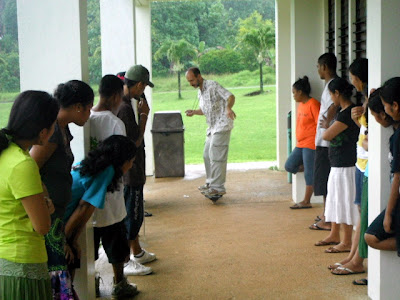
For the past five or more years the term has started on a Thursday, which meant that the first ethnobotany class was also on the first day of class at the end of the week. Attendance had suffered as a result. This term started on a Monday, which put the first ethnobotany class on the second day of classes on a full week of class. Attendance was strong with all but one student attending.

The first day I brought in five plants as a pretest, the results of which were depressing. That introduction plus coverage of the syllabus left time only to cover cyanobacteria. The first day of class was wet and rainy, and the students were not yet prepped with the knowledge that ethnobotany walks under the rain. In view of this, I had brought in a specimen of cyanobacteria (Nostoc). Thus moss was not covered on the first day of class.

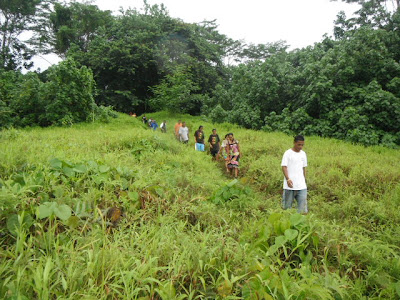
On the second day of class, the class headed out on the hike into the valley of the monilophytes. I did not open the class, opting to leave from in front of the classroom at 3:30 to maximize the time available for the hike. We stopped to put backpacks in the division supply closet as the weather was again rainy.

Behind the gym the class paused briefly as I looked for moss sporophytes. I did not see any and moved on. I opted to use the trail that takes off from the southwest corner of the parking lot on the west side of the gym.

This dropped the class down into the area where I had previously found Psilotum nudum. I did not locate any P. nudum, the area having become covered with Piper ponapense.

I led the class through the Hibiscus tiliaceus to the trail.

On the Ridgeline


The class stopped on the ridgeline to view the lycopodium Lycopodiella cernua and the sun-loving fern Dicranopteris linearis. Lycopodium is a member of the division Lycophyta, the ferns are members of Monilophyta. After a fire three years ago, and over-harvesting due to decoration for graduation, the Lycopodiella was scarce. This term the Lycopodiella appears to have recovered and expanded along the ridgeline.

Again the language loss among the students was severe. Only one student came up with kidien mal. One of the few Chuukese students disputed unen kattu. And for the first time that I can recall, the main island Yapese student was clueless as to whether the plants even had a name.


The class then paused at the top of the steep slope where Nephrolepisspp. and Thelypteris maemonensis were observed. A tree at the top of the trail now has a healthy growth of the lycopodium Huperzia phlegmaria on the trunk. Since last January strobili have developed on this plant. I was devastated when not a single student could name the Nephrolepis fern - rehdil. A single young man may have known the plant, but was too shy to say. The inability of essentially all of the Pohnpeians to name rehdil is unprecedented.

Local uses and meanings of these plants was also explained, along with names in the local languages. The local names for Microsorum scolopendria, its use as amwarmwar, and the function the plant had as a mwarmwarin protecting the dancer from soumwahuen eni were covered. A plant known locally as marekenleng was located on a tree, this plant is currently listed in the virtual herbarium as Asplenium polyodon.

Also found atop the steep slope was Davallia solida (ulung en kieil). I was so taken aback by broad and deep loss of language, that I forgot to cover the term devolution. Asplenium nidus was encountered as we descended the slope.    Now that I no longer cover the use of Vittaria, the fern is re-establishing on the trees at the top of the slope. This omission has been necessary due to over harvesting of the plants. This term I mentioned only the Pohnpeian name and that the fern is a primitive fern.


On the slope

The descent into the valley was particularly wet and slippery this term due to ongoing drippy rain.


In the valley

Down in the forest I could not locate Humata banksii. This term I also did not locate the Psilotum complanatum nor did I see Huperzia phlegmaria in the valley. The Asplenium Polyodon was still present both on top of the slope and in the valley.


Father along the trail the class observed Cyathea nigricans. One student could name the tree, a couple others agreed with the student. The rest of the class drew a blank.


I then took the class down to the river and up to the Antrophyum callifolium. We reached the A. callifoliumaround 16:40. No one said that they knew its name, no one indicated that they had seen this fern before. I then took role and at 16:47 I dismissed the class. This was one of the later dismissals, but this term add/drop continued until the next day. No one dropped the class.


Overall my impression  continued to be that plant language loss is increasing term-on-term. While there will always be statistical fluctuations in the knowledge set of a given class, this class seems weaker in their local language skills than any previous class.

Density of soap

Laboratory 01 in SC 130 Physical Science focused on the linear relationship between volume and density for soap. The class began with a return look at Monday's demonstration.

Measuring the mass of the vials did clearly demonstrate that the sinking vial was slightly more massive than the floating vials. Density calculations were complicated by the cap being slightly larger than the glass vial. Volume calculations attempted at 8:00 were plagued by measurement and mathematical errors. Misreading of the calipers and forgetting to halve the diameter both contributed to a confusing presentation. At 11:00 an attempt was made to determine the volume by displacement using the graduated cylinder.


The complication is that the masses do not yield densities that predict floating and sinking.


The floating vials massed at 13.2 and 13.4 grams. The sinking vial massed at 14.0g. By displacement, the volume of a vial is 14 cm3.

Differences in the 1.575 cm diameter of the vials was less than 0.025 centimeters between vials, thus volumetric differences in the vials were on the order of, at most, 2%. The mass difference was the larger effect at 6%.


I also massed an empty 100 milliliter beaker, filled the beaker with 80 ml of water, and remassed the beaker to work out the density of the tap water in the laboratory.


A 43.7  gram beaker massed 126.4 g with 80 ml of water for a calculated density of 1.03 g/cm3 for the tap water. The complication with this approach is that few, if any, of my students have worked with milliliters, thus this calculation is little better than magic.

The above implies a water mass displacement of 14 times 1.03 or 14.42 grams of water, suggesting that all three vials should float. As they do not all float, errors in measurement must remain. The differences are small, only a 6% spread in mass, a difference of less than one gram. This is a rather sensitive system.

Cutting the soap into a rectangular slab

Harmony beauty soap and Safeguard anti-bacterial soap both with a density greater than one gram per cubic centimeter was used by six lab pairs in each section. Two lab pairs in each section had Ivory soap with a density of less than one gram per cubic centimeter. The soap was carved into square chunks so the volume could be calculated from length × width × height.


The class began with the Freeman Dyson quote:
For a physicist mathematics is not just a tool by means of which phenomena can be calculated, it is the main source of concepts and principles by means of which new theories can be created... ...equations are quite miraculous in a certain way. ... the fact that nature talks mathematics, I find it miraculous. ... I spent my early days calculating very, very precisely how electrons ought to behave. Well, then somebody went into the laboratory and the electron knew the answer. The electron somehow knew it had to resonate at that frequency which I calculated. So that, to me, is something at the basic level we don't understand. Why is nature mathematical? But there's no doubt it's true. And, of course, that was the basis of Einstein's faith. I mean, Einstein talked that mathematical language and found out that nature obeyed his equations, too.
At the start of the class I noted that if the density of the soap was less than one gram per cubic centimeter, the soap would float. If the density of the soap was more than one gram per cubic centimeter, then the soap would sink. The density would be determined from the slope of the graph later in the class period.

Connie masses Harmony soap

I also included a quote from William Gilbert on the need to perform experiments and when experimenting to "handle the bodies carefully, skilfully, and deftly, not heedlessly and bunglingly." The above difficulties with the vials suggests that I too am not heedful enough of Gilbert's cautionary words. Somewhere in the vial measurements I bungled.


This class also provides an opportunity to introduce the mass balance and measuring in centimeters. After gathering the data on the length, width, height, and mass of the soap, the class moved upstairs to the computer laboratory to plot the data and determine the slope of the best fit line.


The class does not presume prior knowledge of linear regressions, on the contrary the class teaches the concepts of slope and intercept through the science encountered in the class.


Only after the students work out their slope data do I ask them to predict what their soap chunks will do when dropped into a beaker of water. Each makes a prediction. Then I drop the Harmony soap chunks into the water, followed by the Ivory soap chunks. As Dyson noted, the students made a mathematically based prediction and the soap knew what to do.


The chart is based on student data for the Ivory, Harmony, and Safeguard soaps. The blue line is a density of one gram per cubic centimeter, the theoretic density of water. Obviously this experiment could be mathematically simplified by having the students directly calculate the density per chunk. The densities could then be averaged. The point, however, is to move the students towards mathematical models. Laboratory three and section 041 will feature non-linear models. Slope is mathematically a farther reach for the students, the gain is worth the mind stretching.