Saturday, October 30, 2010

My annual numbers

Every term in MS 150 Statistics I use a Tanita scale to measure the students weight and to estimate their body fat. The data is primarily used, with names stripped out, as number sets to play with during the term. Secondarily this provides information to a sample at high risk of obesity and associated metabolic syndromes, number two on the planet by one measure. The students become inured to my exhortations to exercise, eat right, and to track their numbers.

Because I get to see the students numbers, I always feel that sharing my numbers is incumbent on me. Although I do try to take a daily pill for my health.

  • Blood pressure 110/70 is down year-on-year.
  • Weight: 144
  • LDL: 86
  • HDL: 41. A tad low. 45 would be better. Fish oil recommended.
  • Cholesterol: 138. A personal best in this century for me. Credit maybe the running, but also maybe the daily glass of red wine since fall 2008. 
  • Sugar: 102. High for me, I usually see numbers in the seventies and eighties.
  • PSA 1.1
  • Uric acid: 7.8. Borderline. 6.9 last year, 7.7 the year before. Less pork. I do not usually eat shrimp, lobster, clams, shellfish, crabs, and other problematic foods. Hydration may be an issue too.
  • ASD: normal
  • ALT: 79: borderline elevated. Possibly related to alcohol intake.
The cholesterol was the number that concerned me. I typically saw numbers in the 160s and 170s through to a 2007 cholesterol of 169. Then in 2008 I hit 219. With more attention to my diet, exercise, and a daily glass of wine or a single beer, that dropped to 178 in 2009. That 2008 spike also saw my LDLs hit144 after a 100 in 2007. 2009 saw that number drop to 118 and now down to 86. My 2008 HDL, however, was good at 57, falling to 41 last year and now holding at 41 - a tad low.

The results are mixed. My fasting blood sugar is high, at least for me, climbing from 85 in 2008 to 97 in 2009 and now 102. An opportunity to follow-up on my blood sugar should occur on 14 November. The uric acid levels are also a concern as they suggest problems downstream with issues such as gout.

Sokehs Shopping Center and Dien both open

Friday 29 October was auspicious indeed with the triple play of Sokeh's Shopping Center re-opening, Dien market being open, and social security day all landing on the same day.
Re-opening of one the largest stores on Pohnpei and a plus for residents of Sokehs and Kitti.

Bicycles can induce large eye syndrome.

Mitsuo "Luke"Daniel
Weilanter "Oaulik" Samuel.
Aramas Dien o Poahloang: Deisleen and Debra.
Happiness is a bottle of joy!
More happiness is more bottles of joy!

Thursday, October 28, 2010

Quadratic fit with Wolfram Alpha

In laboratory 03 the students gather time versus distance data for a falling ball. The data from three groups was average and is presented in the table below.

time (s) distance (cm)
0 0
0.41 100
0.47 120
0.52 140
0.56 160
0.6 180
0.64 200
0.69 220
0.73 240
0.77 260
0.83 280
0.84 300
0.9 400
0.95 500

In the laboratory the students square the time to generate a linear regression, which is then used to determine the acceleration of gravity.

The WolframAlpha computational knowledge engine provides another option to this approach. Given a set of paired data, WolframAlpha will find the quadratic least-squares fit.

To get the data into the input format expected by WolframAlpha, I used OpenOffice.org setting up a table that included the brackets and a trailing space after the comma.

{ 0 , 0 },
{ 0.41 , 100 },
This was copied to Notepad++ where the extraneous tabs were deleted using a find and replace, along with an extended mode find and replace using \r\n to remove the carriage returns and new line feeds. This created a string that could be pasted into WolframAlpha:

WolframAlpha then interpreted the input.
After interpretation, WolframAlpha returned the least-squares fit for the quadratic relationship along with an output chart for the residuals (not shown).


Tuesday, October 26, 2010

[tech] FaceBook continues to roll out academically useful tools

Within the last week FaceBook rolled out what FB is calling "new groups." New groups are not the same as old groups. They are more like friend lists, but with new functionality. One major change is that the group creator selects friends into the group, as one did with a friend list. No need to send out group invitations. The new group has, if set up as a closed group, its own closed, private wall. No one outside the group can seen posts in the group.

One of my students just discovered that the group I set up, psa3, permits group multi-way chat. This has been a critically missing piece of technology for FaceBook chat. FB chat has been two-way only chat up until now. I do not know how the student "activated" the multi-way chat, but the window stays open as long as any member is on line.  Members who are on line are displayed by their profile image at the top. I will be following up with her to see if she remembers how she opened that multi-way chat.

A tantalizing icon on the publisher unit labeled "doc" suggests that documents could be attached to a post. That is another piece those of us in the classroom need - ability to post documents. I continue to believe that it is easier to build a classroom where the students are already living in cyberspace, rather than building it elsewhere (Moodle, Blackboard) and hoping the students will come. My students are already in FaceBook, if FB will build the tools I need to serve them where they already are, so much the better.

Post-script: One major complication. Any member of a new group can invite other friends to join the group. The group originator has no control over this. Thus my physcial science class group now has friends in the group who are not members of the class and who were not added by me. To date I have not determined how to retain administrative control of a group one starts. I have not yet tried setting up a "secret" new group. My guess is that FB decided the groups should be able to "go viral" and thus set them up so any member can add members.

As for "popping open" the group chat, simply clicking on the group icon appears to do this automatically, which is why the student who started the group chat did not realize she had initiated the group chat.

Monday, October 25, 2010

Sokeh's ridge hike

The guns of World War II are long silent, but the reminders of that now long ago conflict are still on Pohnpei. On United Nations Day the students of Phi Theta Kappa hiked up the ridge to clean-up around the 127 mm Japanese coastal defense guns. The ridge is filled with history of a war, the memories of which are fading with the passing of the generation who survived the war in these island.
PONAPE HARBOR: Seen from Kolonia is Ponape's main harbor. In the background, Sokehs Rock rises over 600 feet above the sea. Photograph: U.S. Marine Corps, Arthur H. Navarre Collection (Courtesy of Diane Hindy). Copyright ©2008 Marine Bombing Squadron Six-Thirteen Association.  All Rights Reserved.
Circa 11 September 1945. Either the USS Hyman and USS Farquhar is likely to be the ship in the harbor based on a preceding page.

The ridge we climbed is on the extreme left of the photograph. The highest point, on the right end of the ridge, is the present day location of the cell towers.

JAPANESE DEFENSES: Located on Sokehs Rock, this Japanese 127mm dual-purpose gun overlooked the main harbor town of Kolonia. Photograph: U.S. Marine Corps, Arthur H. Navarre Collection (Courtesy of Bill Kehr). Copyright © 2008 Marine Bombing Squadron Six-Thirteen Association.  All Rights Reserved.
Undated photograph.

Prior to setting off, two of the hikers down the heavy duty boots grandma purchased in Wisconsin, summer 2009. The boots are not used very often, but were sure useful today.
After a long, slow trudge to the top, the gang was excited to reach the 127 mm guns.


Not sure what the unit on the right side of the gun housed, but for a Kosraean it is a good place to sit and rest.


After a photo session with the guns, the gang headed on up to the cell towers, a location that back in 1992 appeared to me to possible be an anti-aircraft gun emplacement and spotting tower base.
Two of the climbers on the "observation platform" built atop a cement equipment shack at the towers.


The back of Paipalap - Sokeh's distinctive rock.
Kolonia with Nett Point in the background. The new state capitol building looming large just right of image center. Built with money from the People's Republic of China - somehow apropos for a trip to see Japanese WWII hardware.
Posing as proof of arrival at the topmost point.

The airport with work occurring on the extension on the far end of the airport. Also under construction is the new expanded terminal building.

Walking back to the guns, the students of Phi Theta Kappa had arrived and were cleaning up around the 127 mm guns. Even in 1992 the guns were lost in the forest as hinted at in the old image above. Since 1992 community efforts to clean up and plant Hibiscus rosa-sinensis, ground orchids, and other flowers have occurred.

Hand-pulling grass from the top of the berm.

And a favorite place to pose for photographs. Seventy years on, these youngsters have no direct knowledge of the war nor do they usually even have elders around from that day and age. The generation that could tell the stories - who were old enough to remember the war - are now a dwindling few.

Thursday, October 21, 2010

Thatching

The SC/SS 115 Ethnobotany class taught each other thatching. In past terms the class used Nipa fruticans. Nipa fruticans can be obtained non-destructively from the plant.

 Edelynn starting her thatching.

This term the class used the traditional material for Pohnpeian thatching,  oahs, (Metroxylon amicarum). Often the harvesting of oahs is done by cutting down the tree due to the extreme height of the mature leaves. This term the supplier was able to harvest leaves from a young oahs without cutting down the tree.

Strick getting started.

There are two styles of Pohnpeian thatching, doakoahs en Ruk and doakoahs en Pohnpei or simply doakoahs. Doak means "to pierce" with a needle-like object. Oahs is the Pohnpeian name for Metroxylon amicarum.
Rafaila working on doakoahs en Pohnpei.

On Pohnpei in the past the tip of a marlin (a bill fish) was used as a needle. Today the sharpened end of a toothbrush with a hole in the end is a good needle, nails are also sometimes used. Nails with heads, however, do more damage to the frondlet due to their heads.
Amilain.

Today some students carved "needles" from bamboo. One student noted that up in the forest ketieu is preferred (Ixora casei). Another used a short shaft of Acacia auriculiformis. Ultimately whatever material is hard and handy is used.
Glory working on what appears to be doakoahs en Ruk.

Craftsmanship and skill are shown in the even spacing of the stitches and the tightness of the weave. String is not typically used to stitch the thatch together. Some use the outer skin of the main petiole on oahs. One student noted she could not work with the string as she was used to using the outer skin of the main petiole on oahs - the fibers are long and stiff enough to function as their own needle. Others weavers unravel rice sacks of woven plastic for "thread". Some students had heard of the use of hand woven coconut rope.
Megan halfway along the rahu.

Frondlets are folded so as to create a one-third, two-thirds split in relation to the length of the frondlet. The base is one-third, the apical end is two-thirds. The minor rafters over which the frondlets are folded are made of either Phragmites karka (Chuuk: Woowo, niwo, Kosraen: loa, Pohnpeian: lirau) or Saccharum spontaneum (Kosraen: ac, Pohnpeian: ahlek). The minor rafters are called rahu in Pohnpeian. Today we used what appeared to be lirau.
Kimberly starting her thatch.

Deisleen.
Monaliza working on doakoahs en Pohnpei.

Doakoahs en Pohnpei differs from doakoahs en Ruk in being laid on a 45 degree diagonal. Note that traditionally Pohnpeian thatch was not covered by a net to protect the roof from wind damage.
Elizabeth working on doakoahs en Ruk, Amilain in the background with doakoahs en Pohnpei.

On the flat, outer island atolls in mid-ocean the wind is a more significant source of damage. On Pohnpei rain and subsequent thatch rot are apparently more problematic. Pohnpei thatch is not netted down. The thatch is designed to catch the wind and "fluff" slightly, aiding in drying of the thatch and slowing rot.

Reedwin shows his expertise with a tight, regular weave, evenly spaced leaves.

Removal of the nohk - the back half of the midrib - is necessary when using oahs due to the thick midrib. The oahs frondlet cracks and breaks unless this is done. This is not apparently strictly necessary with parem. The nohk from oahs are then used to make a whisk broom. The oahs in use was from a younger tree, on some the nohk could be removed, on others the nohk could not.

Samantha and SepeBrianna set the leaves down in pairs as per Kosraean practice. Kosraeans, however, use Nipa palm. Kosrae does not have oahs. Kosrae is presently thought to have only four species of palms. Coconut (Cocos nucifera), betel nut (Areca catechu), Ponapea ledermanianna (Kosrae: kitacr, Pohnpei: kedei) , and Nipa fruticans. On Kosrae Nipa fruticans is used for thatch (Kosrae: fahsuc, Pohnpei: parem). Fahsuc is narrower than oahs. Thatching frondlets are laid down in pairs and folded at the midpoint.

Deisleen working on a needle. Many thanks to the maintenance crew, the knives were just sharpened prior to class.

Lloyd teaches Rosalinda, Jeffrey in the background. This is how this session works. Those who know how teach those who do not.

In Chuuk pandanus is used for thatch, as well as coconut palm leaf. Coconut palm leaf has a reputation for a short life span across Micronesia.

Dayne displays a finished thatch piece.

Linguistic note: dok is "pierce" while oahs refers to Metroxylon amicarum. The combining of the words is what is known in linguistics as verb noun incorporation or incorporated objects. When the word is by itself, it is dok (intransitive), which means to pierce or to stab. The transitive form of it on the other hand is doakoa. The use of /oa/ is sometimes /o/, depending on the following vowel or consonant sounds. For instance, doakoahs, to pierce oahs, dokpwihk, literally to stab a pig (to pig-slaughter), dokomwomw, to spearfish,etc. [Source: Robert Andreas]

Mirror reflections and apparent depth refraction

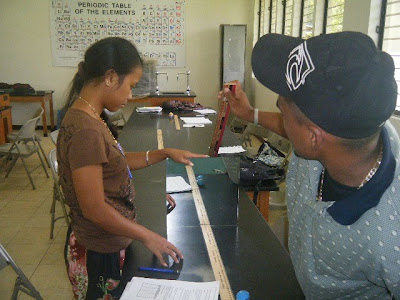
Laboratory ten began with an investigation of the relationship between the distance of an image behind a mirror versus the distance of the object in front of a mirror.


Jessicalynn and Brian work out the image position.

In the second part the students worked on measuring the apparent depth of a penny under water versus the actual depth of the penny.


Norma peers into the small bucket, Corazon the larger bucket, Leilani is measuring.

The small blue bucket provides a nice intermediate depth between beakers and the Ace bucket, but the bottom is not at the bottom so to speak. A white flat-bottomed bucket of the same size would be better. Behind the Ace bucket are graduated cylinders that provide even more depth.

Sanolyn works with a 2000 ml graduated cylinder.

Monaliza indicates the apparent location of the penny image under water by looking in the top of the graduated cylinder. The cylinder keeps the viewing angle small. For small angles the ration of the actual depth to the apparent depth is effectively equivalent to the index of refraction. Eva records the data.
Posted by Picasa

Wednesday, October 20, 2010

Turning an odd number

Turning an odd number is hard when turning an even number was so exciting a year ago. That the year being turned is a square number did nothing to comfort the birthday girl.

The barbecue was handled by a hired professional. Having just turned two, she is an expert barbecuer.

A gathering of family and friends, well-wishers all.

Blowing out the sparkling candles.

Being the first world statistics day, I am left pondering the probability that World Statistics Day would be declared to land on my youngest's birthday.
Posted by Picasa