Friday, April 30, 2010

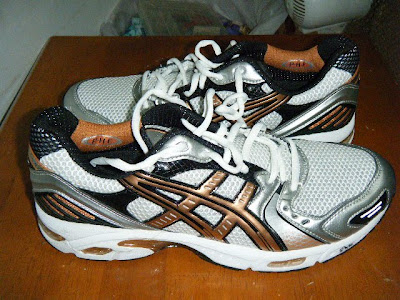
ASICS Gel Evolution 4

New shoes are always a motivator to get up and out the door!
These are ASICS Gel Evolution 4 shoes that will rotate with my 3010s.
Posted by Picasa

Laboratory 14

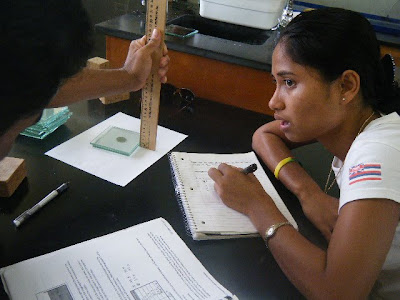
Laboratory 14 provided the absolute minimum of structure. On the board I wrote, "Determine the index of refraction for the glass panes." I provided only the glass panes. Orally I told the students, "If you need anything else, ask and, if the laboratory has the requested item, I will provide it." Laboratory ten included determination of the index of refraction of water, thus the students were not starting from a completely blank slate of possible ideas. One of the first requests was for rulers and meter sticks.
Sepe requests clarification of a value.
Eliander and Steward work on the problem.
Charlene requested a basin of water as part of her approach to the problem.
Nick built an air-layered glass stack as part of his approach to the solution.
Posted by Picasa

Thursday, April 29, 2010

Physical Science Site Swap Laboratory

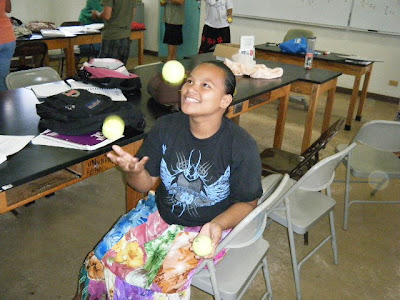
The final laboratory of the year is both for fun and to expose the students to a whole new form of mathematical model called site swap notation. Lorry-Ann demonstrated juggling while sitting.
Keicyleen has three up.
Although difficult to discern in the photo, Brigida was multiplexing the two balls into one hand and then returning to a three ball cascade.
Midion practices keeping three balls in a cascade.
Posted by Picasa

Sunday, April 25, 2010

The Semantic Web

I have been enamored of the semantic web for over a decade. I still retain old Dublin core metadata on my courses home page from the days long before the abbreviation RDFa existed. Dublin was hard, requiring special effort or a tool to generate the necessary code.

I have watched from the sidelines as microformats has slugged it out with RDFa and the accessibility community. Both seemed complex, with a steep learning curve for minimal gains for my target audience - my students. Achromats (a genetic color blindness that runs in the Pingalapese population, see also Island of the Colorblind) need an alternate style sheet that reduces the contrast, not RDFa for screen readers. And I have that available for many of my pages.

A recent article by Mark Pilgrim on a third way caught my eye not because of the accessibility argument but rather providing metadata information to search engines such as Google. Although one is clearly carrying water for Google, the Netscape image tag argues that a big enough force in the industry at a particular time can simply drive a technology into existence. Besides, microdata feels more logical, more comprehensible, than any microformat or RDFa material I have read. I think microdata tries to solve a smaller problem with fewer pieces and hence feels more manageable.

I used the article to annotate an "about me" page on the college server and then ran the page against the Google Rich Snippets Testing Tool. The result was rather pleasing. Well worth the few minutes spent adding microdata "sugar" to the page.

Friday, April 23, 2010

Stability of FaceBook as a business app space

In proprietary, desktop based software I have a dated genogram with some 3000 people. Seeking a way to move that data into the cybercloud, about two some years ago I began experimenting with Geni. 

Geni was an interesting concept, collaborative genogram building. The crowdware concept applied to family trees. The catch was that you had to convince family members to join Geni, and that was a significant hurdle. Join and regularly log on.

A year ago Geni deployed a FaceBook application interface. FaceBook and Geni seemed like a natural pair, a win-win for both. No need to log on to the Geni web site, every FaceBook member can install the app, and the app would fire off useful notifications.

At some point, however, Geni decided to discontinue the FaceBook app. Although the data still exists at Geni.com, the power of being able to share and collectively build the genogram through FaceBook was really the useful aspect of the program for me. Geni.com as a stand-alone web site is useless. FaceBook provided the critical social connectivity aspect.

I have effectively lost my data, at least the usefulness of my data, because an app abandoned FaceSpace. Which raises the following question: if I use FaceBook as an academic vehicle with students, do I not face the same risk of loss of presentations and other academic material when an app developer decides to pull out of FaceSpace? How stable is FaceBook as an app sphere for business critical uses?

Sure, I could develop presentations and other academic material to deploy in FaceBook using SlideShare and the like, but if the app pulls out at some future date, then I have lost potentially years of labor. Is FaceBook ultimately just a toy for connecting with people or can FaceBook mature into a platform that can support business needs?

Ethnobotany cultural ceremony field trip

The SC/SS 115 Ethnobotany course visited the home of Betwin Nicholas in Pehleng, Kitti, Pohnpei. There sakauen enilap was prepared.

Sakau was first prepared for Nahnmadeu as Soumas en kousapw. A four cup nopwei was served. Pwel went to konot, second to Nahnowa, third to Lupein, and fourth - sahp - back to Konot. Note that all spellings are my own, my apologies for my misspellings.

After nopwei Nahnowa greeted the titles present and welcomed the class.

With these formalities out of the way Nahnowa asked what ceremony the class would like to observe. A decision was taken to present sakauen enilap as would be presented to the Nahnmwarki.

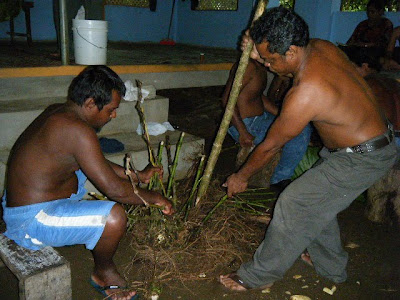
A trunk of weipwul, Morinda citrifolia, was cut, brought, sharpened, and used to break the sakau root stock. When used in this manner the trunk is no longer referred to as weipwul but rather as kirikai.
Each of the four strokes was done under the verbal command of the menindei. I could not catch the four command phrases. I have cryptic notes that suggest the following might have been the first three, although I may be completely in error.

Sakauen rotapwel (the plant is still standing)
Sakauen salapwel (the sakau is down)
Sakauen sinani

I do not list the fourth phrase. After the four strokes of the kirikai, four branches were placed on the front platform of the nahs.


After the presentation, a two stone sukusuk was begun. The sukusuk ended on a two stone synchronized sokama.


Pwel from the two stones went to Konot, Nahnmadeu, and to Luhk. The second cups with to Lupein and another woman whose title I did not hear clearly. Third went to Luwon and Thomas, the later being a driver for the class. Fourth returned to Konot who honored Nahnsou and myself.

This was the first time I had seen such a ceremony in my seventeen years here, and the ceremony was new to the eyes of all of the students, including those from Kitti. My understanding was that the ceremony is reserved to Nahnmwmarki, Nahnken, Rosa, and a few other special high titles in Kitti.

After the second nopwei, the hosts treated the class to dinner, another first for the ethnobotany. To say we were welcomed and made to feel completely at home would be an understatement. The hospitality of the family made each and everyone feel like a member of the family returning home after a long time away.

With food served, each student in the class introduced themselves including their clan line name.

A few remained into the evening talking and sharing stories around the stones. More images!

Posted by Picasa

Saturday, April 17, 2010

Joy Hotel Pohnpei Breakfast

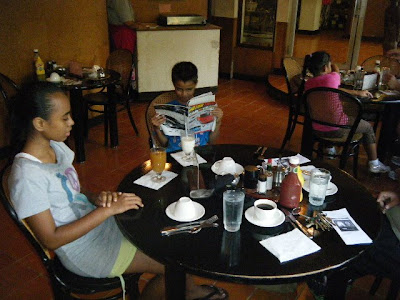
After any fun run on Pohnpei, many of the participants head for the Joy Hotel and breakfast. Our gang hit the Joy.

Tamara and her daughter also went out for breakfast.

The Joy is all about family and friends. Doctors Gregg Dever and Giuseppe Cuboni were in residence this Saturday morning.
Posted by Picasa

Women and Sport 5k

On Saturday morning 17 April the Women and Sport 5k run was held here in Kolonia, Pohnpei.

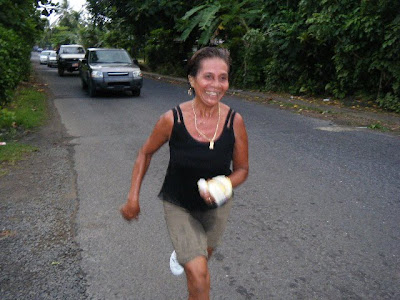
By my calculations, Wone clinched the fifty and older master's category with wins for Wone runners in both the womens and mens category. Wone luak took the female win - Elena Salvador Yamada above, while the male win went to a runner with ties to Pahnais, Wone and Dien, Poahleng. Meanwhile I joggled an intentionally slower pace in my new 3010s - my first run in them as they only arrived on island yesterday. I finished in 28:46.

Although I am a flat-footed overpronator who usually runs in motion control shoes, some twinges, increased mileage, and my age suggested I ought to shift to a shoe with more cushioning. I used to run in the ASICS 20xx series, but a pair of ASICS 2080s gave me blisters under my arches. I was concerned that the 3010s might do the same, too much arch does not work well for my feet.

The run this morning was too short, but I felt no hot spots under my arches as I did in the 2080s. I will know better after a few longer runs in the 3010s. My initial reaction is strongly positive, I did not even feel the need to use my gel inserts that I have been using fairly regularly since a bout of Plantar's fasciitus back in 1996.

My son finished in a personal best 34:54.

My eldest came in under 40 for the first time in recent years at 39:27.

Shrue joined and finished with Tamara and Yvonne in 58:17. The youngest was on an overnight with a friend and undoubtedly slept right through the event start time.
Posted by Picasa

ASICS Gel 3010

My effort to push my three month seven day running time sum over 400 did have a casualty - my Mizuno Wave Renegade 4 running shoes. The carbon rubber heel went and then the road ate through the outsole. Guess I am still a heel striker. Not to mention that two years of running had pounded out much of the cushioning.
The newly arrived replacement is a pair of ASICS Gel 3010 ASC1384-WHRY-11-D from RoadRunner Sports.
Posted by Picasa

Thursday, April 15, 2010

Floral litmus solutions

Laboratory thirteen in physical science had the students collect flowers from around campus, produce floral solutions by boiling in water, and then test to see which floral solutions changed color for both a known acid and a known base. Teaching in the tropics makes this laboratory possible in both November and April.
Syd-Lee, Keicyleen, and Midion discuss their results.
Syd-Lee, Keicyleen, and Melojane test unknowns.
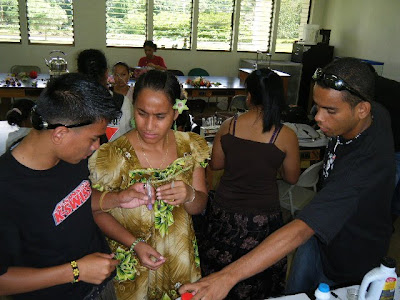
Marla working on a floral solution, decorated with flowers.
Deltalei uses a floral solution that changes for both acids and bases to determine whether an unknown is an acid or a base.
Posted by Picasa

Sunset

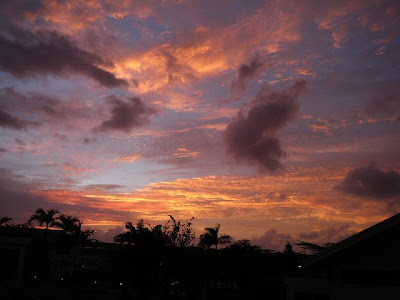
A couple weeks ago a FaceBook friend asked for more pictures of Pohnpei sunsets. During an evening family picnic at the college we were all treated to the following.
These images were captured on the Palikir campus of the College of Micronesia-FSM using a FujiFilm FinePix Z33WP.
Clouds are not always white and fluffy!
Posted by Picasa

Evening activities

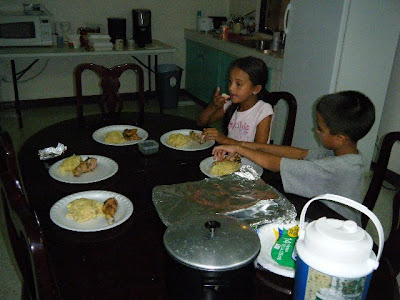
A picnic dinner at the college in the lunch room. Iron pot banana, fried chicken, and cayenne pepper fresh off the bush.
Monopoly remains a popular evening activity.
Posted by Picasa

Wednesday, April 14, 2010

Lunches

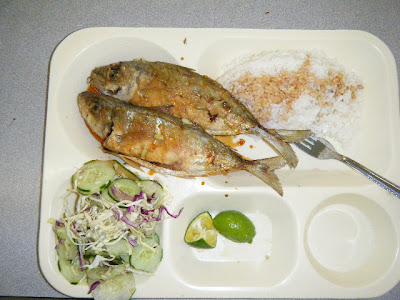
Pedidi, which I have surely spelled incorrectly, appears to receive mixed reviews from lunch diners. I, however, enjoy the fish especially with lime and soy sauce. 
The day before my wife and I enjoyed lunch out at the only Chinese restaurant on Pohnpei.


Sunday, April 11, 2010

Children and Youth Fellowship Building Dedication

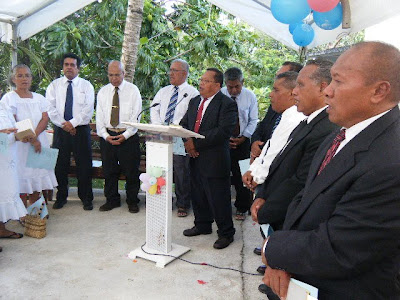
Kosrae-Kolonia Congregational Church dedicated the Children and Youth Fellowship Building on 10 April 2010. Reverend Eden Skilling was joined by pastors from Kosrae including Solomon Mongkeya, Takeo Likiakas, Madison Nena, and Toloenna Jose.
The etawi srisrik children's choir sang inside the new center on the second floor of the current church in Kolonia, Pohnpei.
The college youth, etawi fwasr, also sang for the gathered community.
Posted by Picasa