Tuesday, August 31, 2010

Traditional plants of Pohnpei
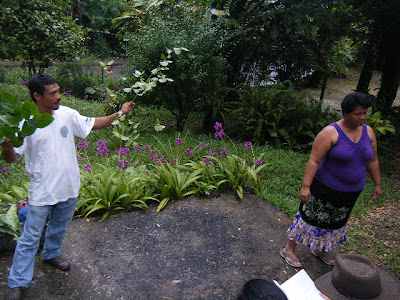
The SC/SS 115 Ethnobotany class visted the Pohnpei Traditional Plants ethnobotanical garden at the Pohnpei campus. This term Totoa had Ben lead the presentation. As I had explained to the class, ethnobotanical knowledge resides within a cultural and linguistic context. Having Ben present the plants in the language of their usage on the island on which the field trip was held was most apropos. The students had the opportunity to experience ethnobotany as an ethnobotanist might on an initial visit to a foreign culture.

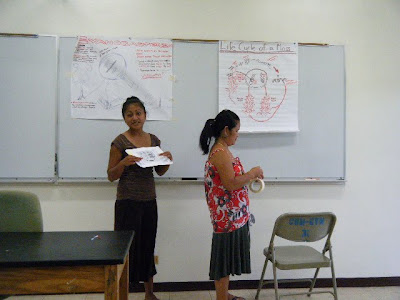
Ben presents topwuk and oahr above. Although I had coincidentally brought oahr to class on the first day, many of the students appeared to have forgotten the plant. Topwuk and oahr are both consider Premna obtusifolia, although oahr is both vegetatively and florally distinct from topwuk.
A close up of topwuk.
The group listens attentively to Ben. Kasinta and Edelyn down in the front. Arrayed behind them are Dayne, Sharon, Antoinette, Rophino, Lloyd, Kimberly, Nixon, Samantha, and Lanze.
Deisleen, Strick, Jeffrey, and Monalisa.

Up front Megan and another visitor to the class. The college's national campus is now dominated by students from Pohnpei state. Of the students in the class I am aware of only two who do not at least understand if not also speak Pohnpeian. One of the two has already demonstrated a solid knowledge of plants, the second of the two is from the culture with the most severe loss in terms of plant names.
Deisleen and friend at the end of class.

This field experience was made possible by the College of Micronesia-FSM/Pohnpei campus, the division of T and M. The class owes a debt of thanks to Director Penny Weilbacher and Agriculture Coordinator Totoa Fetalai-Currie.

Monday, August 30, 2010

RipStik accelerated motion

In a previous article I shared the use of a RipStik in SC 130 Physical Science to demonstrate linear constant velocity motion. The ability to generate a relatively constant velocity by swizzling at a constant rate on level ground was useful to that demonstration. 

Today I first introduced the calculations necessary to determine the acceleration as the change in velocity divided by the change in time. I used a hypothetical example where the acceleration was 2 m/s² thus y = x². I made a table time (s) versus distance (m) with x-values at 0, 2, 4, 6, and 8 seconds. I squared the times to generate artificial distances. 

I used the table to calculate the velocity from zero to two seconds and from six to eight seconds. I then used the two velocities and the overall time difference to calculate the average acceleration.


With this example given in class, I moved to the porch to generate actual data.
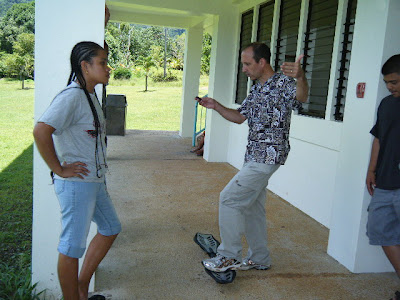
Annabelle watches as I explain what I am about to do

I began by explaining the set-up. The previous week I had measured the inter-pillar distance at 4.6 meters. As in the summer, I planned to use the full length of the porch to generate more data than the two points I had recorded last spring. This is in part a reflection of my increased confidence and ability on the RipStik. I have more control over my acceleration and a higher top end than I could attain last spring.


In my right hand is a chronograph
 I began slowly, gradually building up speed. Monalisa appears doubtful on the right.

As I passed each post I clicked on a lap timer that was keeping track of both lap and split times
I returned from the far end of the porch confident of a new final velocity. Adam on the right.
In this demonstration I accelerated the RipStik from rest over a distance of 36.8 meters. Data from the run is recorded in the first two columns below.

Time (s) Distance (m) dtheor (m) v (m/s) a (m/s²)
0 0 0 0 0.18
5.08 4.6 2.84 0.91 0.18
8.18 9.2 7.37 1.48 0.19
10.64 13.8 12.47 1.87 0.16
12.41 18.4 16.96 2.6 0.41
14.26 23 22.39 2.49 -0.06
16.04 27.6 28.33 2.58 0.05
17.29 32.2 32.92 3.68 0.88
18.28 36.8 36.8 4.65 0.98

Distance-theoretic is a crude calculation using only the 18.28 seconds, 36.8 meters data point to determine the coefficient for d = ½ a t². As my acceleration was not truly constant, this is not the best fit quadratic. That said, the coefficient suggests an acceleration of 0.2203 m/s².


The students were to work out the average acceleration from the speed between the first two posts (0.91 m/s) and the last two posts (4.65 m/s), using the time difference between 18.28 seconds and 5.08 seconds. This yields an acceleration of roughly 0.28 m/s². 


The table reveals that from 12 seconds to 16 seconds my acceleration dropped to a deceleration briefly. My velocity was briefly fairly constant.

Graph of time, distance, velocity, and acceleration data
Last spring I attained a peak speed of 1.78 m/s over a 9.2 meter swizzle. This past summer I hit 2.43 m/s over a 19.52 meter swizzle. This term I reached an estimated 4.65 m/s at the end of 18.28 meters. That said, there is likely little upside left as at 4.65 m/s on level ground I am swizzling just as fast as I can drive my legs. And I then have to jump off at the end at a speed nearly double my normal jogging speed.


The exercise always holds the rapt attention of the students. The result is perhaps a more traditional homework, but having the students attempt to do the riding would surely send the bulk of the class to the dispensary for scrapes, bruises, sprains, and possible fractures. None of the students admitted to being able to ride a RipStik, and given what I know of my students outside of class, I am rather confident that they are being honest with me.

Saturday, August 28, 2010

Nihco KSO, birthday, and Wone

A three picnic Nihco Saturday started off with a visit to the Raleigh Welly's birthday boy, celebrating his first birthday.


Gordon, Emliana, daughter, and the birthday boy.
Tulpe and her twins Sharon and Vanessa.

A second picnic celebrated Edwig Miguel's principalship at Wone Elementary school, Kitti, Pohnpei.

Edwig enjoys the moment with Daina to his right.

Jacelyn and her nephew.
 Rocketson Herman.
Making the power.

Volleyball.
Neelma and Chelsea.

The third picnic, hosted by the Kosrae Student Organization included a sleeping lady from the island of the sleeping lady.
Posted by Picasa

Thursday, August 26, 2010

Lycophyte and monilophyte presentations

Students in SC/SS 115 Ethnobotany gave presentations on the botany and local names of cyanobacteria and the primitive plants.

Antoinette and Monalisa present the moss life cycle.

Kimberly and Samantha cover lycopodium morphology including microphylls and strobili.

Dayne gives a lively presentation on the pronunciations of fern names in Pingalapese .

Elizabeth and Deisleen cover the dialectical sound differences on Pohnpei.
Posted by Picasa

Rolling balls and linear relationships

Physical science laboratory two was revised spring 2010 to include five different rolling ball speeds including a stationary ball. Coupled with a Monday RipStik time versus distance data gathering activity that led to a linear regression homework, the week now builds solidly on the concept of linear regressions introduced in the density lab the week before. The use of five balls speeds leading to five linear regressions provides a good basis for a discussion of how slope relates to velocity.

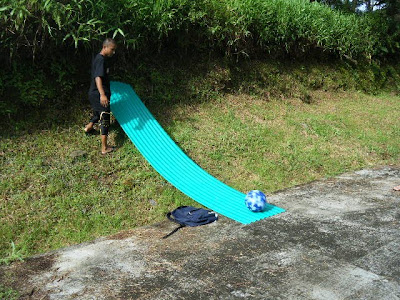
Ceasar releases the ball from the top of the ramp in an early morning run.

The roll from a quarter ramp was done by Ceasar and I only. I had broken up a branch of Albizia lebbeck and was using the pieces as timing marks while chasing the ball. Thus when the rest of the class rolled in between 0815 and 0820, the procedure of using sticks was was already in place.

As Loioshi calls out the seconds, Anna Belle leans in to place her stick. Evelyn waits for the two second mark to be called by Loioshi. Senioleen awaits the three second mark while Norma shifts left in anticipation of the four second location.
The above procedure ensures that the time is the independent variable while distance is the dependent variable. The traditional alternative records the time to a set of fixed distances. This should then be plotted with distance on the x-axis and time on the y-axis as the distance is being chosen first and then the time is being measured. That would, however, yield pace not speed. Some instructors go ahead and plot time on the x-axis and distance on the y-axis, but this then leads to bemuddlement of the concept of independent and dependent variables.


Angelo "throws down" on the five second mark in the 1100 section.


Loioshi enters the data into OpenOffice.org 3.2 running on Ubuntu 10.04 in the science computer laboratory. The course has a mathematical focus on linear equations and predictability; a writing focus on grammar, vocabulary, organization, and cohesion; and a technical focus on using spreadsheets and word processing software to produce reports that integrate tables and charts with text in a formal report format.
Posted by Picasa

Thursday, August 19, 2010

Wading, Waiting in the River

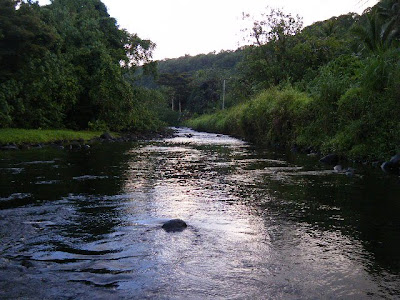
Wading in the dark river just waiting...

...waiting in the fading light of dusk knowing that it will come...

...waiting in the growing gloom sure that the water must push it exorably down the river...

...and then it appears.
Posted by Picasa

Ethnobotanical garden clean-up

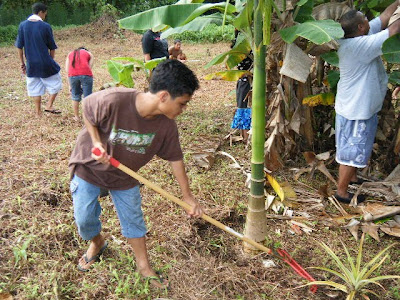
The ethnobotany class includes work on the Palikir student learning ethnobotanical garden. The garden was already cleaned up, possibly by groundskeeping crew members. This left only lightweight tidying up for the students to engage in.

Lanze working around the Areca catechu tree.

Nixon tends to a banana.

Kasinta continued to display strong knowledge of her traditional plants.

Rosalinda works while Deisleen and Strick make some decisions concerning the sugar cane plants.
Posted by Picasa

Density of Soap

Laboratory 01 in SC 130 Physical Science focused on the linear relationship between volume and density for soap. Harmony beauty soap with a density greater than one gram per cubic centimeter was used along with Ivory soap with a density of less than one gram per cubic centimeter. The soap was carved into square chunks so the volume could be calculated from length × width × height.


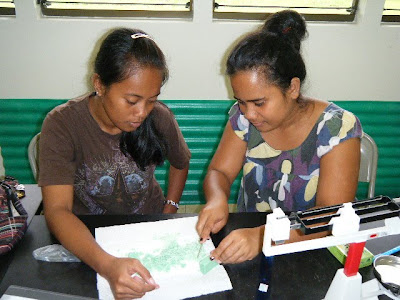
Sanolyn and Rihter carve their soap slab.


Loioshi and Evelynn mass a slab of Ivory soap.

Senioleen enters data into a computer.


While engaging in data entry, Norma experienced sudden and catastrophic failure of the computer she was working on. The monitor would prove to be functioning. On reboot the CPU issued a three beep POST code, a proverbial bell tolling.
Posted by Picasa

Monday, August 16, 2010

River Time

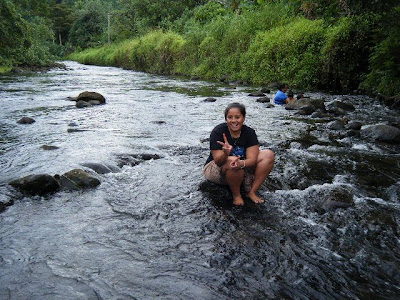
Tropical rain water is cooling but never cold. Liza in the river.

The smaller of the two with Shrue is the braver one.

Opportunities for styling in the water abound.

Posted by Picasa