Tuesday, November 22, 2011

Clidemia hirta

The SC/SS 115 Ethnobotany class went on a search and destroy mission seeking out the dark curse, Clidemia hirta, deep in the forest across the road.
 
Anthony points out a spreading patch of evil.
 

Mary Ann.


Barnson addes to a garbage bag held by LillyAnn.

LillyAnn and Maylanda.

When the class first sees a few small baby plants, they are initially convinced that their instructor has exaggerated the threat. When they encounter their first serious patch they suddenly comprehend the true threat that Clidemia presents.

Dana with Clidemia hirta.

Dana wraps up with a in-forest lecture.
Posted by Picasa

Monday, November 21, 2011

Floral litmus solutions

Physical Science SC 130 laboratory thirteen collected flowers and boiled them to generate floral litmus solutions. Some flowers generate solutions that function both as red and blue litmus paper simultaneously - that is they change to two different colors when a base or acid is added to the floral litmus solution.


John adds acid to his floral litmus solution, Merna Keller on the left. The laboratory uses a variety of local key limes as the known acid. Baking soda is the known base. Chemistry is a quick run from proton and electrons, basics of atomic structure, hydrogen to oxygen, and then the structure of hydrogen and hydronium ions, providing an attempt at a segue into this laboratory. This material always reminds me that physical science is a bizarre course, an assembled beast that has way too much material in it.


Brend adds acid to Spathoglottis plicata. Flowers that work as floral litmus solutions tend to turn magenta in the presence of acids. In the presence of bases the solution may turn blue, steel blue, green, dark blue-green-gray, or almost black.


Testing a basic substance. This term I remembered to bring in Alpinia purpurata which again worked extremely well. Experience had suggested that "waxy" flowers did not usually perform well in this laboratory. Although I was aware that the key compound which makes many of the flowers useful as litmus indicators are the anthocyanins, and that these are unrelated to the outer coating, my experience had been that waxy flowers on island either did not contain anthocyanins or they were hard to extract simply by boiling. Thus I was pleasantly surprised when the Alpinia yielded a full two-color changing litmus solution.


Lisa Lollaine and Ariel Maylea working with the unknowns. Once a functional floral solution is found, the students test of a variety of household compounds such as PineSol (yellow variant), ammonia, diluted bleach, drain openers, hand soap, and rubbing alcohol. The bleach has to be diluted or the color change is followed so quickly by a loss of color (the fluid is bleach after all) that the color change is hard to catch with the human eye.


Mindira and Moses check floral solutions to determine which, if any, detect acids and/or bases. Solenostemon scutellarioides (Coleus, leaf) was not available this year. The plant on the hill has died back. The Alpinia appears to be a good substitute.


Oneal checks unknowns. Much of the fun of this laboratory, if for no one other than myself, is to see how different flowers will react. Some flowers vary in their indication abilities with the time of day. Hibiscus tiliaceus usually does not work well early in the morning when it first opens. The flower works better by later in the day, closer to when it will fall off the tree in mid-afternoon.


Charleen Fernandez.
Alden Damarlane.

Saturday, November 12, 2011

Kosraean thatched hut build

On November 11 and 13 the Kosraean community assisted the Kosrae Student Organization in the rebuilding of their thatched hut.

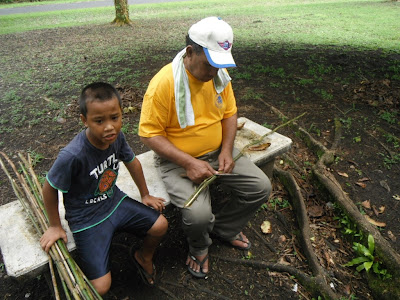
Kosraeans traditionally use dok as both needle and thread for thatching. Dok is a tall grass from high in the mountains that is neither Saccharum spontaneum nor Phragmites karka. I have yet to see the plant, let alone identify it. Neither S. spontaneum nor P. Karka can be be used for this. Thin strips are cut from the outer layers of the tall grass.


The fronds of Nypa fruticans, fahsuc, are used for thatch by Kosraens. They are always laid in pairs, except for rare expert thatchers who can handle three at one lay.


The fronds are wrapped around loa (Saccharum spontaneum), although here the women are using ac (Phragmites karka), but they do not usually use ac. This was a supplier communication error. In addition, there was insufficient dok for thatching. This is probably because the youth group who worked on gathering the supplies apparently did not realize that there was a third plant, dok, required.

Young Kosraeans often do not know the difference between loa and ac, some not knowing even the words loa and ac. Dok is a rare enough word/plant that I had not previously encountered it in seven years of teaching ethnobotany.


The ac (should be loa) is secured by the foot to start the thatch piece.


The end of the dok is tied in a loop to prevent pull-through.


Six fern tree posts form the base pillars. Images herein are chronological. Thatch weaving proceeded simultaneous to hut construction.


The dok is woven back at the end.


Ensuring the roof crown post is vertical. A four log frame is already atop the fern tree logs.


These cross-members are temporary to stabilize the crown posts.


In ancient times rope would tie things together, today bolts are used.


Extra timber along the base of the roof forms a double layer of timber. These lay on top of the cross-members at the sides.


A detail atop a middle fern post above and below.


 Corner post detail. Note that a second layer of roofing timber is being readied to be put in place.


Above is the first layer of timber for the roof. There are essentially three layers: vertical, horizontal, and vertical again.


Below the second, horizontal, layer is being nailed into place.


On top of that second layer is a third, again vertical layer, to which the thatch will be tied. Each layer is slightly smaller diameter wood from the mangrove, possibly called sakasrik.


The above marks the end of the first day of construction.


Ac and fahsuc above.


The above final timber will be tied on.


Thatch attaching.


The thatch is vertical spaced by the length of the fingers - one finger-length up for each new thatch sheaf.


Working on a wall.


Thatch tying detail.

For two days a team seen above has been producing thatch. Even after two days there is not enough thatch for the small hut.


End piece detail.


Awning frame is beginning.


Crown line will be steel sheet.