Monday, May 30, 2011

Space, Time, Matter

In the beginning, nowhere at no time was made of nothing. The perfect symmetry of absence was lost and a singularity became somewhere at some time made of something. Space, time, and matter came into existence.
  • Space is about choice. Forward, backward, left, right, up, or down. You can go any direction. Up to you.
  • Time leaves no choice. Relentlessly marching ever forward into the future. There is no going back. No left time, no right time. No up, no down. Only one direction. No choice.
  • Mass is the mystery. Mass has no direction. Mass has no forward, no backward. No left. No right. No up. No down. Mass simply exists.

  • Space is the questions how close, how far, which way, where am I, how high, how deep, how wide, how long. Space has lots of questions.
  • Time is the questions when, how old, how young. Time has only few questions.
  • Mass is the question how much. Mass has the fewest questions.

  • Space is near, far, over there, here, on, over, under, above, below, big, small, narrow, tall, short, wide, in front, in back, across. Space has many descriptors.
  • Time is now, never, sooner, later, forever, immediately. Time has a only few descriptors.
  • Mass is a lot, a little. Mass has the fewest descriptors. Mass is stuff. Stuff seen and, in the case of dark matter, stuff unseen.

  • Everything else is pure energy. Energy perceived and, in the case of dark energy, not perceived.

SC 130 Physical Science summer term 2011 starts on 01 June 2011 at 9:30 in room A101.

Students in the course will need a scientific calculator for this course. The text book is available in the book store.

I also recommend but do not require a ruler. Another recommendation, but certainly not required, is a digital watch with a built in stopwatch. The stopwatch is often called "chrono" for chronograph. A lot of physical science can be done with a ruler and stopwatch. Some cell phones have built in chronograph.

A final recommendation is sunglasses. Not for style, sunglasses are useful for viewing clouds and ice bows.

In physical science we study the inanimate world. Physical science includes physics, mechanics, statics, thermodynamics, earth sciences, vulcanology, geology, meteorology, climatology, sonics, optics, electromagnetism, astronomy, cosmology, and many more fields. There is too much to cover in a single term, and the amount of potential content exceeds what one could learn in a lifetime. Thus this class focuses on process more than on memorized content. Science is a process, a way of exploring the world, not a set of memorized fun facts to know and tell. Science is a way of thinking.

At the core of every science is mathematics, and mathematics will be a regular core feature of the class. Do not be afraid, mathematics is simply another tool science uses. Science often makes math more understandable.

Science is not science unless it is communicated. The course includes writing up laboratory reports using spreadsheet and word processing software. Laboratory reports are graded on content as well as on grammar, vocabulary, organization, and cohesion. This course will demand a lot of writing from you.

The course includes a focus on the potential use of physical science in the elementary and secondary school classroom. Some in the course are either in an education major, the child of a teacher, or will one day be a teacher - even if you do not now plan to do so.

  • In the end there will be only dark energy, dark matter, and black holes with singularities at their center.

Saturday, May 28, 2011

Between term break doin's

Between the term break is a chance to join me at the office and eat lunch from the cafeteria.
A time to hit the beach at Nihco.
And enjoy the warm, crystalline tropical waters.
The beginning of summer is a time of farewells to beloved teachers and mentors.
A time of change and of moving on.
Of impromptu take-out picnics on the causeway.
Time to drive trucks across the kitchen floor.
Or watch a movie on the SmartBoard after updating thirty Ubuntu 11.04 computers.
Or to simply enjoy a rainy afternoon nap.

Sunday, May 22, 2011

Ahser Edward one year anniversary of his passing

On Saturday the family, friends, and colleagues of Ahser Edward marked the one year anniversary of his passing away.
The one year anniversary is always contrastingly poignant. During the funeral everyone feels a deep and painful and sense of loss and sadness. At the first year anniversary my perception is that friends and colleagues have moved on. The deceased no longer occupies one's daily thoughts. Yet for the immediate family there is no moving on. The hole in their own lives is always there, ever present.
Some say that time heals, but sometimes the reality is that the loss never hurts less for the closest members of the family. The empty place never fills in. Maybe it does not always feel worse, but it does not ever really feel better. There is a disjunction between watching others move on while oneself cannot.
Yet even for those who feel the loss most intensely, there is the comfort of the next generation. 
A chance to hold and to hug, to love again. In new life is renewed hope, a chance to laugh and to play again.

Friday, May 20, 2011

Ubuntu Font

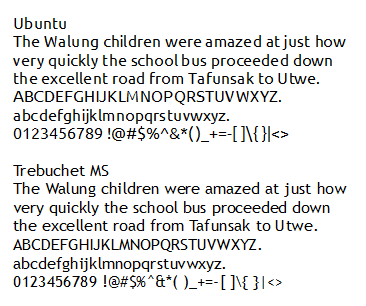
Starting with Ubuntu 10.10 the Ubuntu font family, designed by Dalton Maag, was rolled out. Ubuntu font is a sans-serif font reminiscent of Trebuchet MS, especially in the small tail on the lower case letter L. This may reflect the hand of Vincent Connare who had worked on Trebuchet MS for Microsoft and is now with Dalton Maag. The letter widths and spacing varies slightly from Trebuchet MS, but the two fonts remain close enough to be used in a CSS font stack as substitutes for each other.

On pages such as a syllabus that is actually a complex SVG diagram in HTML delivered as text/html (HTML5 if you will), having a font that will interchangeably behave in a consistent way between Ubuntu and Windows is critically useful. The office desktop on which I develop is a Windoze box, while the student laboratory is Ubuntu 11.04. Student laptops are also typically Windows boxes along with the library desktops.

Wednesday, May 18, 2011

Turning Two

Having only had one previous birthday, turning two is a big event.
 Turning two necessitates a fresh hair trim and head shave.
 Followed by some serious napping.
 And then, upon waking, barbecue chicken for the gas tank in order to provide the energy to...
 ... whack the pinyata
After cracking open Elmo - without cracking open anyone else's head - cake time was with Nemo and Dory.

 Followed by an evening playing with friends. Turning two is good.

Monday, May 16, 2011

Stages in life

Somewhere around service pack three the Nobilis computer moved into the hard drive thrash and churn stage of life. Half a gig of RAM was no longer sufficient for a service pack patched and bloated Windows XP computer. Not to mention the heat issues associated with a unit running in a non-air conditioned condensing humidity tropical climate.

A two gig kit brought the RAM up to where mission critical applications such as Don't Cry Joni play smoothly. System temperatures are back down and hard drive paging thrash is all but gone. For this little guy, there was always YouTube.

For mother's day Shrue crafted a traditionally cut and trimmed Kosraean muumuu from a pattern typical of a bygone era. The look is distinctly grandmotherly in a Kosraean way, which is also a stage in life. A couple of my ethnobotany students explored the differences in Kosraean church dress styles as a reflection of different ages and stages in life.
Sepe wore a blue dress that is stylistically from roughly three to four decades ago and is, simultaneously, might currently be worn by a septuagenarian. Robina wears a dress of contemporary cut and style for a young woman circa 2005.
My youngest begins the stage of giving a short note of thanks to her parents on mother's day in front of the congregation.

Sunday, May 15, 2011

An unofficial look at high school performance in the FSM on the COMET

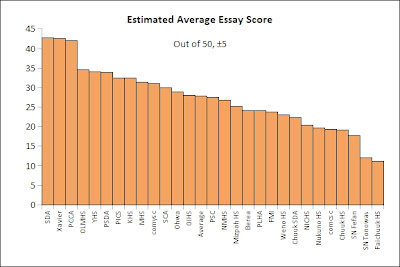
I recently received a copy of a preliminary report on the entrance test administered here at the college. While not all high schools were tested, and the data remains preliminary and tentative, the tables in the report once again provide insight into the relative performance of the high schools in the FSM.

The report consists of pages of tables filled with numbers. Being a visual learner, I decided to cobble together some charts. As I did not have access to the original data, my charts are only rough indications of the approximate rank order. While the rank order is thought to be roughly correct - the same data transformations were applied to all schools, the actual y-axis values are not likely to be correct.

 The essay score averages were reconstructed from classed data and as such represent only a rough estimate of the mean essay score by high school.
The reading grade level equivalent chart is the most problematic of the charts. The subtest is not designed to measure reading grade levels below seventh grade, although the interpolation tables for the subtest include reading grade levels below seventh grade. In addition, the frequency table from which I worked lumped together all students above the 9th grade reading level and all below the fifth grade reading level. This effectively artificially narrows the actual range of the scores.

Despite these multiple problems, the upshot of the data is that reading grade levels for the bulk of the high school students who sat the subtest remain below high school reading levels. This is not unusual given that the students are all ESL students working in English as an L2 language.
The math test chart cannot be connected back to a meaningful y-axis as course placements were reported not scores. The course placements, however, can be used to construct an implied rank order for the school - a relative standing based on percentages placed in courses at different levels.

Interpreting graphs and building mathematical models

The SC 130 Physical Science final examination included questions which tasked the student with reading data from a graph, interpreting charts, interpreting a mathematical model from data, and plotting data on a graph followed by finding the slope for the data.

These questions sought to examine student learning outcome 1.2 for the course, the ability of the students to generate and work with mathematical models for physical science systems. The questions also sought to provide information on general education program learning outcome 3.2, present and interpret numeric information in graphic forms.

Thirty-four students sat the final examination.

Interpreting graphical information

The students were presented with a time versus distance xy scatter graph as seen below. The graph shows the motion of three different marbles. The marbles are labeled A, B, and C. All three marbles start from a time of 0 seconds and a distance of 0 centimeters.

Students were asked:
  1. Which marble is slowing down?
  2. Which marble is speeding up?
  3. Which marble is moving at a constant speed?
30 of the 34 students answered two and three correctly. All 34 answered number four correctly. The students can infer physical results from data presented in graphical form.

The students were then asked,
  1. What is the speed of marble A between five and nine seconds?
  2. What is the speed of marble B between four and eight seconds?
  3. What is the speed of marble C between five and eight seconds?
28, 24, and 26 students resepctively answered these questions correctly. At least 70% of the students can calculate a slope from data presented in graphical form. Slopes are the basis of the mathematical models in SC 130.

In question eleven he students were asked to determine whether a data set is linear or non-linear.

Extension (cm) Force (gmf)
0 0
3 15
6 30
9 45

11. Section five force: Data was gathered for the extension of an elastic band using a cup and marbles to generate the force. The data in the table is from the experiment. Is the elastic band a linear elastic material?

33 of the 34 students correctly determined that the data is linear. 23 students went on to correctly use Hooke's law to determine Hooke's constant for the system.

For question 28 the students were given data in a table and asked to plot that data on a blank graph. 32 of the 34 students correctly plotted all six data points. The other two students plotted all but one data point correctly. Students can plot data on a graph. 26 of the 34 students (76%) then correctly calculated the slope of the line for their data. The most common error was inverting the slope.


Students who have completed SC 130 physical science can read and interpret graphical information, comprehend the mathematical models implied by data and charts, and  they can plot data generating their own graphs.The SC 130 curriculum supports general education program learning outcome 3.2 and the course student learning outcome 1.2. An assessment on other aspects of the course is available.

Tuesday, May 10, 2011

SDA School fair

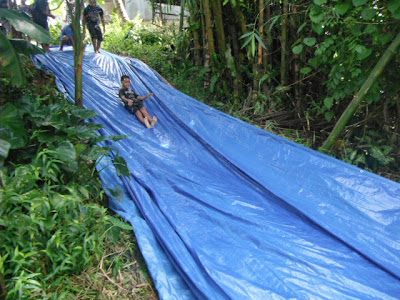
The fifth grade set up a water slide in the jungle. While not Noah's Ark Water Park, the slide was the biggest slide in the Federated States of Micronesia.


One option was to slide down on the dolphin, resulting in lots of excess speed.
Styling! 

Nurses Week Walk-a-Thon

The Pohnpei state hospital nurse's organized their annual Nurse's week walk-a-thon. This year the theme of the week is "Be active, eat smart, lose weight, and get vaccinated!" The specific goal of the walk-a-thon was to help people put in their 10,000 steps per day.
Lois, Bernolina, Emihner. On the right, Fitz. Island Food Community provided the bananas for the walkers. Thanks to Lois and Emihner!
Elena Yamada arrives with a running and police escort. The route included an added leg out to Lidakida beach road, pushing the distance up to somewhere between five and six kilometers.
The route headed out from the Pohnpei state hospital.

A right turn and onto the circumferential road past Genesis.

 Jeanette and Joanie Lane.
 Heading Kolonia-ward towards the bridge.
 Past Tony Nakasone's place.
 And up Etscheit hill. Jazmin headed for the finish line.
Over the hill and down into town.
Past Noel Boylan's office building.
Despite the early morning start, the day was already warm according to the Ace Hardware temperature reading.


The run continued out to Lidakida beach. Inbound the route turned right at Mesenieng and climbed up to the Spanish Wall ball field. From there the runners headed south towards AMCRES where a right turn took us east towards Pohnpei campus.
 The water stop crew at capital hill. After this water stop, the route went down to 4TY and then a right to return to the hospital.
 Bernolina addressing the returned walkers after the run.