Friday, January 28, 2011

Acceleration of gravity

Laboratory 032 involves timing the fall of a ball to determine the acceleration of gravity g. The students drop a small superball from heights of 100 to 300 centimeters inside the classroom.

Sylvia holds a super ball while Caroline and Tracy Ann steady the meter sticks. Irene looks on.

Laboratory 032 now builds on two earlier activities that during a regular school usually occur on Monday and Wednesday respectively. The first activity was a plot of time versus distance for an accelerating RipStik.

Angie holds the meter sticks, Brilinda drops and times.


The students graphed the time versus the distance for the RipStik and found a non-linear relationship (curved line) between time and distance for the accelerating RipStik.

Jermis holds the tape measure as Fritzgerald releases the super ball.

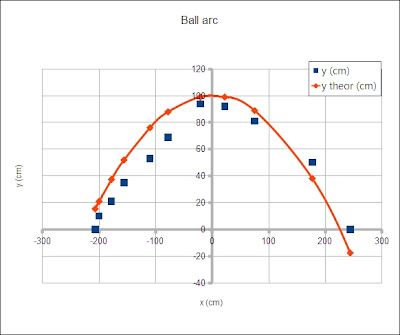
In the second activity, the arc of a ball, the students explored whether the trajectory of a ball might be related to a parabola. A quadratic equation was presented as the underlying mathematical relationship. The students graphed their data and the equation to explore whether the ball arc and the equation were related.


These two activities built into this laboratory where the specific mathematical relationship nature of time versus distance for a falling ball was measured.This term featured the approach of calculating ½t² for the second table and then graphing only the second table. This was also the first term to spend the second portion of the lab period in the computer laboratory. The lab was a solid, wall-to-wall three hours with no break.

Antionette Ardos enters her data


Not graphing the first table left it unclear to the students that the data was inherently non-linear, but as in past terms, the first table was only visibly non-linear due to (0,0) and the 500 cm drop data point. The data from 100 to 300 has such a small amount of curvature as to appear linear given the errors. There also appears to a be a human penchant to increment the times linearily, although how this happens in practice escapes me as the students are reading their stopwatch times. My hunch is that the students are more likely to discard and then repeat a measurement that is not a linear step up in time.

Note that the summer approach of assigning teams to work at specific height was not deployed this term. Encouraging students to compare data between groups, and doing some comparison work myself, appeared to help correct timing errors. There were, however, as always, some groups that slipped past my attention and had serious timing errors in their data.

Also new this term was the use of WolframAlpha to determine the latitude and longitude of Pohnpei and then to use that data to determine the acceleration of gravity on Pohnpei. This value was then provided as the theoretic value against which to check the experimental value. My sense was that most of the students did not understand this portion of the exercise and that I will have to go back and cover percentage difference more carefully.
Kasinta and Ester wait for the ball to be dropped.

Plants of Pohnpei Ethnobotanical Garden Visit

The SC/SS 115 Ethnobotany class visted the Pohnpei Traditional Plants ethnobotanical garden at the Pohnpei campus. This term Totoa had Ben lead the presentation. As I had explained to the class, ethnobotanical knowledge resides within a cultural and linguistic context. Having Ben present the plants in the language of their usage on the island on which the field trip was held was most apropos. The students had the opportunity to experience ethnobotany as an ethnobotanist might on an initial visit to a foreign culture.


Toa provides an introduction to the garden, explaining the purpose and intent of the garden as a place of learning and cultural conservation.


The class was by and large attentive. The loss of knowledge continues to be evident term-to-term as fewer and fewer students are able to name the plants of their islands and fewer still know the uses. A couple days later only a single student recognized kadiring in class. 
The class consists of twenty-eight students, three from Yap main island, two from Chuuk, none from Kosrae per se, one of Pingelapese heritage, one Pingalapese-Kosraean-Palauan, and the rest of the class are Pohnpeian.
Ben then led a guided \tour of the plants of the garden.
Ben covers the uses of Liwekkidenol (Glochidion marianum). Jilted by the one who made your stomach happy? This is the plant you need to achieve forgetfulness.
Skin fungus a problem? Tuhhke en kilinwai is the cure for you (Senna alata). Also useful for general itchiness of the skin. Rub young leaves on one's skin while bathing to reduce the itchiness.


The class owes an ongoing debt of gratitude to Toa and Ben for their assistance each term in starting off the ethobotany class on solid footing. Thanks too are due to Pohnpei campus for sharing the traditional plants of Pohnpei garden with the class!

Artzooka: Minions

My son has been much taken with Artzooka. What was once trash is now treasure, much to the consternation of his mother. His latest effort is Minions.
 Bottle caps form the eyes, the body are toilet paper tubes. A women's razor was repurposed as a nose.


The arms are corks from Wollersheim winery. These are a rare treasure out here on Pohnpei and I expect his supply is exhausted with these three minions.

Each minion is armed with a blue pan.

Thursday, January 27, 2011

Arc of a ball

Exercise 031, the mapping of the parabolic arc of a ball, was modified this term. I wanted more data points than the exercise traditionally generates. Last fall I hit upon the idea of keeping the arc wholly on the white board and using an army of students with markers to capture the ball arc data points.

x (cm) y (cm) y theor (cm)
-207 0 15.36
-200 10 20.99
-178 21 37.41
-156 35 51.93
-110 53 76.1
-78 69 87.98
-21 94 99.13
22 92 99.04
75 81 88.89
177 50 38.12
244 0 -17.6

I repeated this again this term, although the marks were not as accurate as I might have hoped. I also did not leave enough time to explain the theoretic function, how to enter it into a third column in a spread sheet, and then graph the actual data and the theoretic curve on the same chart in a spreadsheet. With 34 students, checking homework took longer. Although the homework check uses time, it also provides a valuable opportunity to see what each and every student is able to do and not do.
The third column of the table is to include the theoretic values based on the equation in the book.The homework was to generate the graph and describe whether the equation appears to well match the actual path of the ball in the air. Is the arc actually described by a quadratic equation and thus parabolic? This term the data leaved much to be desired - the ball wandered through the air.

Tuesday, January 25, 2011

RipStik Accelerated Motion

In a previous article I shared the use of a RipStik in SC 130 Physical Science to demonstrate linear constant velocity motion. The ability to generate a relatively constant velocity by swizzling at a constant rate on level ground was useful to that demonstration. 

This term the non-linear motion of the rolling ball in laboratory two had already set up the concept of curved lines as changing speeds on a time versus distance xy scattergraph. This permitted me to move directly to data gathering for an accelerating RipStik.
This term I was rusty and did not generate the same top end as I have in the past. At the end of the run I simply "ran out" of acceleration capacity.

Pillar Time (s) Distance (m) Velocity (m/s) acc (m/s²)
one 0 0 0
two 4.05 4.6 1.14 0.28
three 6.91 9.2 1.61 0.17
four 9.19 13.8 2.02 0.18
five 10.66 18.4 3.13 0.76
six 12.44 23 2.58 -0.31
seven 13.85 27.6 3.26 0.48
eight 15.23 32.2 3.33 0.05
nine 16.66 36.8 3.22 -0.08

Although my acceleration changed during the run, overall the acceleration held close to 0.20 m/s² The run was no where near as good as the one last fall, but then this is 2011 when anything that can go wrong will go wrong at the worst possible time and worst possible way.
A closer look at the velocity versus time suggests that the acceleration was roughly constant up to the third pillar, and then further acceleration was inconsistent.
Given that the fifth column realigns with the constant acceleration, the data suggests steady acceleration should be possible over the first four to five columns but not beyond. Slower acceleration rates might also be an option, but might be harder to maintain. Some form of beats that increase steadily might help the rider increase speed in a steadier fashion.

Speeding and playing

Over the weekend data was gathered for use in statistics class using Bushnell Speed Radar Gun. Local law enforcement does not have speed guns, although the Sokeh's police had, to the best of my recollection, a speed gun at a couple different times in the past. On Pohnpei state code 71 PC 8-129 specifies a speed limit of 25 miles per hour which is 40 kilometers per hour.

Sitting on the causeway with view to a radar kill shot.

Given that drivers are keenly aware of the lack of speed detection technology, what speeds do drivers choose? The results are in the table below for two locations.

Causeway (kph) Hospital (kph)
40 74 30 25 55
68 60 34 41 34
61 30 53 38 29
30 55 40 27 46
32 44 41 49 39
61 68 32 29 35
58 43 39 31 36
36 54 77 28 55
41 26 44 39 48
35 78 61 39 37

Speeds are higher on the causeway, however that is a longer straight stretch than the one in front of the hospital. The one driver who hit 78 kph (48 mph) is not only over the speed limit, but way above a safe speed for any road on Pohnpei.

Meanwhile, a sports kit sent from Wisconsin is getting better use in Pohnpei in January than it could in Wisconsin at this time of year.
 He is working out whether he is right handed, left handed, or simply ambidextrous.
 He opts for left handed.
Yes, the cars tend to clutter the yards on a small island. And the coconut trees can catch a badminton birdie.

Lycophyte and monilophyte presentations

Students in SC/SS 115 Ethnobotany gave presentations on the botany and local names of cyanobacteria, lycophytes, and monilophytes.
 Vanessa and Julie Ann present plant names in Kosraean and Pingalapese. Julie Ann noted that the Nephrolepis fern called rehdil in Pohnpeian is actually called neiniko in Pingalapese. Her source for this was Mihner Ioanis, her grandmother.
 Jasmine and Jayheart covered the life cycle of ferns with a well done diagram.
 The life cycle of ferns diagram was one of the better ones I have seen over the years.
 Juanita and Lewis covered fern morphology.

Saturday, January 22, 2011

Rolling balls and linear relationships

This spring laboratory 022 was the first of the even "no write up" laboratories. Until this term, student's wrote up every laboratory as a full laboratory report. The reports were then marked for content, grammar, vocabulary, organization, and cohesion. The work load for the instructor, roughly 14 laboratory reports per term, was heavy. With 32 students, the instructor faced hours of grading every weekend, not including work load associated with their other courses. Making the course acceptable to other faculty in the system required reducing the enormous work load.
The eight o'clock class on a wet morning rolls the ball, students lined up to locate the ball at one, two, three, four, five, and six seconds.

This term only the odd numbered laboratories are written up, which cuts the number of laboratories to be marked in half. The unanswered assessment question is whether the writing benefit will be retained. The complication is that only grammar has ever shown a statistically significant improvement.

Alwihter holds the end of the tape at the 800 cm mark. The tape is only 800 cm long, so beyond 800 cm the tape is moved to determine distances.

In laboratory 022 the location of the ball at each second is marked by a different student. Then the distance to the timing mark is determined. This makes the time the independent variable and the distance the dependent variable. As often done in physics, the distance is preset and becomes the independent variable, with a timing determining the time to that fixed distance - such as a photogate.

Angie releases the ball from a quarter way up the ramp, ShirleyAnn is calling out the times.

The ramp permits rolling the ball at a specific velocity that can be repeated. This allows the timing markers to stand near to the correct location for their particular number of seconds. Only a single timer is actually needed, one student calls out the seconds while watching a stopwatch or other digital second timer. This also means that one does not need hundredths of a second.

The wet ground and slight north wind saw slowing the ball on all runs

The ball distinctly slowed down both in the morning and afternoon sections. In the past 022 has provided an example of linear, unaccelerated motion. This term the laboratory failed in this respect. The failure, however, was not as problematic for the curriculum as the failure might have been.

Using the RipStik, I had demonstrated constant velocity motion on Monday. As a result, 022 became an opportunity to focus on what happens on a time versus distance graph when the velocity is decreasing with respect to time.

On Friday quiz 024 was able to exploit this accidental enrichment. Next week's accelerated motion will also benefit: the student's should be able to predict the nature of the curve for my accelerated RipStik demonstration on Monday. That will lead to a homework assignment to confirm that acceleration occurred. The homework will also be able to include, building on questions seven and eight on quiz 024, the pillar-to-pillar velocity.
An overview of the layout of the laboratory

The laboratory was wrapped up by graphing the data in the field and discussing the resulting curves on the paper. Ideas such as tangents to the line, speed between timing marks were introduced.

Without the computer laboratory second half, the laboratory could use some further enrichment and development to really bring forward the idea of the mathematics as making predictions. Maybe the class could be asked to predict the distance based on the particular release height? The complication is that one would have to work graphically - the data was simply not linear this term.
1100 laboratory results

Wednesday, January 19, 2011

Libraries must always change

Since working on the vision statement for the LRC in 1993, I have always felt that libraries should be the information heart of the campus. Today's library is not necessarily contained within a building as evidenced by Greene, Roser, and Ruane's The Anywhere Library. As a preparation towards serving on an ad hoc committee at the college, I felt it prudent to bring myself up to speed on the changing role of libraries in the digital age and the implications for the college LRC.

I might not tackle the Association of Research Libraries 92 page scenarios for research libraries in 2030 (although I did download it), but there is an abbreviated article on it in the Chronicle.

I did enjoy the 2003 "What libraries can learn from bookstores" but I realize that few college libraries are prepared to serve coffee and cinnamon to their patrons. Still, thinking in terms of "what if the library had to survive based on the money its customers spent" is an interesting exercise. What might the LRC do to attract patrons, not just students in search of a place to check their social media sites.

To catch up on current events in libraries I am reading the Association of College and Research Libraries blog and an excellent blog by the Philosophy & Religion Librarian at Princeton University. In "Libraries Never Change" Wayne Bivens-Tatum quotes Grace O. Kelley:

The library, even more than other institutions, seems not to have been altogether a true part of the social process. In some way, it has been switched out of the current of social change, occupying a niche or eddy of its own. For a long time it seems to have been but slightly affected by the forces which have been changing the rest of the world. One looks in vain in histories of culture and education for studies of the modern library as an active force which is making its impress upon the social fabric. Due to the nature of its organization and of its service it has been possible for it to continue to function largely on its original indefinite ideals and, in a sense, to let the modern world go by....

Not only our knowledge of the world, but the world itself, keeps changing from day to day. "The inescapable drive of change under the accumulation of ideas and traditions, under the relentless impacts of science and invention," make a fixed regime impossible. "An industrial civilization founded on technology, science, invention, and expanding markets must of necessity change and change rapidly." Any institution which does not change too, adapt itself to the times, and become part of the onward "drive of change," will be pushed aside to be left perhaps for a time to make a harmless life of its own.
Grace Kelley wrote those paragraphs in The Library Quarterly, Vol. 4, No. 1 (Jan., 1934). No, I did not type that wrong, the year was 1934. The need for libraries to change, to not remain a fixed regime, to adapt to the relentless impacts of science and invention is a permanent state of affairs for libraries. 

Tuesday, January 18, 2011

Underage RipStiking

The packaging clearly says for children eight years old and older. And a best effort is made around the house to ensure that riders are of the appropriate age. In theory a younger rider will have a lower body-to-board weight which ought to lead to less ability to control and propel the board. Someone forgot to tell one of the denizens of our domicile that they were too young to learn to ride, let alone to ride a RipStik.
And not just a little younger, fifty percent younger. Four years old. And ripping the new arrivals parking lot at the airport.
Yes, she is not wearing the latest from Fallen. Those are zoris, flip-flops for those living to the east of the international dateline. Learning to ride, to "wiggle" as she says, without coming out of your zoris, let alone remaining upright, is a serious skill set to master.
Meanwhile, also enjoying the smooth ride provided by Penta-Ocean were pair riders.
No RipStikers were harmed in the process of obtaining of these images!

In a nod to The Cat in the Hat, I demonstrated to my physical science class that I can ride a RipStik, lecture on linear velocity, and take a social media profile self-portrait all at the same time. And that is not all I can do, no, I can do more... as the Cat said...
Behind me one of my students is laughing at me... but then, as Seuss asked, what would you do?

Monday, January 17, 2011

RipStik in physical science: linear motion

To demonstrate linear motion while retaining some modicum of attention span from my social media saturated students, I rode a RipStik along the sidewalk in front of the laboratory. The activity is built around the linear relationship between time and distance for an object moving at a constant velocity. Thus my goal is to retain a constant velocity over the 36.9 meter distance.

Time (s) Distance (m) Pillar-to-pillar velocity (m/s) Acceleration (m/s²)
0.00 0.00

3.30 4.60 1.39
6.54 9.20 1.42 0.01
9.97 13.80 1.34 -0.02
13.14 18.40 1.45 0.03
16.10 23.00 1.55 0.03
19.32 27.60 1.43 -0.04
22.74 32.20 1.35 -0.02
25.86 36.80 1.47 0.04

The times were obtained by using a stopwatch to time the passing of pillars that are 4.6 meters apart.
Click on the chart to view a clearer image

The time versus distance data has a linear regression slope of 1.43 m/s. My velocity varied above and below that value by about seven percent. The acceleration data indicates only small variations in acceleration over the run.

The data was gathered in later one third of the period, the students are given as homework the task of plotting the data, determining the slope and thus the speed of the RipStik. The students are not asked to find the pillar-to-pillar velocities and accelerations, although that would be certainly be appropriate for a physics class. The class is a physical science class that is a survey of the physical sciences from mechanics to cosmology and all points inbetween.

The data is available in Google Docs spreadsheet.

Sunday, January 16, 2011

Madorun

Saturday afternoon was sunny with a strong breeze running off of the ocean. Saturday was also the day a good friend and long time colleague was interred on Kosrae. Had he been a drinker of sakau, I might have had a circle of partners to join over a cup and talk story. He was not, however, a partaker of the slimy concoction. Over the years I had known him, outside of work he kept to his home life.

With his entire family over on Kosrae for the burial, I felt a sense of emptiness. The past thirteen months has seen a number of friends cross that final frontier. Benson, Iris, Ahser, Wilson, and now Harvey. Not being able to be at his graveside mourning, I did what I always tend to do when loss hurts. I ran. I ran down the hill. Down to the river. And I kept on running.

From the start  at 14:44 I ran slowly in the heat of the afternoon, not reaching The Village until just after four. The Madolehnihmw border slid past me at 17:11 and I reached the ESDM school at 17:31.

Sunset finally ended my run three hours after starting, and I collapsed into the grass on a knoll above a church on top of a larger hill in Kinakapw, Madolehnihmw. I cannot say I felt any less of a sense of loss for the effort. Only that three hours of running in equatorial sun, heat, and humidity brings a sense of pleasant exhaustion. I also enjoyed the many who called out my name, invited me to sakau, offered me dinner, or shouted "Kommoal!" as I ran past. I was reminded that although I may one day live elsewhere, this is where I feel welcomed and at home.

Somewhere out in U I realized that if I should be so fortunate as to one day keel over while running, I should be honored to be buried right where I fall, for clearly that would be the place chosen for me to "kommoal" in the most final sense of the word rest. I wonder what the local laws are concerning road side graves?

Ethnogardening

The ethnobotany class includes work on the Palikir student learning ethnobotanical garden. The garden is now being weed-whacked by the grounds crew at the college. As a result the course has acquired more rakes and hand cultivators and shifted from grass whacking to generalized cleaning.


The class started with a walk-though introduction to the plants in the ethnobotanical garden. Identifying the plants and their uses is the core to the final examination.

Cleaning around the Saccharum officinarum
Hertin mans a rake

Density of soap

Laboratory 01 in SC 130 Physical Science focused on the linear relationship between volume and density for soap. Harmony beauty soap with a density greater than one gram per cubic centimeter was used along with Ivory soap with a density of less than one gram per cubic centimeter. The soap was carved into square chunks so the volume could be calculated from length × width × height.
Carving the soap in a rectangular chunk

The class began with the Freeman Dyson quote:
For a physicist mathematics is not just a tool by means of which phenomena can be calculated, it is the main source of concepts and principles by means of which new theories can be created... ...equations are quite miraculous in a certain way. ... the fact that nature talks mathematics, I find it miraculous. ... I spent my early days calculating very, very precisely how electrons ought to behave. Well, then somebody went into the laboratory and the electron knew the answer. The electron somehow knew it had to resonate at that frequency which I calculated. So that, to me, is something at the basic level we don't understand. Why is nature mathematical? But there's no doubt it's true. And, of course, that was the basis of Einstein's faith. I mean, Einstein talked that mathematical language and found out that nature obeyed his equations, too.
At the start of the class I noted that if the density of the soap was less than one gram per cubic centimeter, the soap would float. If the density of the soap was more than one gram per cubic centimeter, then the soap would sink. The density would be determined from the slope of the graph later in the class period.
Alwihter masses a chunk of soap

I also included a quote from William Gilbert on the need to perform experiments and when experimenting to "handle the bodies carefully, skilfully, and deftly, not heedlessly and bunglingly."

 ShirleyAnn masses Ivory soap which has a density less than one

This class also provides an opportunity to introduce the mass balance and measuring in centimeters. After gathering the data on the length, width, height, and mass of the soap, the class moved upstairs to the computer laboratory to plot the data and determine the slope of the best fit line.

 Entering data in the computer laboratory using Ubuntu and OpenOffice.org software

The class does not presume prior knowledge of linear regressions, on the contrary the class teaches the concepts of slope and intercept through the science encountered in the class.

Only after the students work out their slope data do I ask them to predict what their soap chunks will do when dropped into a beaker of water. Each makes a prediction. Then I drop the Harmony soap chunks into the water, followed by the Ivory soap chunks. As Dyson noted, the students made a mathematically based prediction and the soap knew what to do.