Thursday, September 30, 2010

Clouds

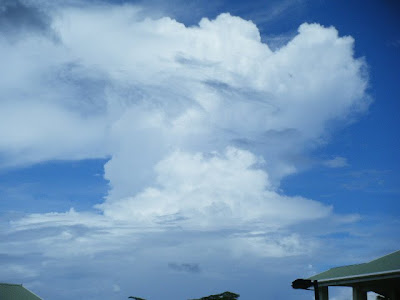
Mornings of late have featured isolated builds of cumulus and cumulonimbus, everything from congestus to castellanus and capilatus incus. All photos are from the Palikir campus of the College of Micronesia-FSM on Pohnpei.

Aye, there be a temperature up there, me matey!

Early morning post-dawn sun lit up this top directly overhead early in the morning. Spectacular. Always remember to look up once in a while. Just a hint of a pileus at the very crown of the cloud.

A tower building west of campus while low level fractus scud slides into the top of the frame.
Posted by Picasa

About the house and town

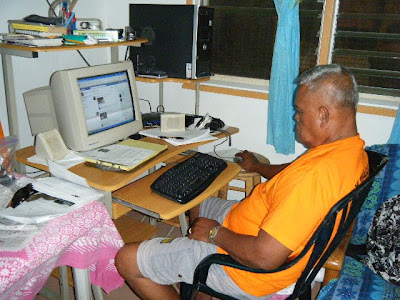
FaceBook brings generations to the computer who might not have previously considered using computers outside of the work environment.

Food tastes better when worn or when found on the floor.

The Police Academy out for evening physical training. Kampare!

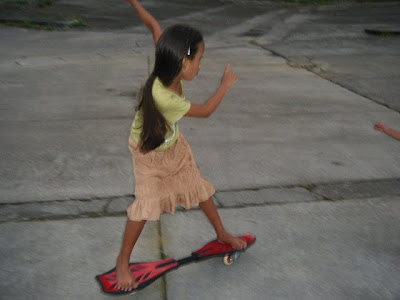
The new RipStik rider in the house. The family that Rips together, Stiks together.
Posted by Picasa

Ethnobotany class visits Island Food Community of Pohnpei

The SC/SS 115 Ethnobotany class at the College of Micronesia-FSM visited the Island Food Community of Pohnpei to learn about the importance of local food, or as is said now around Pohnpei, "Go local!"

Emihner Johnson presented background statistics on the health crisis facing Pohnpei. In 1949 a health survey found zero cases of diabetes among the population on Pohnpei. Now one in three adults have diabetes, rates of cancers which may be in part linked to dietary choices are on the rise, along with heart disease.

A change in diet and a shift to a more sedentary lifestyle are known to be proximate causes of the health crisis. Indeed, the Pacific Island Health Officers Association declared a state of health emergency on May 25th 2010.

Ms. Johnson drove home the aphorism, "Plant, grow, harvest, cook, and eat!" The class also learned that growing and eating local has important positive impacts for Pohnpei, captured by the abbreviation CHEEF:

Culture: local food nurtures culture
Health: local food keeps one healthy
Environment: local food is biodegradable (as opposed to imported food which comes in substantial packaging)
Economy: local food promotes the local economy and increases the gross domestic product
Food Security: local food would be critically important in the wake of an emergency, local food is also safe food - no additives.

Ms. Johnson then presented information on the beta carotene content of various local foods, contrasting the abundance of the vitamin A precursor in local foods and the absence in rice. As a substitute for local starches, white rice has been a devastating choice for Micronesians and their health.

The de-valuing of local food has not just occurred on the home front where imported rice and bread made from imported flour have become staple starches. In the nahs during a kamadipw food is no longer served in a local basket, and the food is often not local food. In the past the kings were presented the best of the local food in a locally made basket such as a kiam. Today at many kamadipws the king is served food on a plastic tray, often including imported foods.


After the presentation the class toured the banana collection at Island Food Community in the Pwunso botanic garden. Ms. Johnson explained the importance of each of the many varieties of banana in the garden.

For those unfamiliar with bananas, there are dozens of varieties of bananas each with their own unique flavor. The rise of the monoculture of Cavendish bananas is one of the great tragedies of the modern world. Many of the local varieties are not only brightly colored, but also loaded with nutrients. Island Food Community has been a global pioneer in bringing awareness of the nutritional value of some of the unique varieties of bananas found in these Pacific island.

The class was deeply thankful for the information gained in the visit to the Island Food Community. Eat a banana and become happy!
Posted by Picasa

Latitude and longitude: meters per minute

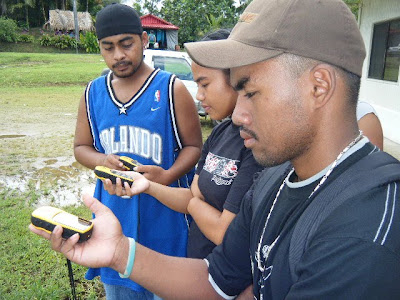
Laboratory 072 began with resetting the GPS units. Brian, Sussy, and Joshua reset the tripodometers on their GPS units.

Yvonne Sue heads down the new sidewalk with the surveyor's wheel, Adam and Tellez in tow.

Joshua follows remains on his line of longitude, tracking due north through the parking lot.

Sussy approaches N 6° 54.593' while walking north on the E 158° 09.564 line of longitude. Data gathered in the two sections is in a Google docs spreadsheet.

Modified the lab and rubric to include an error analysis on the circumference of the earth which I calculated in class. Three years ago this was left as an exercise for the students. The students were unable to complete the task. A year and half ago I dropped the circumference calculation. Slightly better preparation on Monday and Wednesday have encouraged me to reinclude the error analysis task, but using the calculated circumpolar distance determined by me in class.
Posted by Picasa

Gymnosperm, angiosperm, economic botany presentations

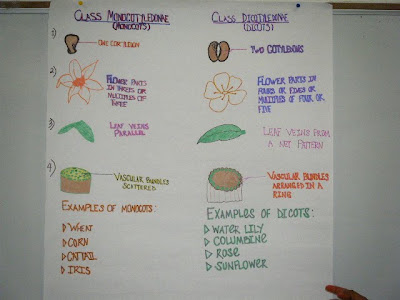
The SC/SS 115 Ethnobotany class students gave presentations on gymnosperms, angiosperms, and plants with economic value. Rophino and SepeBrianna made a particularly good poster on monocots versus dicots.

Amilain and Elizabeth did a superb job of demonstrating the periderm, phloem, and xylem layers using Hibiscus tiliaceus. Elizabeth even found a very thin, translucent layer between the phloem and xylem that may indeed have been the cambium.

Deisleen presented on black pepper, a locally grown plant with both economic value for Pohnpei and an unfortunate history on Pohnpei.

Kasinta did a fine job presenting cinnamon.
Posted by Picasa

Saturday, September 25, 2010

Asher family Nihco picnic

Under the inspiration of Jack Asher, the Asher family held a family gathering picnic. Odd for a Saturday, Nihco was all but empty.

Jack Asher
Reverend Nena Kilafwasru and Jusda Elesha Kilafwasru - daughter of Sepe Intuvius Asher
Myself with a granddaughter of Mada Asher Kim
Two more Asher progeny
Shrue Kilafwasru Lee Ling,

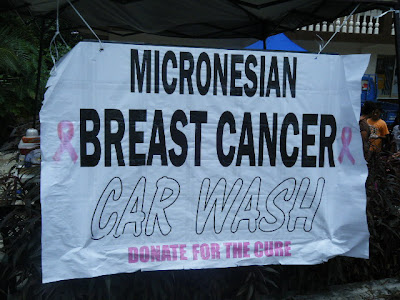
Car wash in support of the cure

In support of the Susan G. Komen foundation, a local crew held a sponsored car wash here on Pohnpei. This was the first such event that I can recall occuring on Pohnpei.

My 16 year old market marauder is held together by Kitti mud, washing it is not necessarily recommended. Even the wash crew were surprised at the amount of mud caked under the chassis.


Lloyd washes the tires. There are no hub caps on my car.

Not much need to blur out the license plate around here. Angelina rinses the car down.
Free snacks and drink were provided at the car wash.

Tamaroaloang o Dien

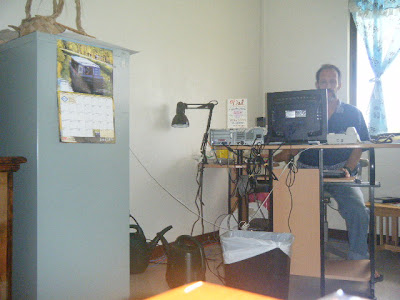
Marking statistics papers at a desk on Friday afternoon sitting in an air conditioned office is something that an instructor could be doing anywhere. Buried in the midst of seventy-nine papers, with sixty-four physical science papers yet to go, there is nothing particularly special or different from the hundreds of other community college professors out there marking papers on a Friday.
Outside my window, however, a tropical sun blazes in a blue sky, and the leaves on the trees are not changing colors with the seasons. Still, I could be in southern Florida but for the yonder hills of Palikir.
There is, however, also outside my office window the following scene which cannot be found stateside.
The ramshackle collection of tin roof perched atop tree fern posts might not look like an evening hot spot, but make no mistake, in upper Kitti Tamaroaloang was the place to be. With Tamaroaloang the only operational market between One Eye in Paies and Na-Na in Enipein, Tamaroaloang was way oversubscribed.

As with any Club 54 in its heyday, only insiders had a shot at sakau in this market Friday night. Jason ensured that I was well supplied and cared for.
The market is friends, family, current and former students, and strong sakau. A place where one does not have to introduce oneself, everyone knows your name, and you know theirs.
With high demand, low prices, and limited supply, the evening ends early in Tamaroaloang. On the way back into town a stop to visit more family and friends up in Dien.
Elwel "Nankoi" Samuel enjoys a cup of fine Kosraean sakau.
Deisleen and Feliciana Spencer.
Kosompaul.
Men pounding root with rocks on rock - another site that would be unusual anywhere else. The office in which I work may be generic, but the world outside the office window is a wonderful place filled with people I know, lives which have touched mine and become a part of my own extended family.

Thursday, September 23, 2010

RipStik Evening

Still riding using the full swinging arm technique, some kind of conversion of arm-swing rotational energy to foot-swizzling RipStik motion.

His skill at managing balance while sitting and moving at relatively high rates of velocity improves year-on-year. Here he is rounding the corner at the bottom of the parking lot having started at the top. Despite the flash freeze frame, he is moving at a high rate of speed, as can be seen on the face of his partner.

Perfunctory 2010 social media self-portrait destined to be profile image.

Special sunset treat for the family that Stiks together.

A video of two person sit riding.

Posted by Picasa

Heat conductivity of materials

Laboratory six intentionally uses the most trivial and basic materials in terms of equipment, only the thermometers would be problematic in a local elementary or secondary school.

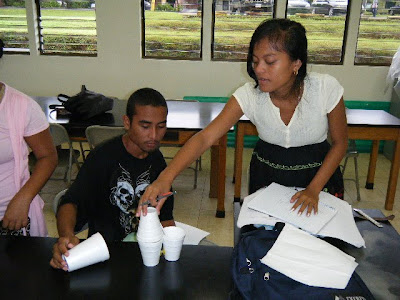
Senioleen and Ceasar adjust their heat conductivity apparatus. The upper cup prevents convective heat loss.

In the first half of the laboratory the students work in pairs to measure the temperature rise in a cup of room temperature water connected to a cup with boiling water. Below a piece of basalt can be seen in a small amount of cool water. The covered cup contains hot water. The other cup rig has a marble between the cups, with holes in the cups exposing the marble to the hot water.

In the second half of the laboratory the student pairs team up to form groups of four students who then design a chart design to use to report their results. Every term the cool water cups start at slightly different temperatures, making a straight-forward column chart of the maximum temperatures an inaccurate reflection of overall temperature rise.

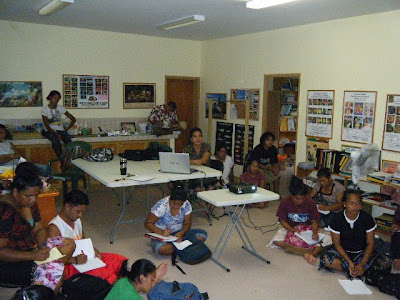
Leilani uses her subcompact computer to sketch out a chart design with the help of Merlisa and the others in her group. Three groups this term used laptop computers in the classroom.
Elizabeth also used a computer to explore chart options.

The design intent is to give the students a chance to problem solve as a member of a team. This design mimics that of many conferences where the participants break up into small groups, propose solutions, and then present their solutions to the larger group.
Adam works the keyboard as Angelo, Yvonne Sue, and Tellez look on. Each member contributed suggestions as their chart evolved on the computer.

Yvonne Sue presents her groups proposed chart type to the class. Although communication skills are an institutional learning outcome, "teacher talk" time still dominates the student's classroom experience. Laboratory six provides an opportunity for students to present to a peer group and gain experience in standing up in front of a group.
Each of the groups in the second half reports to the class on their chart design. This structure has worked exceedingly well the past couple of terms. The result is a wider variety chart designs and greater individual participation in the design process than when I had the class work as a whole on laying out a single chart design. There is also the benefit of providing an opportunity for students to engage in an impromptu presentation, a skill that is often called upon in this world of conferences and participative decision making.
Posted by Picasa