Wednesday, June 30, 2010

Sunset family

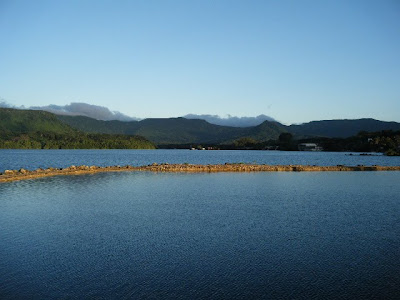
The view south from the coral diggings for the extension of runway nine - two seven, Nahna Laud at the back center of the image.
Peipalap rock in the background.

The horizon on fire.
Posted by Picasa

Electricity

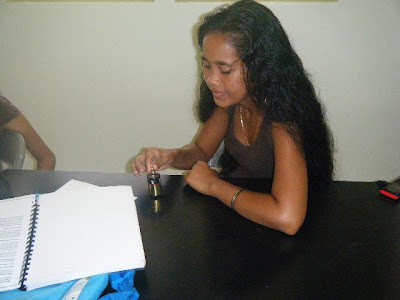
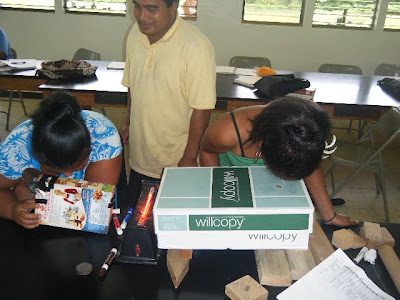
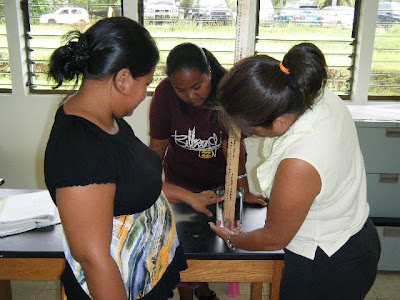
Laboratory twelve in SC 130 Physical Science focused on electricity. Leslie explores batteries and bulbs in part one of the laboratory.
Hattie and Jeanine light their bulb.
Arere finds the correct arrangement.
Jeanine, Edmund, and Hattie read current and voltage values.
Posted by Picasa

Tuesday, June 29, 2010

New RipStik'rs on the block

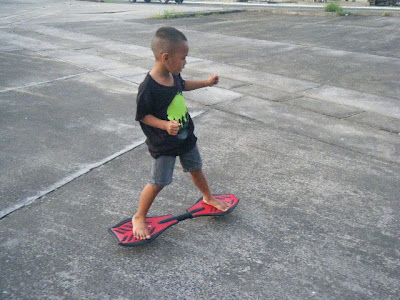
The box says not for children under the age of eight, but try telling that to a rough and tumble five year old who, despite his youth, has a reputation of never crying when he gets hurt. He will accept help to get started, but then he pushes the supporting hand away. He wants to do it himself. He also learned incredibly quickly.

This was only his second day on a board, and his first day in a parking lot. The previous day was a brief encounter with a RipStik on our porch. Maybe younger children still have pliant motor circuits. He often rides in a leaning-back stance that looks off-balance and yet he holds on to the ride.
He has certainly upset the learning curve apple cart.

Another new rider on the block, a visitor from Kosrae. She is a graceful rider with her own style.
A veteran rider.
Passing in front of the theater. There is a truism in the skate board industry that when a youth gets the car keys to the family car, the skate board gets left in the garage to gather dust permanently. Maybe the flip side is that there is always another new youngster who finds freedom and joy in riding a board. Maybe those are the true golden years - from the age at which one can ride until the age when one gets car keys. Nothing is ever quite as playful again.
Of course, play time need not be over if one is a fifty-something who can ride a RipStik. Here is a better use for an outdoor shuffle-board: RipStik riding.
Posted by Picasa

Spectrum tubes and CD spectroscopes

With no access to the computer laboratory for laboratory eleven, I opted to focus on spectra. This built off of the morning lecture on colors, color vision, color blindness , achromatopsia, color constancy, retinex and GIMP. In the laboratory session the students worked with CD-ROM based spectroscopes. In the afternoon class I built a third CD spectroscope. The afternoon section has more education majors, thus I felt they would benefit from seeing the construction process.

After viewing the continuous spectra of the sun, I dug out a box of old spectrum tubes and a spectrum tube power supply also from 1970. Exposed electrodes. 5000 volts. Probably time to buy one the newer units with shielded electrodes or the even newer models without through-the-glass electrodes.

The students above are viewing a tube that is optimistically labeled Neon. The labels have fallen off half the tubes, and while the tube boxes are also labeled, there is no guarantee that forty years on that the tubes are in the right box.

An unlabeled tube in a box marked Nitrogen produced a pinkish tinged orange light:


The tube produced the following image on a CD:
Enhanced by rebalancing with GIMP brings out some of the fainter spectral lines:


The afternoon class appeared to have a greater interest in the tubes and the lines produced by the tubes. The laboratory went well and might be developed into something more substantive if given labeled tubes and equipment that does not have a 30 second run time limit as was the case for the equipment in use today.
Jeanine uses a CD spectrograph to view the continuous spectra of the sun. The day was a cloudy day.
Posted by Picasa

Color constancy and retinex

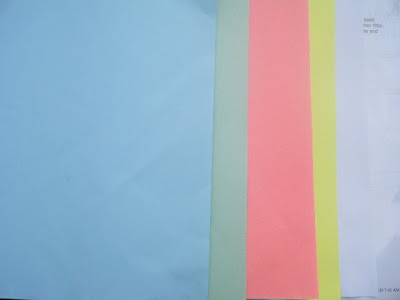
Sun light image shot with camera color balance set for sunlight. The camera was set to manual and kept with this color balance setting. Papers is blue, green, red, yellow, and white.
Fluorescent lighting, the black is the table top on which the paper was placed:
Incandescent bulb, 100 watt soft white:
An incandescent black light, there is outdoor background light present in the classroom:
For the students, the papers did not change colors as much as they actually did as revealed by the camera. For the students, their brains rebalanced the images so that they perceived the colors as seen in the first image.

Lecture links:
Posted by Picasa

Sunday, June 27, 2010

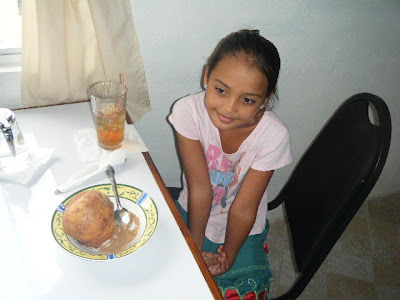
Fried ice cream

Fried ice cream at Kia's on Pohnpei...
...makes for happy and full children.
 Including those new to fried ice cream.

FireFox 3.7 brings SVG animateMotion

Mozilla Developer Preview 3.7 alpha 5 brings support for animateMotion to web pages. An animation of a ball bouncing once on a parabolic bounce can now be achieved with a single, short path statement. Achieving accelerated motion appears to require a good deal more work, but the basics for animated physical science diagrams are in place. Opera and Google Chrome already support SVG animation, however the college systems use FireFox, thus Mozilla support for SVG is critical. With the ability to animate diagrams, students in remote locations on links too narrow for video can better understand the laboratory experiment to be done. While the course laboratories are not yet all designed to be done "from home" there are a significant number that can be done on minimal equipment. Although the exercise remains theoretic, the hypothetical is whether the course could be remotely delivered to an isolated atoll such as Woleai. For most institutions there is no need to consider such as extreme case of distance delivery. For the College of Micronesia-FSM there is more than a hypothetical possibility of desiring delivery to a remote atoll. There are high school teachers out on atolls such as at Weipat high school on Ulul

Saturday, June 26, 2010

Information, power, and privacy

Information has always been linked to power. There was a time when the ability to control information yielded the ability to hold on to power. There are still nations that control information as a key tool to maintaining the power and control of the government.

I still work with people who feel that information is power and that the restricted control of information is important. People who seem to feel that by holding on to secrets their own position in life is made more secure. They are often intensely private and share little of themselves with the world. For them, information sharing is a threat and the Internet is a threat writ large.

I tend to think that sharing information leads to being a more valuable member of a team, yields the security that the secrecy hawks seek in their darkness. Oversharing is better than undersharing in my world. Share and share freely, live as openly as possible.

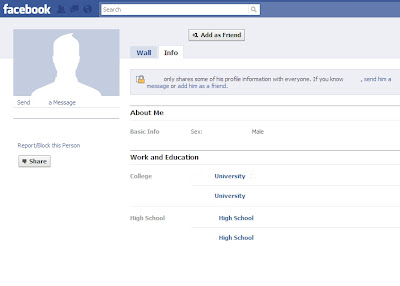
I see this in the choices made by FaceBook users. I recently stumbled across the profile of secrecy hawk. Desperately afraid that if anyone else knows how to do what they do they might be replaced, the secrecy hawk hides knowledge by instinct and without second thought. They nail down their privacy settings to such extreme levels that even if one is a friend of a mutual friend, all one can see is:
The secrecy hawk posts no profile picture, hides their friends, reveals only minimal school information from over thirty years ago, and provides no other identifying marks. 

If the secrecy hawk were a minor, then the tightly secured profile would make sense. There is a clear need to protect minors thirteen and older who can join FaceBook but could put themselves at undue risk with an open profile. An adult living on a small island, however, can hardly argue that their profile puts them at personal risk. On a really small island there really is no privacy, everyone will know Monday morning what you did on Friday night, if not even sooner.

Contrast the above "top secret, eyes only" profile to my own profile that can be seen from within FaceBook by people who are not my friend:
I provide a profile image, data on my location, employer, friends, and school information. The way in which one uses FaceBook seems to me to be a reflection of whether one is an information hoarder or information sharer. I share knowledge and I gain power by sharing. 

I am certain sociologists continue to study this transition. Many traditional cultures have structures wherein knowledge is retained as family or clan line secrets, and the power of families, clans, or individuals rests on the retention of that secret knowledge. This may have been the case long enough for knowledge retention to be considered the original norm. If so, then the Internet age is a brave new age where power comes from knowledge shared, not knowledge retained.

This split often, but not always, appears generational, possibly a reflection of the older tradition of family held secrets. In an organization where external agencies require more communication, more sharing, more openness, and where key upper rung positions are held by older employees, the result can be a collision between older information hoarders and younger information sharers. Unfortunately both sides tend to view the other as the cause of the problems. Because both sides start from fundamentally opposite definitions of self-preservation and institutional survival, there is little in the way of middle ground.

How much do you share personally or professionally? What does your profile look like? Have you ever checked?

Thursday, June 24, 2010

Refraction and apparent depth

Laboratory ten was trimmed to focus only on the apparent depth of an object below the surface of the water. This modification was made in part because the lens lecture was dropped in favor of an additional class session on waves during the lecture period. Having done an analysis of a RipStik swizzle sine curve yesterday, today I reinforced the concepts today using a light weight chain to cover the material in section 091.

Neymi, Donna, and Lilly-Rose measure the apparent depth of a penny
Malcolm at work
This summer the class is not using the A204 computer laboratory. I required students to bring a scientific calculator to class. To my pleasant surprise some of the students are arriving in class with lap top computers. Lilly-Rose sets up a graph of the data while Donna and Neymi look on.

Randy enters his data into his lap top while Maureen looks on.
Posted by Picasa

Wednesday, June 23, 2010

Speed of Sound

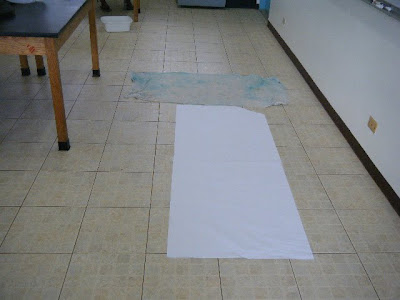
For summer session I opted to use the RipStik for the introduction to waves. I used a modification of the set-up I deployed last spring. The new floor tile, which had an uneven surface, was an unknown factor in the summer run. I used a larger towel. I did use blue food dye, but not enough that it made any difference. The towel was again wet. The results were, if anything, better than those in the spring.
I remembered to time my swizzle. The two sheets were 165 cm in length, which I covered in 1.57 seconds during a second run for a linear speed of 105 cm/s. By good fortune there were four wavelengths on the paper for a wavelength of 41.3 cm. The period was 0.393 seconds, and the frequency of the swizzle was 2.55 Hz. Multiplying the frequency by the wavelength yields a wave speed of 105 cm/s. The amplitude was on the order of 4 cm.
Laboratory nine moved on to measure the speed of a sound wave using echoes. Paulo works on clapping the boards.
Brenna tracks the time while Lilly-Rose looks on.
Posted by Picasa

Tuesday, June 22, 2010

Drawing clouds

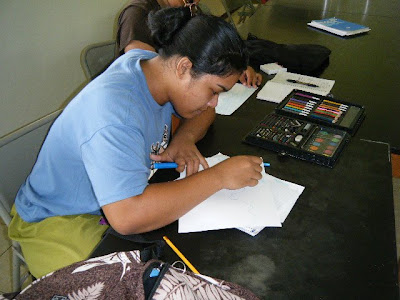
Laboratory eight focuses on observation and the production of an accurate sketch of a cloud. During the regular term these drawings are submitted and marked using a rubric. The summer modification was to post everyone's drawing at the front of the room and then have the class attempt to determine the cloud type depicted. For this purpose names were to be omitted from the pictures to reduce embarrassment.

Mylee works on her sketch. Materials included Crayola crayons and mini-pseudo-art kits.

Hattie at work.

Edmund working on a cumulus congestus.

Pertin developing his first of two sketches.
Posted by Picasa

Summer daze

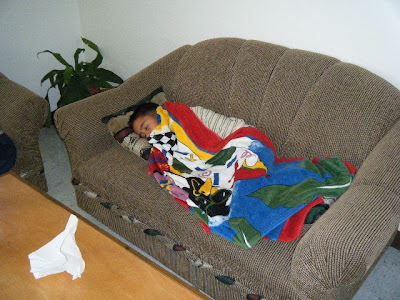
Hot summer days, too hot to play. A visit to the college to have lunch with dad resulted in two down for the afternoon count in the cool air conditioned faculty and staff lounge.

One on each sofa.

Also dazed was a fellow who entered the empty gym floor and walked in a funny manner alone while carrying a carved shark on a stick back in May. This photo only recently became available to me.

Posted by Picasa