Friday, February 26, 2010

Ethnobotany food presentations
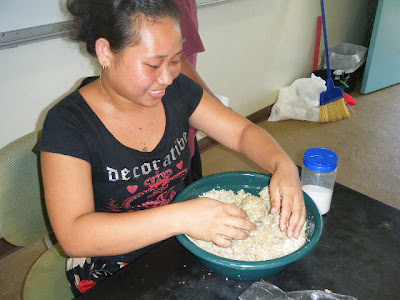
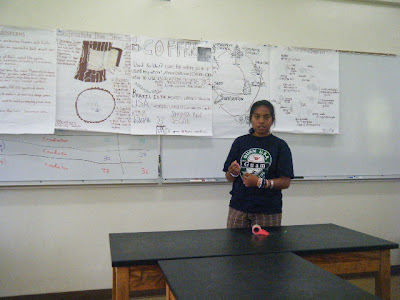
Iumileen prepares Pohnpeian uter en mwahng using taro, coconut, and sugar. The sugar is a modern addition to this food and a student from Yap noted that in Yap taro balls are still made without added sugar. "Go local" is good, but not if one simply adds back in all the salts and sugars found in imported foods.
Leah and Senioleen presented Pohnpeian rohtamahn mwahng.
Vannesa with Kosraean ap made from usr apact (banana) and kaki (coconut milk), wrapped in sra lo (Hibiscus tiliaceus leaf).
Piulyn holds up her Mortlockese ush amad.
Roy presents Pingalapese kesiperper. Although the Kosraean ap, Pohnpeian uht idihd, and Mortlockese ush amad are essentially similar foods, the flavor and texture of each varies with both the culture and the family. Roy's kesiperper had smoky undertones from cooking with local wood. Leaf wrapping choices also varied with the Pohnpeians tending to use banana leaves.
Tuesday, February 23, 2010

Fire field orchids

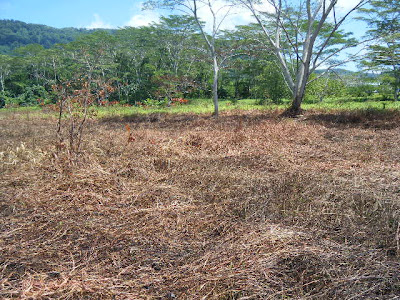
The El Niño dry spell this spring has led to a spate of fires around Pohnpei. Last week the swamp on the north side of the college entrance caught fire and burned. Probable cause is surmised to potentially be a cigarette. The swamp burned during the last El Niño dry spell in 1998
A view toward the Palikir ridgeline to the north
The college maintenance team had to run hoses from the dormitory as there are no fire hose hook-ups at the maintenance building on the north side of the road. 
Looking east-northeast

Given the loss of Lycopodiella cernua on other nan mal areas of campus, I was pleased to see fairly healthy growth of L. cernua out in the bog. These plants are usually protected by the impassable bog, becoming exposed only during an El Niño spring. Although the fire took it's toll, L. cernua typically benefits from the competitive loss of the razor grass post-fire.


The fires cleared the area and the dry weather permitted exploring the bog. Ground orchids are growing out in the bog.


The orchids in the bog are apparently self-seeding and fairly prolific.


Meanwhile, at home, a less common variety of Hibiscus rosa-sinensis is enjoying the sunny weather.

Saturday, February 20, 2010

Rotary 5k

The first fun run of 2010 was the Rotary 5k.
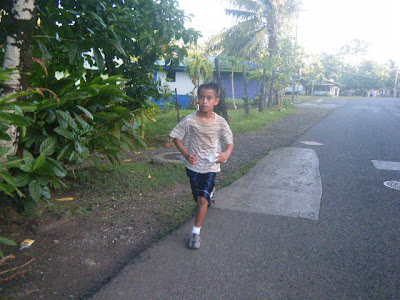
I joggled to a finish in 27:29, with my son just behind me at 37 minutes. For me, that is a good time. Last year we ran the same route during the Rotary 5k and I finished in 28:33. Given that I continued running for another half an hour shuttling back down the route to check on children, I have to think that my new running regime is having a distinct impact.
My eldest daughter finished in 45 minutes, well off last year's 36 minute pace. Usually she keeps apace with my son, but today she dropped back and joined a friend. The trophies were taken primarily by a revitalized Pohnpei Track Club who all ran excellent races.

The youngest strolled in after a 54 minute walk and talk with some of her teachers.
 After the run, the part of a Saturday run that all of us look forward to - the victory lap breakfast at the Joy Hotel!

Friday, February 19, 2010

Gymnosperm, angiosperm, economic botany presentations

Yvonne Sue covered the economically important coffee plant. The poster presentation included two cups of coffee labeled as being my coffee. Kona coffee was quoted at thirty dollars a pound, Jamaican Blue Mountain was quoted at fifty dollars a pound.

Marcia covered the uses and global price for black pepper.

Jessica and her camera shy partner presented on the economic value and uses of mahogany. There are a couple of stands of mahogany on the island, few students realize that the trees are non-native trees planted as a part of forestry projects.
 Sweeter gave a detailed, comprehensive, all around look at cinnamon including food and medicinal uses.

Thursday, February 18, 2010

Heat conductivity of materials

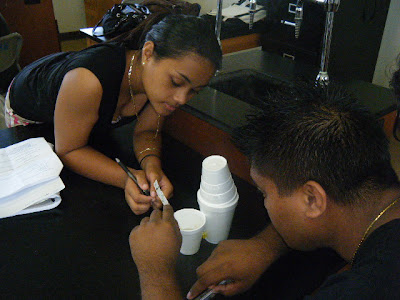
Laboratory six intentionally uses the most trivial and basic materials in terms of equipment, only the thermometers would be problematic in a local elementary or secondary school. In the first half of the laboratory the students measure the temperature rise in a cup of room temperature water connected to a cup with boiling water.
 Madlene and Irving, the inverted cup is on the hot water cup

In the second half of the laboratory the students work collectively to hash out a chart design to use to report their results. Every term the cool water cups start at slightly different temperatures, making a straight-forward column chart of the maximum temperatures an inaccurate reflection of overall temperature rise.

 Midion and Syd-Lee use a plate to shutdown convective heat loss

This term, as in prior terms, two cups started from a different temperature but ended at the same temperature. This data is always the data that generates the most discussion. The scientifically stronger students fairly quickly latch onto the problem that the common maximum temperature will lead to columns of equal height, which does not accurately reflect the greater temperature rise for the water that started at a lower temperature.
Venessa and Melojane read their thermometer

In the 8:00 section I did have to point out this difficulty when the class fairly quickly settled on a column chart of maximum temperatures. In the 11:00 section two students saw this issue early on the class discussion.

Krystal, Deltalei, Keicy

During the class discussion portion of the laboratory the students will invariably turn to me and ask "Is this right?" I try to minimize my presence by moving to the extreme back of the laboratory and using reflected questioning to keep from providing a single right answer. Remaining quiet is possibly the most difficult task for an instructor, especially if the solution is not necessarily the optimal solution. 

Mae, Cecelia, Brigida. Cecelia and her partners would provide some of the best insights in the morning session.

During the class discussion I might occasionally suggest to someone that they get up and sketch their idea, but my main task is to remain quiet. I have found that the dynamics of student led discussions here can require that one simply sit quietly while no one does or says anything for as long as five minutes. 

Jessica and Erleen

In a classroom, as any teacher has experienced, even 30 seconds of silence can seem long and I would guess that many teachers would feel the need to jump in at some point. I have learned to simply sit and enjoy the quiet. I suspect that the ability of a class to sit and do nothing with nothing happening may indeed be uniquely Micronesian. Yet at the end of the period someone will invariably have thought of an idea that moves the group forward.

Jessica sketches a chart concept

To an external observer, nothing might be happening during those long pauses, but in reality there is a lot of mind-time on task occurring. The ensuing discussion always reveals that thought has occurred. 

When I have students thinking about science, talking about science, even gently arguing about the best way to present their science, then learning is getting accomplished.

Flowers and bananas

Some photos of flowers in the yard and breakfast bananas on the tree.
 Lily.
 A developing pineapple.
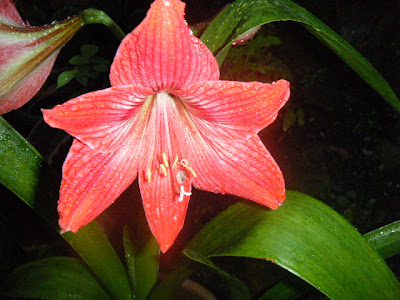
 Orchid.
 Bananas - tree ripened.
Bromeliad.

Friday, February 12, 2010

Ethnobotany visits Pwunso Botanic Garden

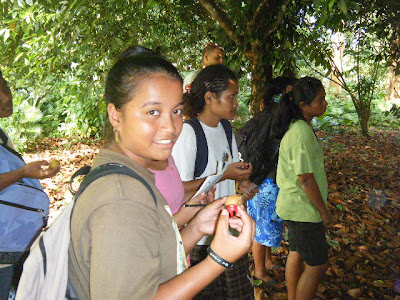
On 11 February the ethnobotany class visited the nominal Pohnpei State Botanic garden at Pwunso. This year the Pohnpei Visitors Bureau was dark and locked. The office had all but run out of cash power, and the building looked more decrepit than ever. That said, the plants are thriving possibly due to being left to their own natural growth patterns.

This term we changed our route as the middle gate is now kept locked. We started at the cloves, coffee, and what used to be black pepper plants. The posts for the black pepper have all fallen down, an apt metaphor for the black pepper industry in Pohnpei.

Jessica holds a clove nut, the surrounding mace still in place.
On this field trip I turned photo duties over to Marsela. While other students in prior terms have focused on stylish photos of their friends, Marsela focused on plants and the presentation.


The branch is that of a coffee plant. On a coffee farm the bushes would be trimmed to facilitate harvesting, and the plants would likely be replanted prior to reaching the age of our coffee "trees."

The Cinnamomum trees in the garden were mistaken for the local C. carolinense (madeu), but the trees have been identified by a team from the National Tropical Botanic Garden on Kauai as being C. verum, cinnamon trees.

The hot sunny weather has apparently been of benefit to the blooming of the clove trees - there were more cloves on the trees than I have seen in a decade. That or the trees have hit the age at which they bloom.
The class had to walk around the outside of the Pwunso area along the road to PICS in order to reach the kauri pine (Agathis robusta), the Calophyllum inophyllum, allspice, and teak.

Hooke's Law

Laboratory five investigated Hooke's Law using readily available local materials, styrofoam cups, marbles, and elastic bands.
 Cecelia adjusts the zero point on her cup

The design intent is that the laboratory could be reproduced in an elementary or secondary school with minimal equipment. The meter sticks and triple beam balances, however, are rare outside of the college here in Micronesia.
 Delta Lei measures the downward displacement, Krystal masses the marbles, while Nancyleen records the data.

In lieu of a triple beam balance, the marbles are each roughly five grams. One could simply use five grams for the mass of each marble. With modifications, a ruler or two could be substituted for the meter stick.

Kesusa masses marbles while Nick make displacement observations

We had to close the windows and the door because the wind was interfering both with the hanging cups and with the triple beam balances. With no air conditioning, and Pohnpei sweltering under an El Niño sun, the room was a tad warm and stuffy. Still, the scientists forged on gathering their data.
Sepe and Mayleen work on the mass for one of their marbles

Data from this laboratory exercise is available in OpenOffice.org Calc format.

Wednesday, February 10, 2010

RipStik Learning Curve

My youngest daughter wanted to learn to ride a RipStik. She had made a couple of attempts on two prior days without any success, she would fall off almost as soon as she started moving. This evening I took her out to the movie theater parking lot and worked with her on learning to ride the RipStik.
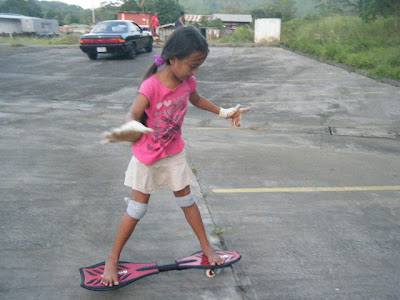
Those are socks for knee guards - she skinned a knee on a prior day's fall - and gloves for her hands. The lack of shoes might seem an obvious oversight, but she runs and plays barefoot every day and the bottom of her foot is quite tough. Kids who play barefoot find that learning to ride barefoot is far easier than learning to ride with shoes on.

I also used the opportunity to gather some data to play with in statistics class. The data in the table indicates her attempt number and the number of seconds she remained up, rolling, and successfully riding the RipStik [rolling time (s)]. Her first attempt ended as soon as it began, her second lasted a scant half a second, but by her third try she was up and riding for almost a second.
Attempt Rolling time (s)
1 0
2 0.5
3 0.92
4 2.58
5 8.54
6 3.64
7 5.75
8 4.81
9 12.25
10 7.88
11 8.31
12 10.4
13 9.28
14 10.59
15 10.13
16 16.58
17 11.95
18 6.31
With each attempt she was generally, but not always, able to ride longer. Except for the 18th and last attempt, I steadied her on the board and she pushed off from my arms. On that last attempt, she mounted and launched the board without my assistance. Although she was unsteady and the ride only lasted six seconds, she had successfully launched the board.
I realize the data is not a true "learning curve" nor is that my use for the data. My use is in a linear regression example for statistics class. Note that the scatter graph is based on data rounded to the nearest tenth of a second.

No child was hurt in the production of this data.

Tuesday, February 9, 2010

RipStik Evening Session

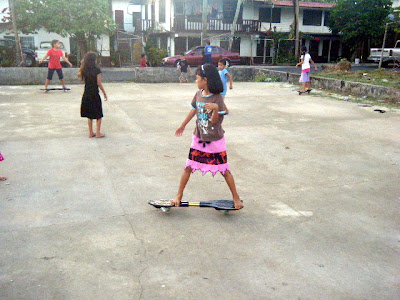
All that remains of the building is the cement pad. In a town with limited recreational opportunities, an open cement pad is the next best thing to a playground. Especially for caster boarders.
The rule is that if and when you fall off, the next kid sitting on the sidewall gets to ride. Despite the hard falls, the local rule appears to be no complaining, no crying.
If a rider is good enough to remain up indefinitely, then the local rule is apparently that zoris can be thrown at the bottom front of the rider's RipStik in order to precipitate a fall. As a result of this, the local kids are generally proficient at sudden maneuvers to avoid colliding with a zori. 
Occasionally riders would attempt to knock other riders off their boards. The kids all seemed to be able to withstand these shoves and remain up and riding despite hard pushes and thrown slippers.

Meanwhile, over in a quieter and less competitive lot, my son works out the rudiments of a new sport. Some form of street hockey or polo while mounted on a RipStik. 
He has also demonstrated dribbling a basketball and playing catch while riding. Somewhere in far off suburbia some kids are using caster boards to invent some unique new sport. Caster boards have none of the limitations of a skateboard - the rider never needs to touch the ground to move over level ground. The boards can turn on a literal dime, and a good rider can put herself or himself anywhere on the field of play fairly quickly, maintaining stability despite occasional knocks or field objects.

Sunday, February 7, 2010

RipStik Forces

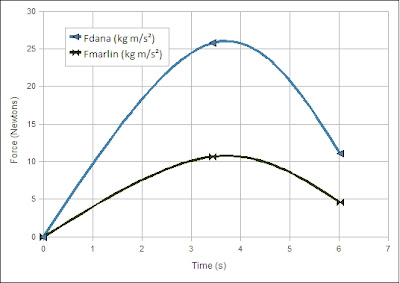
Noting that I seem to topple off of my Stik more often and harder than my son, I ran a crude check on the minimal force required to achieve linear acceleration of the RipStik. The force data is based on earlier acceleration measurements.

time (s) d (m) velocity (m/s) acceleration (m/s²) Dana (kg) Son (kg) Fdana (kg m/s²) Fson (kg m/s²)
0 0 0 0 65.91 27.27 0 0
3.43 4.6 1.34 0.39 65.91 27.27 25.77 10.66
6.02 9.2 1.78 0.17 65.91 27.27 11.07 4.58

The force to accelerate me is larger by the proportion of my mass to my son's mass. I am exerting far larger forces through the caster wheel system. 

The result is that when I do hit a crack, rock, or hole in the cement, there are far larger forces at play. With increasing force, things go wrong both faster and with more destabilizing consequences. Or at least this is my excuse for spending more time getting acquainted with the ground.

Saturday, February 6, 2010

Saturday morning

Saturday morning is marking papers. Outside. On the porch. In February.
Saturday morning is getting out the entire air fleet.
The air fleet is made possible by a plane-a-day calender, a Christmas gift that keeps on giving each and every day.
Flight ready to launch.
Saturday all-day is teenager-stare-at-small-screens day.