Sunday, January 31, 2010

Beyond 200 minutes

In the spring of 2009 I moved beyond pedometers and into an effort to tally 200 minutes of running per week. The target of 200 minutes per week was a result of a previously found relationship between a seven day pedometer average and my seven day total running time. 

A month into the 200 minute program and initial results were promising. The key indicator was a three month weighted average of my seven day total time statistic. The goal was 200 minutes per week, but not a Sunday to Sunday basis. I used a spreadsheet to track my seven day total running time each and every day. A simple seven row sum function handled this. Each day I could calculate how many minutes I needed to maintain 200 minutes of running.

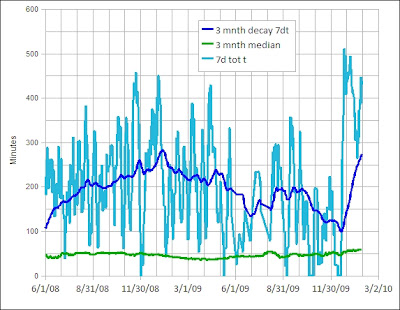
The three month weighted average consisted of a 50% weight on the average of the most recent thirty days worth of the seven day total time, one-third on the prior 30 days, and one sixth on the thirty days before that. Thus the average was a three month span, but with half the weight on the most recent 30 days. This is essentially a modified quarterly average. I refer to the statistics as the three month decay for the seven day time (3md7dt).

By late November 2009, however, a single chart was showing signs of a long, slow downward trend in the 3md7dt for the year to date.
Although the 3md7dt saw improvement in August and September, by late October and November the average was falling again. By the time of the final examinations I was so certain I needed to get "back to the basics" of running that I produced a final of the same name that used numbers from a run. The 3md7dt fell below 100 minutes for the first time in the history of my use of the statistic on the day of a colleague's funeral, 20 December 2009.

Even then I did not know what I meant by back to basics, but by nightfall I knew that I had to get out an run at least an hour a day every possible day. The 200 minute per week/28 minute per day goal had led to a running year of short runs that now felt like junk runs. 

On the 21st of December I started running at least an hour every night. The impact of this change can be seen above on the right side of the chart.

There was one remaining question that I had - was the downward trend in 2009 and the preceding upward trend in 2008 a reflection of pedometers and the shift to the 200 minute per week goal, or was it part of a larger natural cycle in my running? Pedometers appeared to drive my running times up, and the 200 minute goal appeared to lead to a collapse. But what had come before June 2008?

I pulled out all my logs going back to 10 June 1998 when I first started recording the duration of my runs. Although I began running sometime in the fall of 1978, I only occasionally and sporadically noted a particular run or a time. I taught mathematics, physics, and physical science; running was my time away from the worlds of equations and numbers. I ran to see new places, to get out and about wherever I lived. Only in 1998 did I start to track my running duration.

1199 run times later, I had an answer.
The three month decay for the seven day total time begins about three months after the first log entry. The chart came as a surprise to me - I had never looked back at the logs in terms of consistency of running. Besides the overall erratic, inconsistent nature of the statistic, I appear to have run more consistently and racking up more time prior to 2000.
 
With the move from a home in Lewetik, Nett, to one in town in 2001, my running all but collapsed for the rest of the decade. Taking the 3md7dt to be a form of a quarterly average of my seven day running total, I rarely accumulated more than 100 minutes of running a week. Against a CDC minimum recommendation of 150 minutes per week of vigorous exercise, I was a failure. 
 
I had fallen below 150 minutes on 07 July 2000 and did not climb back above 150 minutes for a seven day period until 15 July 2007 - some seven full years later. Even that was but a brief spike and I would not again climb above 150 minutes until 18 June 2008, this time remaining above 150 minutes until 13 June 2009. Summer 2009, however, saw some good long runs and some quality hill work despite the low total times.

Yet even the 2009 "collapse" never sank to the "depths" in which my running existed from 2001 to 2008. Clearly the pedometers in late 2007 and into 2008 had a huge positive impact on my weekly total running time. Even the junk runs of 2009 kept my running at a level far above my 2001-2007 numbers.

An hour a night every possible night has caused a reduction in sakau intake. I already had looked at the impact of sakau on running in December 2009, February 2009, and  December 2008. I knew of the immediate sakau impact. Looking over my logs over the past twelve also reminded me of times giardia and other intestinal ailments took me out of action for a few days that then stretched to a many days and even weeks. There is longer term negative impact on vigorous physical exercise for the sakau drinker.

I think there is a real challenge facing any "exercise for health" program in a society with a penchant for Piper methysticum. Although I try to have both running and sakau, clearly there is something almost antithetical about trying to do both.

Nett Point in January

While El NiƱo puts the deep freeze on north america, europe, and siberia, Pohnpei continues to provide reasons for letting go of an unhealthy attachment to the four seasons. Here are three of those reasons. 


One.
Two.
Three.
Try striking a pose soaking wet while outside in Omaha right now.
Continental on roll-out at the end of the runway. The work being done is on an extension to the runway.

Friday, January 29, 2010

Dropping the ball: Acceleration of gravity


Laboratory 032 involves timing the fall of a ball to determine the acceleration of gravity g.


Cecelia drops the ball while Brigida observes.

Eliander is the dropper-timer while Steward secures the meter sticks.

Mayleen and Irene work along the laboratory windows.

Nick and Kesusa work on top of a table to get drops as high as 300 cm. The final drops are made from a balcony outside that provide drop heights of 400 and 500 centimeters.
Data from the laboratory (OpenOffice.org Calc file).

Nancyleen working with Cecelia.

Thursday, January 28, 2010

Stiking together

A family should really Stik together through the bumps and falls in life.

We are working on a "flight formation" routine where we sweep down slope
together with proverbial "36" inch cockpit-to-wingtip separation in
echelon and diamond formations. The we split or cross-over.

For reasons that baffle me, mass is playing a role in our downhill speeds. In the underlying physics the mass cancels out - the old feather and hammer fall at the same rate in a vacuum physics experiment. And no, air resistance is not a significant differential factor at the speeds we attain, a mere two meters per second at best. So when we do a formation turn the least massive has to be on the inside, with the middlemost massive in slot, and myself on the outside of the curve. More massive is faster in the world of caster boarding down slope.

I tend to fall more often than the other two, but I view my re-acquaintance with the ground in a positive light.

Learning to rebalance oneself seems to more difficult with increasing age. I watch kids pick up caster boarding so much faster than I do. Seems the motor neurons are slower at setting  up new connections past some age I must have exceeded.

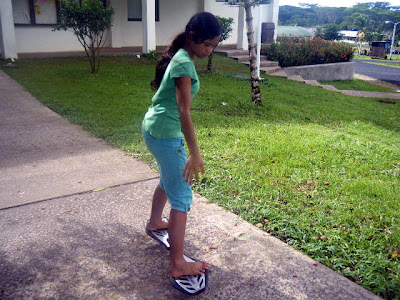
The future slot pilot for the full diamond is still learning, starting with scooting on a RipStik caster board.

And working on stand up riding. If she earns her "wings" she will get her own caster board to fall off of and Stik together on.

Never mind "Got milk." Got balance?

Traditional plants of Pohnpei

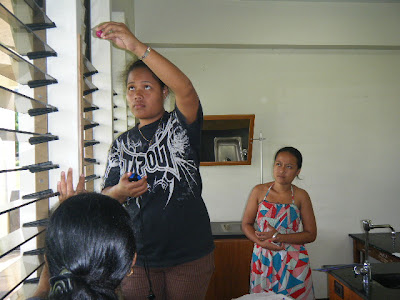
Totoa Fetalai-Currie led a lively presentation on the use of plants on Pohnpei. She began with tumeric and led into a discussion of plants that can be used in curry.

The presentation covered plants for food, healing, construction, and decor.

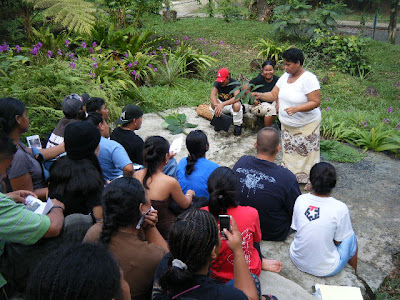
The class listens to Totoa.

Plants were passed around and local names elicited.

Totoa holds Cyathea nigricans.

Adam with Piper nigrum.

Totoa with assistant.


Monday, January 25, 2010

RipStik in physical science: accelerated linear motion

In a previous article I shared the use of a RipStik in SC 130 Physical Science to demonstrate linear unaccelerated motion. The ability to generate a relatively constant velocity by swizzling at a constant rate on level ground was useful to that demonstration. In this demonstration I accelerated the RipStik from rest over a distance of 9.2 meters using columns that were 4.1 meters apart. Measuring the time as I passed each column permitted a calculation of the average speed between each column.

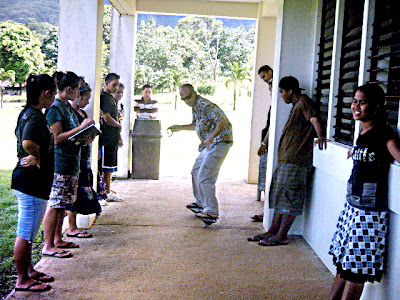
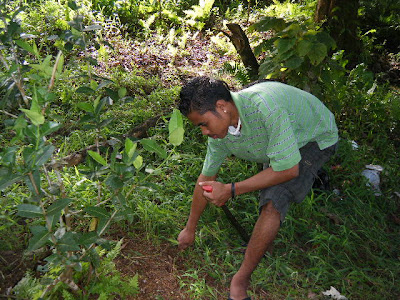
A student captured the image above. The external light and lack of a flash meant that the image had to be processed using a retinex filter in GIMP to lighten the foreground relative to the background. My watch can be seen in my right hand, I used the chronograph feature to capture the split times.


This demonstration required that I accelerate, which meant swizzling faster and with more force than the previous constant rate swizzle. This required more skill than last week. The time and distance data gathered was recorded on the board back inside the classroom. The velocity was worked out in class, the acceleration was left as a homework assignment.


time (s)
d (m)
velocity (m/s)
acceleration (m/s²)


0.00
0.00
0.00
0.00


3.43
4.6
1.34
0.39


6.02
9.2
1.78
0.17


The data demonstrated that, as I rather expected, my rate of acceleration fell as my speed increased.

The RipStik once again garnered the interest of the students, especially when I passed a camera to one of the students and asked them to be sure to get a picture of me if I fell down. The earlier image was taken by that student.


The data will be used to continue an exploration of acceleration in our next class.

Sunday, January 24, 2010

Teaching riders to learn

The two young women were watching my son and I ride RipStiks on campus. They seemed interested in trying to ride, so I offered them a chance to try one out. As one tried to stand on the RipStik, the other steadied her by holding her hands. As soon as the supporter let go, however, the rider immediately lost balance and fell off without making any forward progress. They repeated this approach a couple of times.


My son, meanwhile, went whizzing by, taunting, "See, it's easy!" 


Without giving any thought to my action, I suggested another approach. I asked if the young woman if she was right or left-handed. She was left-handed. So I switched her to a goofy foot stance. Then I told her to put her right foot on the front plate with the RipStik pointed down a very shallow slope. I told her to focus her vision not on where she was going but on the back plate of the RipStik. I told her to lift her left foot onto the back plate while focusing on that plate. Then she could look ahead.

With this advice she was up and riding almost immediately. While her first few runs were no more than a couple meters, she quickly extended her balance skills to cover over ten meters. She was riding, and soon, using the same approach but regular foot, so was her right-handed friend.

Once up on the RipStik, both began to teach themselves how to correct the direction of the board, how to remain on an even keel. With a little instruction, both were now learning to learn to ride a RipStik.


The theme for the teacher's forum this year is Pohnpei now: Teach to learn, learn to teach. I submit that one cannot "learn to teach" "teaching to learn." 


Everyone is born a learner. 
Not everyone is born a teacher.
Nor can everyone be made into a teacher.


Over my years in education I have seen content area experts who were either uncomfortable in a classroom, unable to connect with the students, or simply ineffective teachers. Their students end the term feeling frustrated, confused, and wholly uncapable of learning how to learn more in the subject area. No amount of education nor methods classes would be of any help.


I have seen others, with but a small pocketful of knowledge, who vault their students well beyond their own knowledge set. Their students learned to learn and took that ability and rode that subject area RipStik beyond anywhere their teacher had ever been. For them, methods classes simply provide additional tools to use as they do what they naturally do.


I teach because I do not know how not to teach. As soon as I learn a new skill, I immediately want to share that knowledge with others. As soon as I learn, I want to find a way to effectively communicate that knowledge or skill. Mastering the new knowledge set or skill is intrinsically insufficient for me. I am not satisfied until someone else has learned this new thing too. 


Teaching is an addiction for me, I doubt I have the constitution to stop myself. I am happy I exist in a reality that values teachers, but I fear I would teach even if I was told not to teach. Teaching is my compulsion. I was not taught to teach, that was in me before any methods or curriculum design class. 


Over the years I have seen my students soar to new academic heights, into fulfilling lives and careers. This is one of the perks of teaching on an island, one eventually meets again one's former students. 


At the college the only four year degree is an education bachelors degree in partnership with an external university. Yet students flood into this program as it is the only bachelors degree to be had on this island. That the program takes all comers above a certain GPA carries the implication that anyone can be a teacher. And with their new bachelors degrees, the graduates are virtually guaranteed positions in the local school system. These are the future teaching force for the FSM.


A thorough knowledge of content is a necessary pre-requisite to being a teacher, but content mastery alone is not a sufficient pre-requisite to becoming a teacher. There is more to being a teacher, to teaching others to learn how to learn. 


While in graduate school at the University of Illinois I had the pleasure and honor of hearing both Noam Chomsky and Paolo Freire speak. My recollection is that Chomsky held the view that education was an indoctrination process that converted one into a true believer in that which the existing system wanted one to believe and think. Freire said education was love, and for Freire education was revolutionary for the individual. Once educated to ask questions, the genii cannot be put back into the bottle. I concur with Freire, education is subversive, and teaching is an act of love. 


I fear the result of the current structure that pulls all who seek a four year degree on this island into the education program will be a future with teachers who are not called by the profession, but for whom teaching is simply a job, something to do to earn a paycheck, a task that gladly dropped at five o'clock or on a Friday afternoon. For whom teaching is something done for fiscal compensation, for survival in a job poor economy, for mercenary reasons and not for love. Maybe this is as it must be, but this is not how it ought to be.


Meanwhile a learner continues to learn beyond her teacher's rudimentary advice.


Lycophyte and monilophyte presentations

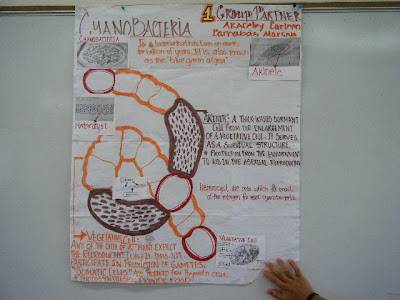
Students in SC/SS 115 Ethnobotany gave presentations on the botany and local names of cyanobacteria and the primitive plants. 

The cyanobacteria covering Nostoc was one of the best and most detailed I have seen in recent terms.


Carleen and Marsela put together the poster presentation, their coverage was both thorough and comprehensive.

Jeffrey, Fritzgerald, and Leah covered the morphology of Lycophytes.

Yvonne Sue and Jessica presented on the life cycle of ferns.

Adam and Sweeter did a comprehensive and entertaining job on covering monilophyte morphology, with a focus on ferns. 

For the first time in the history of the course plant names in Marshallese were presented, albeit tentatively and not specifically primitive plants. A more comprehensive list exists on the Plants and Environments of the Marshall Islands web site.

Marcia and Vanessa present primitive plant names in Kosraean. For both this was a learning experience, few youth in Kosrae know the names of their plants in their own language.


Anchyleen and Iumileen implicitly tackle the sensitive issue of orthography, phonetic languages, and vowel shifts by presenting the Pohnpeian names side-by-side in the two major dialects.

Joannie gives her best effort on plant names that seemed to be completely unfamiliar to her. Yap too may be experiencing botanic devolution.

Thursday, January 21, 2010

RipStik evening

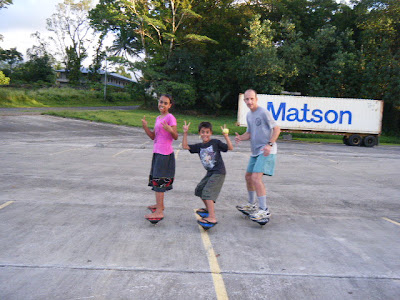
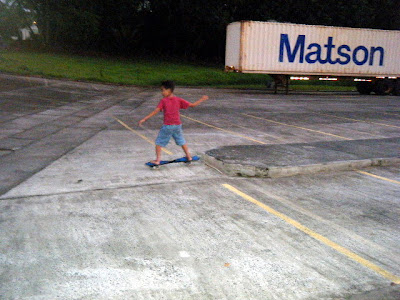
An eight to five day in physical science laboratory and ethnobotany class led to a sunny evening decision to hit a local parking lot and rip with my son. The light was fading when I caught this grainy image of him coming off of our local equivalent of a manual pad on his RipStik.

Rolling by in the gathering dusk.

Rolling balls and linear relationships

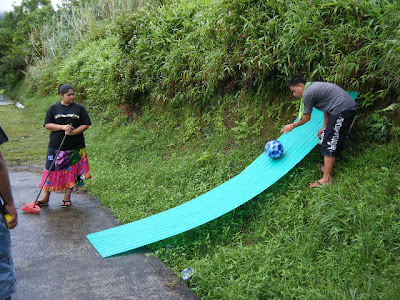
Physical science laboratory two was revised this term to include five different rolling ball speeds including stationary.

The ball being rolled is actually a four square ball. Syd-Lee launches the four-square ball and Tracy holds the "curling" broom.

Keicyleen and Vanessa on the left timing line, Nicole and Jessica on the right line. Krystal can be seen trying jump clear of the ball.

The 8:00 lab used stopwatches to determine the second marks, the 11:00 repeated the experiment but replacing stopwatches with oral counts of the seconds using "one-one thousand..."

To my surprise, the 11:00 data had a higher correlation than the 8:00 data. One major confounding complication: rain forced the 11:00 session into the practice gym and onto the practice gym carpet.

After taking measurements at the gym, the class moved to A204 to enter data. Tracy enters data in the image above.

Monday, January 18, 2010

RipStik in physical science: simple linear motion

Having been taught by my son to ride a RipStik® over the holiday break, I deployed this new skill in physical science class. In the past I rolled a marble past equidistant points on a table. This was easily replicated in an elementary school classroom and remains a useful demonstration. The demonstration, however, lacked any excitement, no pizazz. This term I rode a RipStik past columns that were 4.57 meters apart, timing my split times with a chronograph.

Only one of my students had seen a RipStik before - this is still a remote Pacific island -  and all quickly realized that there was a reasonable possibility of their instructor falling to the ground. Falling down in Micronesia is simply not done, even if the cause is an attempt to do something new. To some extent, one is supposed to practice in private and deliver perfection in public. So risking falling in the middle of campus had my students riveted on my 46 meter ride.
Time (s)
Distance (m)
0
0.0
2.74
4.6
7.16
9.1
10.76
13.7
14.36
18.3
17.81
22.9
20.96
27.4
24.55
32.0
28.2
36.6
31.38
41.1
35.91
45.7
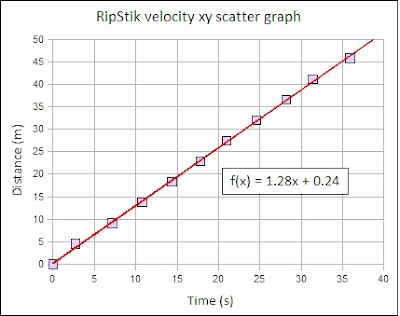
Making an xy scatter graph, plotting the data, and finding the slope was assigned as homework. Having not tried this before, not even a trial run before class, I had no idea whether my speed would be steady enough to generate the linear relationship which I hoped to obtain. I did know, however, that small speed changes have a minimal impact on the overall linearity of a distance versus time scatter graph.

The result was highly linear with a slope of 1.28 m/s. I knew my split time on the first column pair was off, I was a tad early on chronograph lap button as I came up to the post at 4.57 meters. I had not even tried riding the RipStik while holding my chronograph and taking split times, so I was a bit unsteady at first. I had to watch the posts, not where I was going, a recently acquired skill for me.

While I cannot say that my use of the RipStik improved student learning outcomes per se, I can say that I had the full undivided attention of my students and this is always a good first step towards learning. A regular lecture on time versus distance would not have generated the same level of attention.

I continue to practice riding the RipStik - I find I am slow learner of new fast-reflex motor skills at my present age - with the intent of using the device later when the class tackles gravitational potential energy and kinetic energy. I am still learning to ride efficiently up a slope, key to that future activity.

Thursday, January 14, 2010

Ethnobotanical garden clean-up

Students cleaned up the Palikir Student Ethnobotanical garden.

The students both clean-up the garden by pulling and cutting the weeds and they work on learning the names of the plants in their own language. Later we will focus on uses of the plants, the students will also have to perform a matching exercise for the Latin names of the plants.

Marcia and Joannie study Senna Alata.

Joannie.

Marsela working up in the eastern section of the garden.

Sweeter raking.

Pulling.