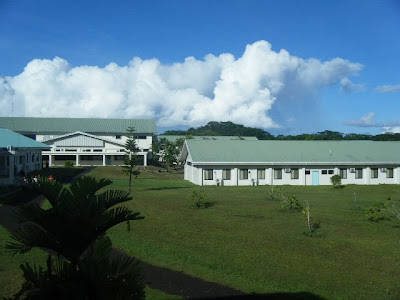
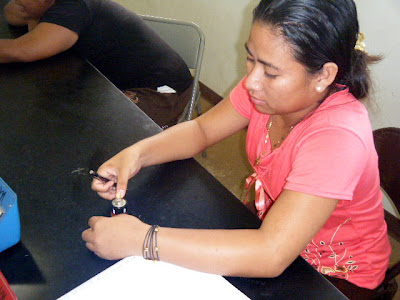
My theory that every single student flash drive on campus is infected with one or another worm or other malware (Conficker, El Dorado, and so many others) was dealt a blow when a single clean drive was discovered. That said, the one exception has been just that, an exception. While better AV choices might reduce the problem, ultimately the vast size of modern flash drives leaves too much room for highly evolved and complex malware replete with anti-AV and anti-update modules. If bandwidth were not the issue that it is at present on campus, then the solution would be to move all student work into the cloud.
Hence Living In a Browser caught my eye. There is virtually nothing the students do at present that cannot now be done in the cloud. Walking around our Learning Resource Center, ChromeOS and the cloud would handle everything I saw being done by our students. I would go a step farther and argue that anything that cannot be done in a browser may not be worth doing - that is, adopting a proprietary desktop-bound solution should be considered only after ruling out cloud options.
Monday, November 30, 2009
Sunday, November 29, 2009
KBP fun run
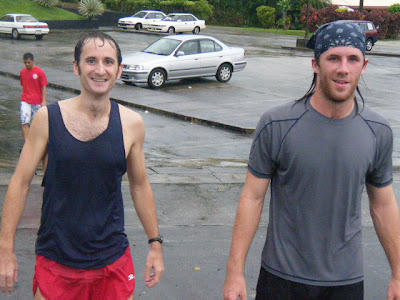
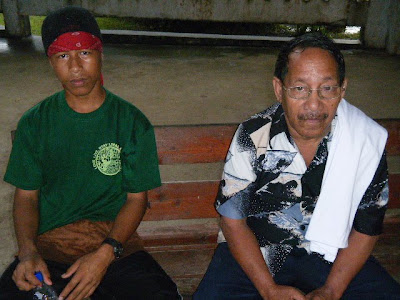
Tim, left below, took first place in one of Pohnpei island's only Sunday fun run.The run was a benefit for a local Filipino community group, Katilingbang Bisaya sa Pohnpei.
The route was new for everyone, starting at the movie theater and heading up Elenieng to Kaselehlie and then up Namiki towards Dolihnier. Around past the water tank, SDA, and PICS, and then back to the theater via Dainy. Tony Nakasone and Rendy Geminaro both joined, Tony having taken second in the 10k just yesterday morning.
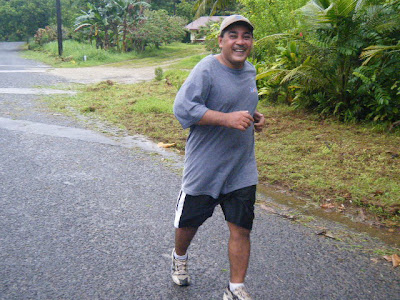
On the right below is the first female finisher.
The 7:00 start was hit by a rain squall that followed the runners up into Dolihner. By the water tank my tennis balls were soaking wet and heavy. My arms were still feeling the effect of over an hour of juggling on yesterday's 10k. I joggled through today to a finish in 31:59.Tim thought the route was long, and organizers were quoting the course at over five kilometers. I haven't directly measured the course and had no feel for the distance as the gusty rain proved a worthy distraction.
The route was new for everyone, starting at the movie theater and heading up Elenieng to Kaselehlie and then up Namiki towards Dolihnier. Around past the water tank, SDA, and PICS, and then back to the theater via Dainy. Tony Nakasone and Rendy Geminaro both joined, Tony having taken second in the 10k just yesterday morning.
On the right below is the first female finisher.
The 7:00 start was hit by a rain squall that followed the runners up into Dolihner. By the water tank my tennis balls were soaking wet and heavy. My arms were still feeling the effect of over an hour of juggling on yesterday's 10k. I joggled through today to a finish in 31:59.Tim thought the route was long, and organizers were quoting the course at over five kilometers. I haven't directly measured the course and had no feel for the distance as the gusty rain proved a worthy distraction.
Saturday, November 28, 2009
Aramas kapw 10k
You know turn-out is low when a fifty year old joggler takes the lead at the one kilometer mark and holds the lead unchallenged for the next nine kilometers. In an informal pilot run of the first ever Aramas Kapw fun run saw six people turn up on a rainy Saturday morning. The run started at PICS track and field, headed down to Amcres and 4TY, out to the airport gate, back up to "administration" field (the old trust territory name for the Spanish Wall ball field), and then up into Dolihner via Namiki, around past Pit Stop and the water tank, returning to PICS track and then a lap on the track. Based on data I had, I put the total distance at about 10.45 kilometers.
Tony Nakasone came in second, still smiling.
Gary Bloom and a young man entered the field together to notch third and fourth place.
Of the six, only one female runner joined the run. She and another young man entered the field together to take fifth and sixth place, with her as the first female finisher.
I finished first in 66:07. I had thought I might juggle-bonk attempting a ten kilometer joggle with late hills, but I felt surprisingly good coming into Dolihner.
Tony Nakasone came in second, still smiling.
Gary Bloom and a young man entered the field together to notch third and fourth place.
Of the six, only one female runner joined the run. She and another young man entered the field together to take fifth and sixth place, with her as the first female finisher.
I finished first in 66:07. I had thought I might juggle-bonk attempting a ten kilometer joggle with late hills, but I felt surprisingly good coming into Dolihner.
Friday, November 27, 2009
Thanksgiving
Thanksgiving with all the trimmings is a tad more difficult in a place where the day is not a holiday. With no one home to do the massive amounts of cooking, Shrue ordered a turkey with all the trimmings.
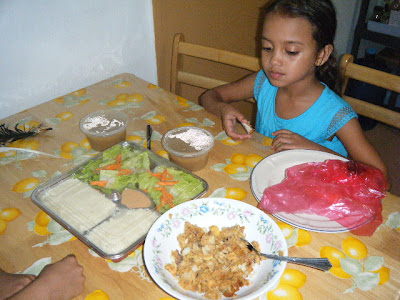
Mashed potatoes, salad, and stuffing. Thanksgiving is not a holiday on Pohnpei. On Kosrae Thanksgiving is an observed holiday replete with church service. The Kosraeans remember and observe the original intent of the holiday - a day of giving thanks to God.
Plus a turkey.
Three on the floor enjoying family Thanksgiving dinner.
Shrue and Alice enjoying their thanksgiving dinner.
Mashed potatoes, salad, and stuffing. Thanksgiving is not a holiday on Pohnpei. On Kosrae Thanksgiving is an observed holiday replete with church service. The Kosraeans remember and observe the original intent of the holiday - a day of giving thanks to God.
Plus a turkey.
Three on the floor enjoying family Thanksgiving dinner.
Shrue and Alice enjoying their thanksgiving dinner.
Ethnobotany sakau ceremony
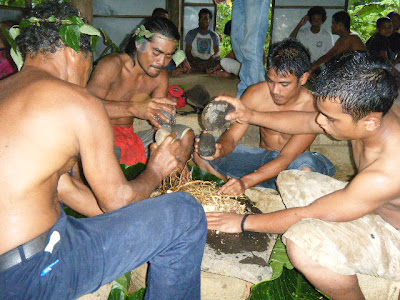
The SC/SS 115 Ethnobotany class capped the fall 2009 term with the observing of a traditional sakau ceremony at the home of Simiai Manuel in Lewetik, Sokehs.
Sukusuk with four pounders. The start pattern differed from that which McKaye was familiar with in Pehleng, Kitti. A five tap precedes the kodihd in Lewetik.
An expert menindei guided the ceremony.
Katielyne, Emillia, and Girlynn observe the ceremony.
Simiai prepares for pwehl.
Daryl as oarir for the guest "nahnmwarki" takes the cup from the menindei.
Nayleen demonstrates her keen knowledge of tradition and custom in sitting properly as oarir for nahnalik Tracy.
More information on ethnobotany can be found on the ethnobotany course home page. Information specific to the Pohnpeian sakau ceremony is covered on a page detailing the reasons for the ceremony and the process. From birth to death, Piper methysticum is central to the ceremonial life of Pohnpei and Pohnpeians. The joining of two as husband and wife, the passing of a loved one, and apologies are all centered on and around the ceremony.
Sunday, November 22, 2009
Index of refraction for glass
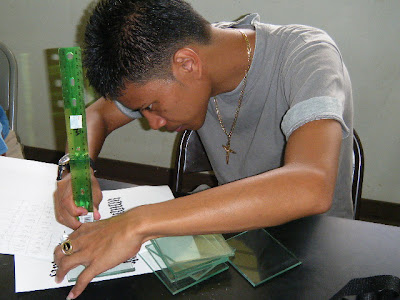
In laboratory 14 the physical science class worked to determine the index of refraction for glass.
Mason works on determining the apparent depth of an image under glass.
Bryner looks for a rotation and angle that optimizes perception of the apparent depth of the words on the page. The words on the page tie back to Aristotle and the first day of class, they will forward link to Angels & Demons on Thursday.
Alfonso opted to use a coin under the glass.
Anchyleen works on her own data.
Verne and Kevin puzzle over the ambigrammatic image sheet.
Brenda, Samantha, and Nadine working on the image depth.
Mason works on determining the apparent depth of an image under glass.
Bryner looks for a rotation and angle that optimizes perception of the apparent depth of the words on the page. The words on the page tie back to Aristotle and the first day of class, they will forward link to Angels & Demons on Thursday.
Alfonso opted to use a coin under the glass.
Anchyleen works on her own data.
Verne and Kevin puzzle over the ambigrammatic image sheet.
Saturday, November 21, 2009
Rainbow
Rainbow over the A building at Palikir. Note that the inside of the rainbow, to the right, is lighter than the outside of the rainbow. My recollection is that this is due to other multiple internal reflections of the sun within the arc of the rainbow.
Spaghetti and coffee cake
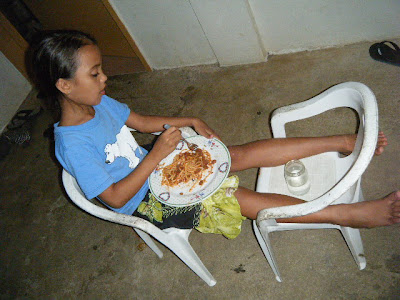
Thursday night spaghetti dinner on the front porch.The youngest eating in comfort.
Originally intended to be a dinner table that would permit sitting on floor cushions back in 1994, now the plastic relic is a fine seat for dinner.
Saturday morning coffee cake, another new recipe from a summer in Wisconsin. The pan was gone in minutes.
Originally intended to be a dinner table that would permit sitting on floor cushions back in 1994, now the plastic relic is a fine seat for dinner.
Saturday morning coffee cake, another new recipe from a summer in Wisconsin. The pan was gone in minutes.
Thursday, November 19, 2009
Evening sun on a cumulus top
An evening working late had me headed home just after six in the evening. The setting sun just caught the top of a cumulus build high above the campus.
A detail view of the build.
Wednesday, November 18, 2009
Google Image Swirl
A few years back Mooter introduced cluster searching. I had played with the technology, along with a related search technology called Kartoo. Mooter was bought by Ask.com which promptly destroyed the clever user interface employed by Mooter. Google has adopted the mapping approach to a new image search engine as described on their blog. As Google is arguably our students first stop when doing research, so a new Google feature is potentially something of which academic IT should be aware. The new Google Image Swirl interface uses some bandwidth, one has to be patient to use it from here. After the image stacks load, one can click on a stack to expand that stack. Images are theoretically thematically grouped. At present the Swirl database only include 200,000 keywords, it will expand with time. Try Micronesia.
Tuesday, November 17, 2009
Heelys, mud, and clouds
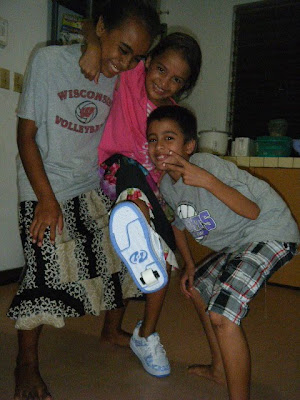
With thanks to a colleague recently returned from a trip to Guam, the youngest is enjoying her Heelys.
All I know is that many stores in Wisconsin have signs that say, "No Heelys allowed." Seems like if wheels on the bottom of our feet was good idea, these signs would not be posted everywhere.
Of course out here there are no signs. This may be because on a campus such as the College of Micronesia-FSM there are mud paths. This is the path the students took in the rain to get to the A+ student services center in order to begin early registration for the spring 2010 term.
Wheels on one's soles are a non-issue in soft, wet, muddy clay. Administration says that there is a sidewalk in the facilities plan. Fortunately our students are rather accustomed to walking under the rain, on mud, in zoris, without getting the backs of the skirts all muddy. This is a true skill that I am still struggling to master - to not flip mud up my back side when walking on zori-suctioning mud.
As a result of the rain the temperatures plummeted under dark skies and snow fell on the distant Palikir mountains.
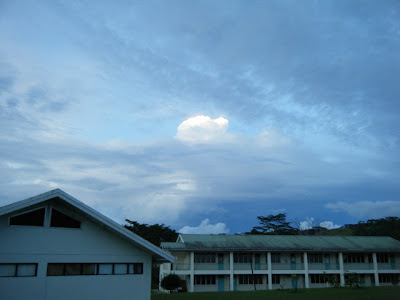
No, not snow, but rather a deck of clouds under other decks of clouds around four in the afternoon. The low white deck stretched across the northern horizon on campus.
At the local elementary school the sidewalks become so slick due to rain and cyanobacteria that the surface becomes effectively frictionless. The kids run and slide on the surface as if it were black ice. Given that, and all the rain, I remain skeptical that the Heelys will ever see much use as Heelys - they seem to be more of a southern California or Australian toy - but they sure made my youngest happy. She's been gliding all around our small home.
All I know is that many stores in Wisconsin have signs that say, "No Heelys allowed." Seems like if wheels on the bottom of our feet was good idea, these signs would not be posted everywhere.
Of course out here there are no signs. This may be because on a campus such as the College of Micronesia-FSM there are mud paths. This is the path the students took in the rain to get to the A+ student services center in order to begin early registration for the spring 2010 term.
Wheels on one's soles are a non-issue in soft, wet, muddy clay. Administration says that there is a sidewalk in the facilities plan. Fortunately our students are rather accustomed to walking under the rain, on mud, in zoris, without getting the backs of the skirts all muddy. This is a true skill that I am still struggling to master - to not flip mud up my back side when walking on zori-suctioning mud.
As a result of the rain the temperatures plummeted under dark skies and snow fell on the distant Palikir mountains.
No, not snow, but rather a deck of clouds under other decks of clouds around four in the afternoon. The low white deck stretched across the northern horizon on campus.
At the local elementary school the sidewalks become so slick due to rain and cyanobacteria that the surface becomes effectively frictionless. The kids run and slide on the surface as if it were black ice. Given that, and all the rain, I remain skeptical that the Heelys will ever see much use as Heelys - they seem to be more of a southern California or Australian toy - but they sure made my youngest happy. She's been gliding all around our small home.
Saturday, November 14, 2009
World Diabetes Day Fun Walk
World Diabetes Day landed on a Saturday this year, allowing for a well attended morning fun walk. First across the finish was a member of the Ardos family.
The female lead finishers.
Three young woman, including a Nakasone, headed in towards the finish line at the state hospital.
Out on the road, septuagenarian Tadesy Yamaguchi is well ahead of a far younger pack.
College students joined in the run as well.
Although none of the kids made it out of bed on an early, dark, rainy, cold Pohnpei morning, all three were up for a hearty breakfast at the Joy Hotel.
I finished the sub-5k loop at a slow 26:45 joggling under the drippy gray skies.
The female lead finishers.
Three young woman, including a Nakasone, headed in towards the finish line at the state hospital.
Out on the road, septuagenarian Tadesy Yamaguchi is well ahead of a far younger pack.
College students joined in the run as well.
Although none of the kids made it out of bed on an early, dark, rainy, cold Pohnpei morning, all three were up for a hearty breakfast at the Joy Hotel.
Thursday, November 12, 2009
Acids and Bases
Laboratory thirteen focuses on uses floral pigments as litmus solutions for determining whether something is an acid or a base.
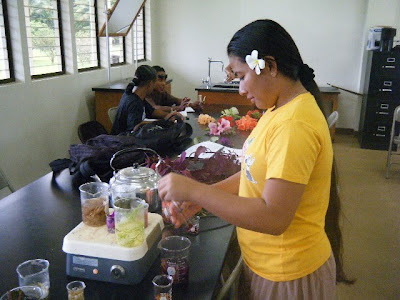
Myleen works on extracting floral litmus solutions. Plants include the flowers of Hibiscus tiliaceus, Hibiscus rosa-sinensis, the orchid Spathoglottis plicata, and the leaves of coleus. Many other leaves and flowers were tested by the students.
The optimal goal was to find a single floral solution that exhibited unique color changes in reaction to an acid or a base. The floral fluid on the left, normally magenta, has turned pink in the presence of an acid and dark grayish-blue in the presence of a base.
Sally-Jean examines a print-out of X11 colors to determine the color of her floral solution. Alfonso records data.
Lynn looks down the table of unknowns to be tested, Warren at the far end.
Verne tests unknowns while making notes. Each term, even each period, tends to find different plants that work differentially well. There are differences in pigment concentrations in some flowers such as H. tiliaceus during the course of the day. This year the purple Spathoglottis orchid appeared to perform well, although it may have an anomalous reaction to mineral lime (calcium carbonate).
Myleen works on extracting floral litmus solutions. Plants include the flowers of Hibiscus tiliaceus, Hibiscus rosa-sinensis, the orchid Spathoglottis plicata, and the leaves of coleus. Many other leaves and flowers were tested by the students.
The optimal goal was to find a single floral solution that exhibited unique color changes in reaction to an acid or a base. The floral fluid on the left, normally magenta, has turned pink in the presence of an acid and dark grayish-blue in the presence of a base.
Sally-Jean examines a print-out of X11 colors to determine the color of her floral solution. Alfonso records data.
Lynn looks down the table of unknowns to be tested, Warren at the far end.
Verne tests unknowns while making notes. Each term, even each period, tends to find different plants that work differentially well. There are differences in pigment concentrations in some flowers such as H. tiliaceus during the course of the day. This year the purple Spathoglottis orchid appeared to perform well, although it may have an anomalous reaction to mineral lime (calcium carbonate).
Wednesday, November 11, 2009
Facebook in Education
FaceBook now supports teacher's who want to set up a page, as opposed to a group, through which to connect with students. The difference between a group and a page is subtle but significant. A class page, as opposed to a group, permits a separate identity, such as "Mr. Jones' Ninth Grade Class" with a separate list of friends (termed fans for a page) from Mr. Jones' personal page. This helps separate family, friends, and students for a teacher. This is, as far as I know, a new capability. Up until about a year ago pages were reserved to people, and then to businesses for a price. Now anyone can start a page - which as noted operates differently than a group.
Buried in FaceBook is their own page on FaceBook in Education which attempts to track educational uses of FaceBook.
As a potential academic platform, FaceBook is maturing and gradually gaining new capabilities. Some of the pieces towards becoming an education platform are already in place. Presentations can be embedded into FB space using SlideShare. SlideShare is a FaceBook app with origins in an independent SlideShare.net web site. SlideShare can import Microsoft PowerPoint and apparently also OpenOffice.org Impress presentations.
File and document sharing is already possible using the My Documents application. Chat is already in place, one of the missing pieces is an online white board, but hints of that technology are already visible in the Visionboard application.
Community colleges have long specialized in bring college to where the student lives, as opposed to state universities that make the student come to the school. Our students already "live" in social media space. I expect that community colleges will probably be in the lead on finding ways to use social media to bring learning to their students.
Buried in FaceBook is their own page on FaceBook in Education which attempts to track educational uses of FaceBook.
As a potential academic platform, FaceBook is maturing and gradually gaining new capabilities. Some of the pieces towards becoming an education platform are already in place. Presentations can be embedded into FB space using SlideShare. SlideShare is a FaceBook app with origins in an independent SlideShare.net web site. SlideShare can import Microsoft PowerPoint and apparently also OpenOffice.org Impress presentations.
File and document sharing is already possible using the My Documents application. Chat is already in place, one of the missing pieces is an online white board, but hints of that technology are already visible in the Visionboard application.
Community colleges have long specialized in bring college to where the student lives, as opposed to state universities that make the student come to the school. Our students already "live" in social media space. I expect that community colleges will probably be in the lead on finding ways to use social media to bring learning to their students.
Monday, November 9, 2009
G2 rainbow
I assess and mark physical science laboratories for grammar, vocabulary, spelling, science content, format, organization, and cohesion using a rubric. With 32 students and a laboratory due every week, I spend roughly six hours every weekend marking laboratory reports.
I realize that I could focus on a one type of error per week and ease my own marking load. This is an approach I have heard used in writing courses. I have found, however, that the laboratory reports improve across all of the areas I mark and improve rapidly early in the term. I hope to get some hard numbers of this improvement later in this term.
The result of this approach is that a laboratory report can wind up literally covered in ink early in the term. The amount of red ink would be enough to cause confusion. Thus I use multiple pen colors, red, blue, black, green, purple, even maroon. I prefer to use Pilot G2 pens - I do a lot of writing and I appreciate the smooth, easy feel of the G2.
I am apparently not alone in this preference - the company claims the pen to be a number one selling gel pen in the United States, they have a strong gel pen market share globally, and there is a cultish following to the pen. Thus I was excited to see a pack of twenty G2 pens in more colors than the seven color Newtonian rainbow.
With the price of G2s on this island, I will only need a small bank loan to afford this 20 pack! I have visions of twenty times the number of comments - or at least an eleven-fold increase (there are duplicates in the twenty pack and only eleven colors produced by Pilot).
By this time each term, the every weekend grind has me wondering whether my writing-across-the-curriculum each and every week is worth the effort I expend. Every weekend has me dragging papers around with me. Yet when I look at what is being turned in at this point in the term, I can see that the students have individually benefited. I am getting better written, more coherent laboratory reports. And the students are now used to cranking out a paper a week. What looked impossible to them the first week is now simply routine.
Some professors spend their every moment engrossed in their research and writing, taking time out only for an occasional lecture of a few hundred students, and leaving to teams of graduate assistants the task of marking and grading. They make important contributions to their fields of research and their names are remembered in their field for those contributions.
I publish not and leave behind no permanent edifice of contributed knowledge. Yet I have no regrets. Every year I again meet former students - this is the nature of living on a small island - and come to know of the impact their education has had on them in life. On a good day, my contribution is to others, not to a field of research. Each has their importance in the role of higher education.
I realize that I could focus on a one type of error per week and ease my own marking load. This is an approach I have heard used in writing courses. I have found, however, that the laboratory reports improve across all of the areas I mark and improve rapidly early in the term. I hope to get some hard numbers of this improvement later in this term.
The result of this approach is that a laboratory report can wind up literally covered in ink early in the term. The amount of red ink would be enough to cause confusion. Thus I use multiple pen colors, red, blue, black, green, purple, even maroon. I prefer to use Pilot G2 pens - I do a lot of writing and I appreciate the smooth, easy feel of the G2.
I am apparently not alone in this preference - the company claims the pen to be a number one selling gel pen in the United States, they have a strong gel pen market share globally, and there is a cultish following to the pen. Thus I was excited to see a pack of twenty G2 pens in more colors than the seven color Newtonian rainbow.
With the price of G2s on this island, I will only need a small bank loan to afford this 20 pack! I have visions of twenty times the number of comments - or at least an eleven-fold increase (there are duplicates in the twenty pack and only eleven colors produced by Pilot).
By this time each term, the every weekend grind has me wondering whether my writing-across-the-curriculum each and every week is worth the effort I expend. Every weekend has me dragging papers around with me. Yet when I look at what is being turned in at this point in the term, I can see that the students have individually benefited. I am getting better written, more coherent laboratory reports. And the students are now used to cranking out a paper a week. What looked impossible to them the first week is now simply routine.
Some professors spend their every moment engrossed in their research and writing, taking time out only for an occasional lecture of a few hundred students, and leaving to teams of graduate assistants the task of marking and grading. They make important contributions to their fields of research and their names are remembered in their field for those contributions.
I publish not and leave behind no permanent edifice of contributed knowledge. Yet I have no regrets. Every year I again meet former students - this is the nature of living on a small island - and come to know of the impact their education has had on them in life. On a good day, my contribution is to others, not to a field of research. Each has their importance in the role of higher education.
Saturday, November 7, 2009
Children of the sunset
I remember with fondness the rare occasions my own father would take me to work with him on a weekend. Relatively empty on a weekend, I had the run of the thirty-first floor. IBM Selectric typewrites ruled the secretarial desks - there were no computers at that time. Within a few short years, however, the typing pool would be replaced by a work processing center, and not to many years after that the word processing center vanished and every secretary had their own word processor.
On an occasional weekend I bring the next generation to the office, an office on the ground floor and located much closer to the equator than that of my own father.
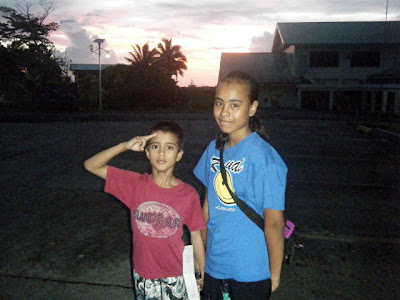
Two of my three with the sunset behind them as we head home.
On an occasional weekend I bring the next generation to the office, an office on the ground floor and located much closer to the equator than that of my own father.
Two of my three with the sunset behind them as we head home.
Cumulus clouds
A line of cumulus clouds formed west of campus at 08:16 on 06 November 2009. The wind was a south wind and the formation was moving northward. This fall has seen the southwest and south winds of a developiong El NiƱo side of the ENSO cycle. From the north end of the complex rain can be seen falling away.
Electricity laboratory
Laboratory twelve centered on the simplest of electrical circuits, electrical conductivity, and Ohm's law.
On the order of half of the students have no prior contact with the experiment known in science education simply as batteries and bulbs. Given one cell, a single length of wire, and a flashlight bulb, make the bulb light. Myleen watched her partner light the bulb. When I asked if she could light the bulb, she said that she could light the bulb. Her own first attempt, however, resulted in a short circuit and a hot wire. I was reminded once again that seeing is never learning, learning only happens when one is doing.
Serleen checks the conductivity of copper using a basic two cell circuit with a flash light bulb. Other materials include zinc, steel, wood, glass, lead, and aluminum. The bulk of the materials are from the local hardware store.
Nadine and Anchyleen look on as materials are tested. A lead fishing weight lays on the paper.
While Antely closes the circuit with a telegraph type switch, Alisi reads the voltmeter. Mason looks on, he was recording data.
For the single bulb the voltage is about 2.3 volts, the current is 0.48 volts. The relationship is not linear. Using two cells for one, two, and three bulbs, there are temperature differences for the bulbs that affect the resistivity.
On the order of half of the students have no prior contact with the experiment known in science education simply as batteries and bulbs. Given one cell, a single length of wire, and a flashlight bulb, make the bulb light. Myleen watched her partner light the bulb. When I asked if she could light the bulb, she said that she could light the bulb. Her own first attempt, however, resulted in a short circuit and a hot wire. I was reminded once again that seeing is never learning, learning only happens when one is doing.
Serleen checks the conductivity of copper using a basic two cell circuit with a flash light bulb. Other materials include zinc, steel, wood, glass, lead, and aluminum. The bulk of the materials are from the local hardware store.
Nadine and Anchyleen look on as materials are tested. A lead fishing weight lays on the paper.
While Antely closes the circuit with a telegraph type switch, Alisi reads the voltmeter. Mason looks on, he was recording data.
For the single bulb the voltage is about 2.3 volts, the current is 0.48 volts. The relationship is not linear. Using two cells for one, two, and three bulbs, there are temperature differences for the bulbs that affect the resistivity.
Subscribe to:
Posts (Atom)