After years of stumbling around in the tropical forests, I have developed a pill that will reduce your risk of heart disease, diabetes, and lower your blood pressure. The pill will both lengthen your life and improve the quality of the lengthened life. There are some provisos, however. You must take the pill every day, although you need take only one a day. The pill consists of all natural unrefined herbal ingredients - which is good news as it means the pill can be classified as a food supplement and not a medicine. This end runs a number of FDA-related issues, as many multi-level marketing food supplement industry types already know.
There is still some work to be done on the formula. At present the pill is rather large. As is very large. Consuming the pill takes a hour. Yes, a whole hour to get the pill down. So you lose an hour a day but add decades to your life. I have not worked out whether the hour loss is offset by the decades of potential gain.
One other complication is that the pill makes you smell bad, stink quite frankly. One has to wash the clothes one was wearing when one took the pill.
In good news, after the age of 40 the prescription eases and one can safely skip taking the pill one day in seven. That said, a daily dose is still the preferred option.
In other good news, the cost of the ingredients is low, at least in the world of medicine. The cost is somewhere around eight to seventeen dollars a month, One usually pays this out in lump sums once every six months to a year.
I suppose the pill is easier to obtain here in the tropics - winter may discourage one from taking the pill. Oh, did I neglect to mention that usually must go outside to take the pill? And remain outside for the full hour?
The pill is now available via my unique global distribution network. The start-up cost for distributors is a good pair of running shorts and shoes, the place to take the pill is the nearest road. Start with small doses, get used to the pill. Maybe even start with walking, build up to running. Until you are running for an hour a day. That is the pill, the magic pill. Every six months to a year replace your shoes. Get your shoes at a store with running specialists if you can - everyone has different feet.
I live in a world in which people believe a pill can work miracles. Where something that is a food supplement is whispered to give hope to diabetics, those with cancer, and cause hair to grow on bald heads. Sometimes there is so much despair and loss of hope in a land wracked by epidemic levels of non-communicable diseases. Yet so few will take the one pill that will really work. Vigorous, sweat inducing, 75% VO-max exercise.
Get out there and run. Run for your life, your good healthy life.
Friday, October 30, 2009
Monday, October 26, 2009
All in the configuration
As a post-script to my assessment of page delivery speed blogicle, I learned that the optimal configuration for a desktop on our system had changed a couple years ago. This sort of thing is not announced as it typically confuses the end user. With a change in configuration my desktop now pulls local pages at light speed.
Sunday, October 25, 2009
An assessment of local web page load times
The ability to effectively use technology such as Smart boards in our classrooms depends directly on the responsiveness of the network serving those technologies. To borrow a Sun Systems slogan, "the network is the computer." While some faculty rely heavily on PowerPoint presentations which being locally stored have little load time latency, the real power of present day learning technologies is only unleashed when they are connected to network and Internet resources.
The page load time data further below is the duration of time in seconds for web pages on the college server to completely load on my desktop in the south faculty building. The desktop used, although the oldest in the division, is an Windows XP machine with two gigabytes of RAM. This combination yields a very responsive and fast desktop. Load speeds are not significantly affected by the desktop hardware.
The desktop is connected via a 100 Mbps connection to a 10/100 hub. I am uncertain of the specifics beyond my local hub, but I gather that hub connects at 100 Mbps to a building hub or switch, which then connects via fiber to the administration building at gigabit speeds. None of the pages accessed involved connecting to resources from beyond the local area network and the Palikir server.
Making sense of the duration data: web page size information
All of the pages loaded are in a single folder on the server ( http://www.comfsm.fm/~dleeling/physci/text/ ). The pages are those that comprise my physical science text. Although there are 51 pages, times were obtained for only 39 page load attempts. My primary task was the printing of the second edition of the text for the book store. There were instances when I did not capture the load duration data. I was loading and then printing the sections. In FireFox 3.6, a print job has to be completed prior to loading a new page.
The web pages are both html5 and xhtml5 web pages. The xhtml5 utilize MathMl and SVG to present equations and diagrams. This greatly reduces the number of image files required in the text. Only a couple of pages make extensive use of images, laboratory seven and eleven. In both cases, the browser is likely to cache the image on a first load and thus subsequent loads will be faster.
All style information for the pages is contained in one of two css files, these are also cached by FireFox and thus are not necessarily loaded on the wire with each page request.
Page size statistics
The mean page size is 9950 bytes, with half of the pages less than the median of 8552 bytes. The largest page is 35020 bytes. None of these statistics includes the attached image files. Once the html or xhtml loaded, the images generally loaded immediately from the cache. These are pages I access with frequency. In some cases I was making minor edits to the pages using secure copy protocol (WinSCP) and then reloading the page in order to print the page.
For reference, these page sizes are small in terms of modern Internet pages. "From 2003 to 2008 the average web page grew from 93.7K to over 312K" (WebSiteOptimization.com) That puts my largest page at less than half of the 2003 average size, and my mean page size at a tenth of the average web page size. These physical science pages are simply tiny in terms of size. If there is difficulty in loading these small and efficiently coded pages, then there is little hope of loading the average modern web page in 2009.
In other words, these pages should load far faster than random pages pulled from the server to a desktop with an empty cache. These pages are also far smaller than the typical Internet page found "in the wild." The duration data reported below is effectively the fastest possible times one can hope to obtain from the college server.
Duration data
The following table records the load times for 39 html and xhtml files starting at 2:00 P.M. on Monday 19 October 2009. Thus these load times reflect "business day" data. Time were measured using my digital watch. No specialized equipment was used, but then as the data shows, load time durations are not in the sub-second range where millisecond precision would be useful.
Progressive loading means that the page began to load prior to the browser's 30 second time-out limit. If the browser receives no data from the server within 30 seconds, then the browser indicates failure of the page to load and terminates the page request.
Duration statistics
The mean load time for these pages was 17 seconds, with half of the pages taking 12 seconds or more to load. The mean page load time for similar pages under similar network conditions will be between 13 and 21 seconds. At first glance, this might not seem that long. Yet in the classroom this represents a very long pause.
On the weekends pages such as those above load in under a second, virtually instantaneously. While ideal, this may not necessarily be realistic during the business day at the college. I think it was Mary Wilgocki, formerly of REI and subsequently a member of the college Title III team as the IT specialist, who noted that at REI the goal was response times to telephone order salesperson's desktops of under three seconds. I may have that number too high, it might have been less, but certainly not more. The reason was business driven - a wait time of over three seconds gave the customer on the phone time to reconsider their purchase. REI lost orders when wait times exceeded something on the order of a couple seconds. Pause for moment and count one-one thousand, two one-thousand, three one-thousand. Time enough to think, or for a student to become distracted.
For some hard numbers, the WM100 is a performance benchmark based on the average page load times for 100 of the most visited sites on the Internet, as reported by Alexa ( WebMetrics.com accessed on 25 October 2009, data updated hourly ). The median load time for the top 100 is 4.4 seconds, with number three Google loading html in an average of 0.45 seconds and the full page in 0.73 seconds. Clearly local network load times should be well under these Internet values.
In my teaching methods courses I was taught to count off six seconds after asking a question in class. Six seconds is a long pause, but many instructors jump into the perceived uncomfortable silence long before six seconds.
Thus having pages take 12 or more seconds to load is an intensely long period of time in a classroom situation. To have a page time out after 30 seconds almost completely disrupts the flow of a classroom presentation.
For students in courses such as mine where academic support materials are all available on line, the long load times impede their ability to effectively and efficiently study by using the material I have placed on the college servers.
Discussion
The page load times for locally stored and served pages is entirely within the ability of the college to remedy. This does not involve connectivity to the Internet. In fact, any expectation of improved bandwidth off-island via the fiber optic cable arriving this December on Pohnpei has to be tempered by the reality that our own core systems are slow to deliver local pages even on high speed LANs. I cannot imagine what the load times would look like from WAN locations beyond the Palikir campus.
There is a tendency to blame social media for the lack of bandwidth. This leads to solutions such as throttling back social media sites during the business day. While I do not disagree with this approach, it is rather like solving the problem of children getting infected cuts on their feet by restricting them to padded bedrooms and not letting them play outside. Solving this issue by trying to find new restrictions to attempt to more effectively use the college's all too limited bandwidth is a band aide approach at best. Given that this is being done already, the data above indicates how insufficient this approach is at present.
The most explosive area of growth in education is in on line videos, often via YouTube and other video sharing sights. These sites often double as social media sites. Throttling back these sites would also limit access to educationally useful material. There is no way our current network could begin to deliver the series of ocean science streaming videos now embedded in version five of Google Earth. The issue of social media site access and throttling is dwarfed by demands streaming video would place on the system.
Yet streaming video, including live feeds such as Skype, are likely to be important to distance education efforts here at the college.
Conclusion
This data is meant in good faith and to support IT in funding requests to upgrade the network core at the college. Servers and networks can deliver pages to sites such as ours in under a second. There are thousands of vastly larger enterprises on the planet that deliver pages to more users. This is actually not rocket science - this is simply an equipment issue. This is something that money can solve.
The page load time data further below is the duration of time in seconds for web pages on the college server to completely load on my desktop in the south faculty building. The desktop used, although the oldest in the division, is an Windows XP machine with two gigabytes of RAM. This combination yields a very responsive and fast desktop. Load speeds are not significantly affected by the desktop hardware.
The desktop is connected via a 100 Mbps connection to a 10/100 hub. I am uncertain of the specifics beyond my local hub, but I gather that hub connects at 100 Mbps to a building hub or switch, which then connects via fiber to the administration building at gigabit speeds. None of the pages accessed involved connecting to resources from beyond the local area network and the Palikir server.
Making sense of the duration data: web page size information
All of the pages loaded are in a single folder on the server ( http://www.comfsm.fm/~dleeling/physci/text/ ). The pages are those that comprise my physical science text. Although there are 51 pages, times were obtained for only 39 page load attempts. My primary task was the printing of the second edition of the text for the book store. There were instances when I did not capture the load duration data. I was loading and then printing the sections. In FireFox 3.6, a print job has to be completed prior to loading a new page.
The web pages are both html5 and xhtml5 web pages. The xhtml5 utilize MathMl and SVG to present equations and diagrams. This greatly reduces the number of image files required in the text. Only a couple of pages make extensive use of images, laboratory seven and eleven. In both cases, the browser is likely to cache the image on a first load and thus subsequent loads will be faster.
All style information for the pages is contained in one of two css files, these are also cached by FireFox and thus are not necessarily loaded on the wire with each page request.
Page size statistics
| Statistic | Size (bytes) |
| Count | 51 |
| Min | 1806 |
| Max | 35020 |
| Mode | None |
| Median | 8552 |
| Mean | 9950.94 |
| StDev | 7687.73 |
| Coef Variation | 0.77 |
The mean page size is 9950 bytes, with half of the pages less than the median of 8552 bytes. The largest page is 35020 bytes. None of these statistics includes the attached image files. Once the html or xhtml loaded, the images generally loaded immediately from the cache. These are pages I access with frequency. In some cases I was making minor edits to the pages using secure copy protocol (WinSCP) and then reloading the page in order to print the page.
For reference, these page sizes are small in terms of modern Internet pages. "From 2003 to 2008 the average web page grew from 93.7K to over 312K" (WebSiteOptimization.com) That puts my largest page at less than half of the 2003 average size, and my mean page size at a tenth of the average web page size. These physical science pages are simply tiny in terms of size. If there is difficulty in loading these small and efficiently coded pages, then there is little hope of loading the average modern web page in 2009.
In other words, these pages should load far faster than random pages pulled from the server to a desktop with an empty cache. These pages are also far smaller than the typical Internet page found "in the wild." The duration data reported below is effectively the fastest possible times one can hope to obtain from the college server.
Duration data
The following table records the load times for 39 html and xhtml files starting at 2:00 P.M. on Monday 19 October 2009. Thus these load times reflect "business day" data. Time were measured using my digital watch. No specialized equipment was used, but then as the data shows, load time durations are not in the sub-second range where millisecond precision would be useful.
| Time | 14:00 |
| Load time (s) | Comments |
| 5 | |
| 6 | |
| 12 | |
| 7 | |
| 12 | |
| 30 | failed: time out |
| 28 | |
| 30 | |
| 10 | |
| 12 | |
| 37 | progressive loading |
| 30 | |
| 12 | |
| 9 | |
| 7 | |
| 35 | progressive loading |
| 13 | |
| 5 | |
| 13 | |
| 1 | less than one |
| 3 | |
| 5 | |
| Time | 15:30 |
| 27 | |
| 30 | failed: time out |
| 14 | |
| 21 | |
| 5 | |
| 8 | |
| Time | 15:35 |
| 30 | failed: time out |
| 30 | failed: time out |
| 30 | css failed to load |
| 13 | |
| 30 | failed: time out |
| 22 | |
| 36 | progressive loading |
| 11 | |
| 10 | |
| 9 | |
| 10 |
Progressive loading means that the page began to load prior to the browser's 30 second time-out limit. If the browser receives no data from the server within 30 seconds, then the browser indicates failure of the page to load and terminates the page request.
Duration statistics
| Statistic | Value (seconds) |
| Count | 39 |
| Min | 1 |
| Max | 37 |
| Mode | 30 |
| Median | 12 |
| Mean | 16.87 |
| StDev | 11 |
| Coef Variation | 0.65 |
| Lower 95% ci | 13.31 |
| Upper 95% ci | 20.44 |
The mean load time for these pages was 17 seconds, with half of the pages taking 12 seconds or more to load. The mean page load time for similar pages under similar network conditions will be between 13 and 21 seconds. At first glance, this might not seem that long. Yet in the classroom this represents a very long pause.
On the weekends pages such as those above load in under a second, virtually instantaneously. While ideal, this may not necessarily be realistic during the business day at the college. I think it was Mary Wilgocki, formerly of REI and subsequently a member of the college Title III team as the IT specialist, who noted that at REI the goal was response times to telephone order salesperson's desktops of under three seconds. I may have that number too high, it might have been less, but certainly not more. The reason was business driven - a wait time of over three seconds gave the customer on the phone time to reconsider their purchase. REI lost orders when wait times exceeded something on the order of a couple seconds. Pause for moment and count one-one thousand, two one-thousand, three one-thousand. Time enough to think, or for a student to become distracted.
For some hard numbers, the WM100 is a performance benchmark based on the average page load times for 100 of the most visited sites on the Internet, as reported by Alexa ( WebMetrics.com accessed on 25 October 2009, data updated hourly ). The median load time for the top 100 is 4.4 seconds, with number three Google loading html in an average of 0.45 seconds and the full page in 0.73 seconds. Clearly local network load times should be well under these Internet values.
In my teaching methods courses I was taught to count off six seconds after asking a question in class. Six seconds is a long pause, but many instructors jump into the perceived uncomfortable silence long before six seconds.
Thus having pages take 12 or more seconds to load is an intensely long period of time in a classroom situation. To have a page time out after 30 seconds almost completely disrupts the flow of a classroom presentation.
For students in courses such as mine where academic support materials are all available on line, the long load times impede their ability to effectively and efficiently study by using the material I have placed on the college servers.
Discussion
The page load times for locally stored and served pages is entirely within the ability of the college to remedy. This does not involve connectivity to the Internet. In fact, any expectation of improved bandwidth off-island via the fiber optic cable arriving this December on Pohnpei has to be tempered by the reality that our own core systems are slow to deliver local pages even on high speed LANs. I cannot imagine what the load times would look like from WAN locations beyond the Palikir campus.
There is a tendency to blame social media for the lack of bandwidth. This leads to solutions such as throttling back social media sites during the business day. While I do not disagree with this approach, it is rather like solving the problem of children getting infected cuts on their feet by restricting them to padded bedrooms and not letting them play outside. Solving this issue by trying to find new restrictions to attempt to more effectively use the college's all too limited bandwidth is a band aide approach at best. Given that this is being done already, the data above indicates how insufficient this approach is at present.
The most explosive area of growth in education is in on line videos, often via YouTube and other video sharing sights. These sites often double as social media sites. Throttling back these sites would also limit access to educationally useful material. There is no way our current network could begin to deliver the series of ocean science streaming videos now embedded in version five of Google Earth. The issue of social media site access and throttling is dwarfed by demands streaming video would place on the system.
Yet streaming video, including live feeds such as Skype, are likely to be important to distance education efforts here at the college.
Conclusion
This data is meant in good faith and to support IT in funding requests to upgrade the network core at the college. Servers and networks can deliver pages to sites such as ours in under a second. There are thousands of vastly larger enterprises on the planet that deliver pages to more users. This is actually not rocket science - this is simply an equipment issue. This is something that money can solve.
Thursday, October 22, 2009
Reflection and refraction optical laboratory
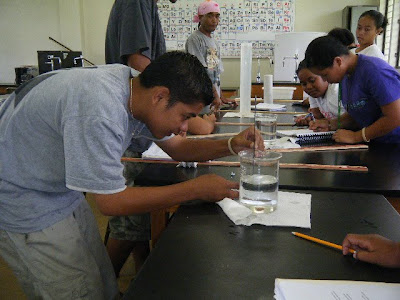
Kevin works on the apparent depth of a penny in water. The slope of a line plotting the image depth for the penny versus the actual (object) depth for the penny is the index of refraction for the water the penny is in.
Cassandra and Marsela work on the apparent depth of their penny.
Prens makes a measurement while Warren looks on.
Brenda considers her reflection set up.
Anchyleen works on the position of the image while Aleen holds the mirror.
Alphonso tries to gauge the depth of the image.
Cassandra and Marsela work on the apparent depth of their penny.
Prens makes a measurement while Warren looks on.
Brenda considers her reflection set up.
Anchyleen works on the position of the image while Aleen holds the mirror.
Alphonso tries to gauge the depth of the image.
Turning even
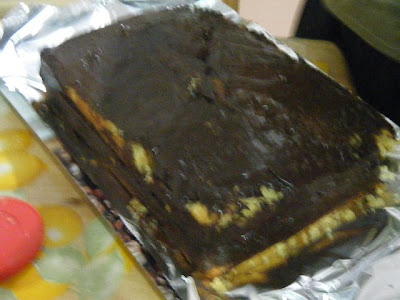
The cake was so moist that it fractured. Despite appearances, the cake had a wonderful almost pudding-like moistness.
Even is ready to blow out the candles. Prior to the special day she had noted that it is better to be even number than an odd number. Later she realized that she will be odd in another year, and asked if odd numbers really were bad.
Play dough is fun at any age!
Rainy day beading.
Hair styling with play dough.
Even is ready to blow out the candles. Prior to the special day she had noted that it is better to be even number than an odd number. Later she realized that she will be odd in another year, and asked if odd numbers really were bad.
Play dough is fun at any age!
Rainy day beading.
Hair styling with play dough.
Sunday, October 18, 2009
Kamadipw en Kousapw Dien
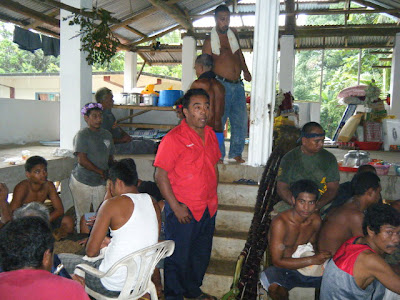
On Saturday 17 October kousapw Dien, Kitti, in Pohnpei honored Soulik Elwel Oaulik Samuel and celebrated another successful year. A kamadipw is a gathering of friends and family, a party, and a kamadipw en kousapw is a relaxed, informal party. Sakau, yams, pigs, sugar cane, and lots of food are central to the activities for the day.
Speeches thank the members of the kousapw, a land unit on Pohnpei, for their hard work and contributions over the past year. Speeches can also lay out the plans for the coming year in the kousapw. At the center of the ceremonial aspects of the kamadipw is the sakau ceremony. The sakau ceremony is involves pounding the sakau and then the presentation of cups.
A kamadipw en kousapw is light-hearted and easy going. Entertainment can include songs on a ukelele and the occasional dancing of a woman who gets caught up in the excitement of the moment.
Leading Kousapw Dien is Elwel Oaulik Samuel.
The kamadipw is a family affair for all ages.
More photos of the festivities!
Speeches thank the members of the kousapw, a land unit on Pohnpei, for their hard work and contributions over the past year. Speeches can also lay out the plans for the coming year in the kousapw. At the center of the ceremonial aspects of the kamadipw is the sakau ceremony. The sakau ceremony is involves pounding the sakau and then the presentation of cups.
A kamadipw en kousapw is light-hearted and easy going. Entertainment can include songs on a ukelele and the occasional dancing of a woman who gets caught up in the excitement of the moment.
Leading Kousapw Dien is Elwel Oaulik Samuel.
The kamadipw is a family affair for all ages.
More photos of the festivities!
Location:
Dien, Kitti, Pohnpei
Ethnobotanical garden clean-up
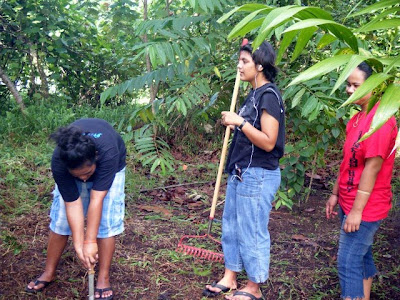
On 15 October the SC/SS 115 Ethnobotany class performed a midterm clean-up of the ethnobotanical garden. Angielyne Aten was the photographer. The garden was in better shape than it had been in August, although the Hibiscus tiliaceus was overgrowing to the south of the mango tree. Simiai Manuel, a member of the college security forces, and I worked on the H. tiliaceus.
Alwihter Moya hand pulls weeds in the central area of the garden.
Kristina Hadley.
Girlynn and Gendalin.
Alwihter Moya hand pulls weeds in the central area of the garden.
Kristina Hadley.
Ethnobotany food presentations
Nayleen of Pohnpei presents uht moatoar (pounded or ground banana).
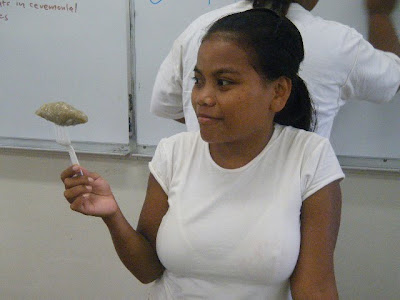
Fermented breadfruit, Chuukese kon. This is a must-have food for any happy gathering in Chuuk.
Fried bananas is a basic but favorite dish.
The fried banana was presented by a Pohnpeian group including Alwihter, Tracy, and Bersin.
Charlene and Kristina presenting uht kekihr and mwahng erier.
Trisha Dawn presented food from Mwokilloa.
After the presentations, the class enjoyed tasting the many dishes from across Micronesia.
Charmarie, Kristina, and Charlene chatting over an all local meal.
Fermented breadfruit, Chuukese kon. This is a must-have food for any happy gathering in Chuuk.
Fried bananas is a basic but favorite dish.
Charlene and Kristina presenting uht kekihr and mwahng erier.
Trisha Dawn presented food from Mwokilloa.
After the presentations, the class enjoyed tasting the many dishes from across Micronesia.
Charmarie, Kristina, and Charlene chatting over an all local meal.
Tuesday, October 13, 2009
Paradise Puff Pillows
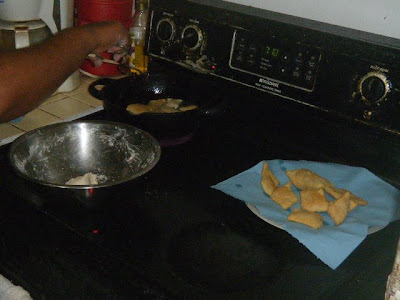
After enjoying them in Wisconsin, Shrue tried her hand at puff pillows. The result was an instant favorite.

Paradise Puff Pillows

Paradise Puff Pillows
2 cups flour
1 and 1/2 teaspoons baking powder
1 teaspoon salt
2 teaspoons shortening
Mix the above ingredients, adding enough luke warm water to reduce sticking to hands. Knead the mixture until smooth. Divide into two loaves and roll each out to 1/4 inch thick. With knife, cut into six or eight pieces. To cook, drop pieces into extremely hot oil or shortening. Turn almost immediately. They will usually puff on the first turn. Remove from grease when golden brown. Serves 3 or 4. Make 1 and 1/2 times the recipe for family - 2 times if we had guests.
Drawing clouds
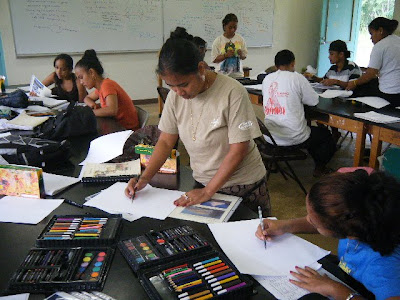
Alisi works on sketching clouds while referring to images.


Antely at work pre-sketching her cloud type. Laboratory eight is about observing and then recording accurately via a drawing.


The rubric is an art rubric. This introduces observation into the course as well as providing exposure to the use of an artistically based rubric. Ivyrose works on her sketch.


Monday, October 12, 2009
Gymnosperm presentations
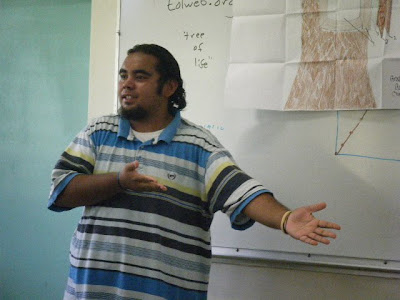
Garry Nanpei presents the layers of a typical gymnosperm/angiosperm (dicot).
Julie Dickson Anton introduces angiosperms.
Hermina covers the difference between monocots and dicots.
Kristina assists Hermina.
Riantho in action.
Julie Dickson Anton introduces angiosperms.
Hermina covers the difference between monocots and dicots.
Kristina assists Hermina.
Riantho in action.
Wednesday, October 7, 2009
Shrue returns from Manila
Shrue returned today from her journey to the Philippines. She arrived after tropical storm Ketsana (Ondoy).
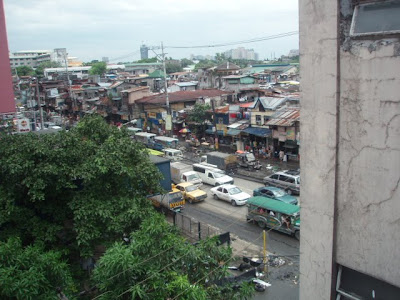
Across the road were stores that sold rice and other food stuffs.This view is from the Delos Santos Medical Center in Quezon City, Philippines.
On the heels of Ketsana came Parma (Pepang), sending flooding rains back into Quezon City.
The food production capabilities at Delos Santos were in the basement, they had not recovered when Quezon City reflooded. Food in the hospital collapsed to chicken in soy sauce with rice.
Water three meters deep from the San Juan river had inundated the hospital. Eventually MiCare (FSM national health insurer) had to de facto evacuate patients from Delos Santos. Shrue spent a night at Capitol Medical before flying out to Guam.
On her way home, Shrue did have a better time on Guam, seen here with Virginia Waguk.
Shrue also got to join the gathering on Guam welcoming her father on Tuesday evening.
Her father is on a pastoral visit to the Kosraean Congregational Church of Guam.
Across the road were stores that sold rice and other food stuffs.This view is from the Delos Santos Medical Center in Quezon City, Philippines.
On the heels of Ketsana came Parma (Pepang), sending flooding rains back into Quezon City.
The food production capabilities at Delos Santos were in the basement, they had not recovered when Quezon City reflooded. Food in the hospital collapsed to chicken in soy sauce with rice.
Water three meters deep from the San Juan river had inundated the hospital. Eventually MiCare (FSM national health insurer) had to de facto evacuate patients from Delos Santos. Shrue spent a night at Capitol Medical before flying out to Guam.
On her way home, Shrue did have a better time on Guam, seen here with Virginia Waguk.
Shrue also got to join the gathering on Guam welcoming her father on Tuesday evening.
Her father is on a pastoral visit to the Kosraean Congregational Church of Guam.
Friday, October 2, 2009
Good hair day, useless hairdresser
Every day is a good hair day for my daughter. At present, however, her hairdresser - being me - is incompetent.
The new morning routine is early up, eat, shower, and dress. No morning chores - they are all shifted to the afternoon and evening. The result is a sleepy breakfast crowd.
Latitude, longitude, minutes, and meters
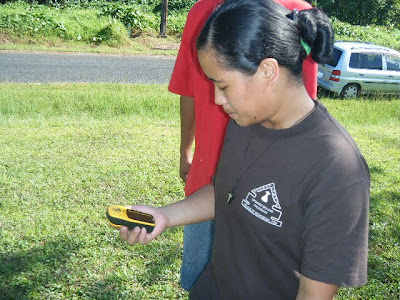
The SC 130 Physical Science class engaged in an exercise that ultimately leads to determining the circumference of the earth at the latitude of Pohnpei. Using GPS units to determine their latitude and longitude, the class walked a line of latitude in laboratory seven, recording the change in longitude. Marsela watches the latitude and longitude on an eTrex GPS unit, ensuring she remains on the correct latitude as she walks west.
The class has access to five GPS receivers, Lynn led another team along the line of latitude.
Annie rolled the surveyor's wheel in the morning laboratory class. While both the morning and afternoon classes were sunny, the morning class left everyone soaking wet. The air was all but saturated with water, a humidity haze colored the ridge to the east blue. By midday the temperature had climbed, lowering the relative humidity, and making conditions actually more comfortable.
In the midday lab Sally-Jean rolled the surveyor' wheel.
The wheel has a circumference of three feet. The distance is converted to meters and compared to the distance in meters calculated by the GPS units and to the distance in meters later obtained from the Google Earth ruler.
Annie rolled the surveyor's wheel in the morning laboratory class. While both the morning and afternoon classes were sunny, the morning class left everyone soaking wet. The air was all but saturated with water, a humidity haze colored the ridge to the east blue. By midday the temperature had climbed, lowering the relative humidity, and making conditions actually more comfortable.
In the midday lab Sally-Jean rolled the surveyor' wheel.
The wheel has a circumference of three feet. The distance is converted to meters and compared to the distance in meters calculated by the GPS units and to the distance in meters later obtained from the Google Earth ruler.
Gymnosperm and economic botany field trip
The SC/SS 115 Ethnobotany class journeyed to the Pohnpei State Botanic Garden at Pwunso, in Kolonia, Pohnpei. The field trip focused on gymnosperms and plants with economic value.
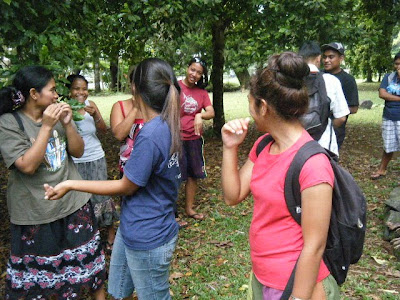
Crushing, smelling, and even occasionally tasting the spice plants was encouraged.
Nicole examines a leaf while Kristina strikes a pose.
The guided tour included cloves, Norfolk Island pine, cinnamon, a cycad, coffee, black pepper, nutmeg, carambola star apple, mahogany, teak, painted eucalyptus, allspice, Callophylum inophyllum, and kauri pine.
Jaykay, Randall, and Angielyne.
Sylvana and Sayleen in front, Girlynn, Beautrina, Nayleen,and Daryl just behind along the road.
Emillia examines Averrhoa carambola, the star apple tree. Girlynn and Sylvana look on at the tree. This Japanese introduction is locally known as ansou.
Crushing, smelling, and even occasionally tasting the spice plants was encouraged.
Nicole examines a leaf while Kristina strikes a pose.
The guided tour included cloves, Norfolk Island pine, cinnamon, a cycad, coffee, black pepper, nutmeg, carambola star apple, mahogany, teak, painted eucalyptus, allspice, Callophylum inophyllum, and kauri pine.
Jaykay, Randall, and Angielyne.
Sylvana and Sayleen in front, Girlynn, Beautrina, Nayleen,and Daryl just behind along the road.
Emillia examines Averrhoa carambola, the star apple tree. Girlynn and Sylvana look on at the tree. This Japanese introduction is locally known as ansou.
Subscribe to:
Posts (Atom)