Tuesday, April 28, 2009

Lunch options

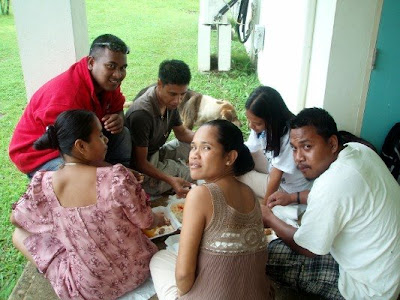
Our students truly lack options on places to eat lunch on rainy days here on Pohnpei. The lack of an actual student union building, a dedicated facility for the students, and a paucity of sheltered places in which to dine, has our students gathering to eat in any corner they can find. Few stretches of sidewalk are under cover, despite rain fall in Palikir running upwards of 510 centimeters per annum.

One does have to fend off the begging dogs, but our students maintain their sense of humor and composure in the face of the odd conditions under which they often dine.
Saturday, April 25, 2009

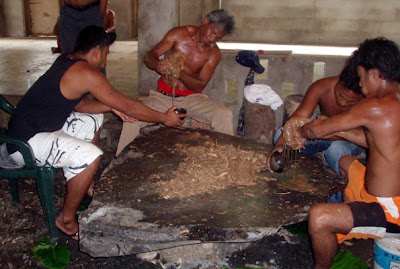
Ethnobotany class observes sakau ceremony

The SC/SS Ethnobotany class was hosted by Senator Dahker "Nahnihd" Daniel at his nahs in Pehleng, Kitti.

The students observed the traditional preparation and the ceremonial serving of the first five cups. Tyson, Dexter, Christopher, and Redeemer observe the pounding of the sakau.

Women sit along the sides of the nahs. Roxcindlina, Tesiann, Tracy, Krystal, Aleen, and Melojane.

The ceremony included the four pwoaikoar leaves of the wild taro.

The stone is a rare "singing stone" that produces different notes from different places and resonates after each strike like a bell.

The menindei for the ceremony was the highly respected expert on Kitti traditions, Soumaka.

Our host, Nahnihd, is called to the ngarangar.

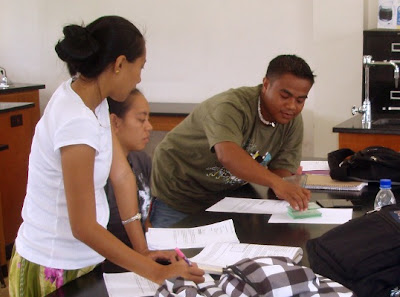
Index of refraction for glass using image depth

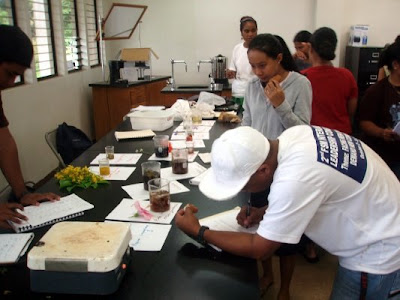
Marlinda and Welianter attempt to measure the image depth while Elsieleen looks on.

Below, Charles is working on the apparent depth of a penny. My own preference is to use a flat sheet of paper with printing on it.

To the right of Charles' stack are pieces of tinted window louver. These are too dark to be useful.

This particular laboratory exercise depends on a supply of old window louvers. The complication is that the louvers are usually coated with a coralline layer that is all but impossible to remove. Put away the ammonia based cleaner - those are useless. I was able to restore very old panes to near new transparency using a sulfuric acid based toilet bowl cleaning compound. Use gloves and goggles! The louver above had only the right hand side cleaned.

Tuesday, April 21, 2009

Cloud watching

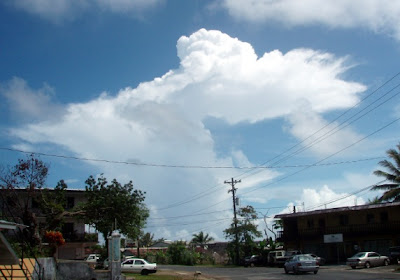
A cumulus build north of Kolonia experiences mid-level sheer on the ninth of April.

A rebalance of the sky over the College of Micronesia-FSM Learning Resource Center yields a striking image of the cloud structure on the sixteenth of April. Cumulis humilis is under an extended deck of mid-level clouds associated with rain cells. April is the season when the intertropical trough passes northwards over the FSM.

Sunday, April 19, 2009

Running: no trash talk required

A colleague was talking trash to another colleague about an upcoming sporting event. Depending the season my colleagues talk trash about basketball, baseball, or football. The kind of fellows who also engage in fantasy football, who say things like "We are going to beat you on Sunday." I sometimes ask, "We who? You are not on the team." The players are not even from (pick the team and its city of your choice). The players are all hired guns, ringers, outsiders. There is no particular loyalty to a particular city.

Last week I asked a colleague who lives for "his teams" whether he was going to join Saturday's 5k walk/run. "I would beat you so bad! You would be eating my dust," was the first thing he said. That caught me off guard. I wasn't even thinking of who might beat who, I was just inviting a friend to join in the fun.

Although my colleagues would never understand, runners do not talk trash. On the contrary, runners more often sandbag. Running is not a couch potato's sport. Quite frankly, running is boring to watch except possibly for a runner. Running is a participative activity. Runner's know all too well the dozens of things that can go wrong during a running event. Runners will usually talk down their ability. Runners know that you are only as good as your last run, each run is a new opportunity to potentially fail. Runners prove themselves one run at a time, and for many runners, we prove ourselves only to ourselves.

I looked at my colleague. He is carrying a few extra pounds, not a lot, but enough. He does not run. He does not exercise walk. Once in a while he shoots a sphere at a metal ring in his back yard. Based on time logged, his primary form of sports participation is as an ESPN couch potato. Not yet middle aged, but given the diet out here one has to consider that a serious 5k run on that Saturday in the heat and humidity of Pohnpei could have left his wife a widow and his daughter fatherless. More likely he would finish at a walk.

I had no goal to win, my usual goal is to try to come in under 30 minutes. In 2008 I finished the Women in Sport 5k in 29:07. That was a good run. On Saturday I was wearing
Environmentally Neutral Design
Stumptowns, shoes that are much lighter than the usual motion control shoes such as the Mizuno Wave Renegade IV shoes I have been wearing over the past year.

I have been running more consistently since July of last year. Coupled with more consistent running and the faster turnover that the END shoes seem to encourage in my feet, I ran an 8k out and back to the airport at under a six minute per kilometer pace during the week before the 5k.

Encouraged by my sense of fitness, I went out harder than I usually do on a 5k that Saturday. I hung on to my pace choice, using my tennis ball heights and a focus on my slight forward lean that chi-running introduced me to. No, I am not a chi runner. I do it all wrong. Still, I think about my form and posture a lot more since reading the book.

The section of the route along main street is a double-back. As I passed runners who were ahead of me running the other way back to the finish I would shout out, "Kampare!" a Pohnpeian adaptation of a Japanese word of encouragement.

Coming up Namiki in the final 500 meters I was winded and my leg muscles were tiring, but the weather was gorgeous. Sunny, not yet beastly humid and hot. I dug down into my inner geek and asked myself, "What would Worf say?" A runner I came up on had also gone out fast, then dropped to a trot, and had now dropped to a walk. As I came up alongside him I said, "Almost there! Let's go! Today is a good day to..." and I was on past him.

No, runners do not talk trash. The last thought in my mind as I passed him was, "I am going to make him eat my dust." On the contrary, I wanted him to "win" too. Of course neither of us were "winners" in the sense that my colleagues understand winning. For them there is only number one. The winner of Saturday's 5k was long ago finished and done, I know him personally and he is a very humble fellow who only shares his times if he is asked.

I would cross the line in 26:43, a very good day for me indeed. I felt a shot of pure joy, and then I turned around and headed back up route to find my kids and give them encouragement. Runners support each other, encourage each other, even while competing whether for the "win" or simply against their own goals. Finishing is winning, no trash talk required.

Saturday, April 18, 2009

Women in Sports 5k run

Ran the Women in Sports 5k run this morning, joggling to a 26:43 finishing time. No pictures of the photographer - not until the next generation is faster.

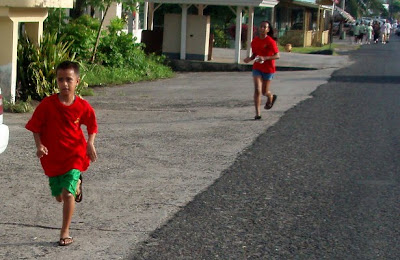
The middle ahead of the elder, they would swap positions by the end of the 5k.

Passing the tire shop along Namiki-Dori

The middle one crossing the finish line. Meanwhile, well back down the route, the youngest and a friend brought up the family tail. The youngest was along principally for the after-run breakfast at the Joy Hotel.

This run featured the first time that I recall an "official" spectator that cheered the runners. The spectator even had a sign she held up. Very inspiring, and a first for this runner.

Friday, April 17, 2009

Floral pigments as litmus solutions

In physical science laboratory 132, the students gather flowers to test as potential litmus solutions. Once a floral pigment is found to be effective - changes to different colors when an acid or base is added, then the floral litmus solution is used to test household products to determine if they are acidic, basic, or neutral.

The flower petals are boiled in water. Hibiscus tiliaceus and a dark red coleus often prove to be most effective in detecting acids and bases.

Nicole studies a color chart. The student's tables include a description of the color. Color descriptions are based not on a scientific color scheme, but rather a more common set of colors - those found in a box of Crayola crayons. The students also have reference to the X11 colors they learned about in laboratory 11.

Divine Grace and Chersea also study a color chart.

Yasko tests the household "unknowns".

Benskin and Nicole.

Sunday, April 12, 2009

Easter Pineapples

Spring break is cleaning season. The least favored task: weeding in the pineapple patch.

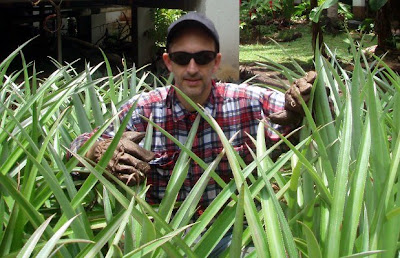
Flannel: not just for cold weather. Our pineapples are not the same as the one's seen in stores abroad. These plants produce a small, almost round fruit that is very sweet. The pineapple does not even taste "pineapply." The downside is that these pineapples have ferociously sharp recurved thorns, tiny little thorns, that break off just under the skin. Vicious little thorns.

Despite the flannel shirt, pineapple thorn damage to my forearm.

Shrue and friend.

New outfits for Easter Sunday! The eldest has entered a teen phase in which one does not smile for photographs taken by parents. The world is about teen angst, misery, and the general oppression of parental units.
Posted by Picasa

Friday, April 10, 2009

Kosrae Congregational Good Friday service

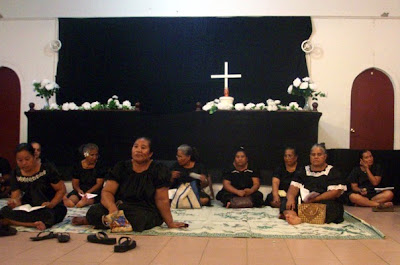
In the evening of Good Friday, the Kosrae Women's Christian Association presents a special program of song, prayer, and bible passages. The evening starts off in the light.

The front of the altar is not only draped in black, but the holy place is sealed off from the congregation.

Alice, Sepe, and Notwe prepare for the program to come.

Emliana reads a passage from the bible in Kosraean. The windows are covered with dark blue fabric.

At the hour of the reckoning, the darkness falls, literally. All lights go out, not a candle is lit. The women sit in the dark, alternating reciting passages from the cross interspersed sorrowful songs. Their voices crack with a deep and visceral sadness that casts a pall over those in the church. In the dark some of the women are heard softly crying. The emotional impact on one sitting and listening in the dark is unexpectedly powerful, moving, and evokes a sense of both fear and intense loss.

As the program draws to a close, candles are lit and the women move out into the congregation.

After the program is completed, the church members gather on the porch to share a meal and commune with family and friends.

Nipasta Julia and member Shrue hold candles as the program comes to a close.

Define plain white dress

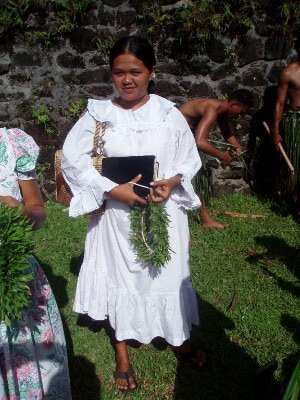
The church wear of the deaconesses and pastor's wives of the protestant churches here in Micronesia are traditionally a plain white dress. When the Protestant missionaries introduced Christianity in the 1850s, they brought with them the asceticism of the Boston Congregational churches of their time. Simple churches painted white, often lacking in both internal and external adornment. Clothing was to be simple, black and white, nothing too colorful or too bold.

Kenye, above,wears a plain cotton dress with the traditional long sleeves. To this day the deaconesses and wives of pastor's dress in white each and every Sunday. The complication is that the other women of the church get to wear the brightest and "shiniest" new floral fabrics, colorful dresses that say, "I have a new dress!" This year a new fabric appeared on the island, a plain white fabric with silvery-white sequins.

The sequins diffract light and thus sparkle in the colors of the rainbow in the sun. Technically the dress itself is still colorless - counting the sequins as being essentially without color. Yet the deaconess or pastor's wife can still sparkle in her new dress on Easter along with all the other women of the church.

Wednesday, April 8, 2009

Rain storm run

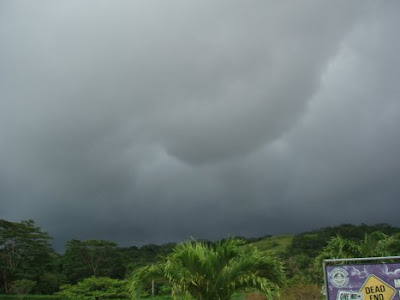
Two hundred minutes is my present seven day target for my running. Last week some sleepy evenings knocked my seven day total under 200. By this evening I had whittled the deficit down to 71 minutes. The day had been windy with heavy rain storms moving through Palikir - the Inter-Tropical Convergence Zone was sitting directly over Pohnpei. A tropical trough.

Decks of tropical cloud cover extending from sea level to the top of the troposphere made the day dark. By 17:10 the day was already turning into night, although the sun would remain above the unseen horizon for the next ninety minutes.

As I headed down Dolihner hill toward Blue Nile I could see a gathering darkness to the east. I slipped around the Pohnpei campus gym, through the parking lot, and swung right down the hill toward 4TY. Cars filled with Mand-bound Pingalapese in Wednesday evening church service clothes were backed up at the stop sign in front of the new JG store.

At Ace Commercial I could see the ridge lines of U. Or I should have been able to see them. The ridge line was gone, replaced by a white column of water. Above the sky was black. To the left was a horizontal set of clouds arranged in four ring-like banks. The outer edge of the gust front rode under this ominous looking formation of clouds. Ahead lay only whiteness - a solid wall of falling water.

As I headed toward the storm front I was less concerned about the weather than the impact the weather would have on traffic and drivers. Broken air conditioning units and consequently fogged windows meant that I would have to consider every vehicle as a potential hazard. I know of no one who knows the simple solution of wiping the inside of the windshield down with a lightly soaped paper towel. Pretty much any bath soap will work, at least during daylight hours.

I often run a route out into Nett, and timing of my run often has me out at Nett river bridge late in the day. On sunny days I have raced the lengthening shadows of trees on the bridge, racing to stay in the sunshine ahead of the shadows of the oncoming night. While I might win the shadow race on the bridge, I know that all runs come to an end and the darkness of night eventually wins. Running is about enjoying the journey, the end of a run brings a sadness. So I run for sunshine.

The rain moves but slowly on Pohnpei. For all the vertical violence, the rain was moving toward me no faster than I was running toward the rain. I met the rain out at the Nett river bridge - Dausokele. I slogged through the rain, continuing on past Kusto's market. Only a few die hards were in market at a time when the market would usually already be packed.

At Palipowe junction I turned around and headed back toward Kolonia, soaked to the skin but starting to feel better now that I was headed back into town. My shoes were heavy and wet, I had stopped at 3-Star to re-lace them when Joe passed by headed east toward Kusto's market. Heading up Etscheit hill a cold shiver went through me - something I have not felt in years. One is rarely chilled on a run at six degrees north latitude in the western Pacific ocean.

Tonight I was running in part to log 71 minutes. I suppose I run to stay fit. Yet neither reason explains thirty years of running on three continents and eight islands. Ultimately I run because I have to run. Or more reflective of my 6:45 kilometer pace, I jog because I have to jog. I also had to stop at Ace Commercial to retie the drawstring on my running shorts because I was about to become a 1970s streaker due to waterlogged heavy running shorts with elastic that died a few dozen washings ago. My running shorts are a good five or more years old.

I ran up the waterfront, water rolling over the road from the rain which had eased off. I headed straight on out the causeway, looked to my right, and saw only dark white. No Lenger. No Param. No Nett Point. All gone. A second storm cell was sweeping in from the east. This cell was closer, I had not seen it until I got out onto the open causeway. I was quickly enveloped in a rain-soaked wind roaring in across the lagoon. Big, heavy rain drops make a curious dockety-dock sound on my shirt. They were large enough and being driven hard enough that I felt each drop impact me.

As the front edge of the storm cell moved toward Sokeh's ridge, the cloud above began to block out the remaining light. The world was going dark and fast. I was running against the wind and the rain. Part of me was revelling in the joy of the effort, part of me simply wanted to be home, warm, and dry.

Alone now on the darkening causeway I was lost in my own solitary thoughts. As I turned around at Lidakida, I knew I was going home. My body senses that direction is toward the barn, and an energy flows back into my legs. Though I want to get home, I still do not want the run to end. End it must, end it will, but the joy is in the run, not the finish. Life is about the journey, few want to reach the end of the adventure.

Heading up past the former Spanish garrison of Santiago de la Ascension, a hole in the clouds developed ahead of me toward weather station hill. I picked up the pace through town. State pay day shoppers were stocking in for Easter. At weather station hill I caught up with the eastbound cloud hole. As the main road turned west at centerpoint, I was able to keep up with the hole all the way into Dolihner. My own private patch of dry sky moving with me as I ran.

Unusual for a 12.9 kilometer run that was now an hour twenty-seven minutes old, my skin was cool and dry. I was not soaked with greasy sweat, I did not perceive that I was sweating at all. I turned in at Dolihner and made the porch just as a third rain cell and road level darkness arrived. Above, through the rain, I could that the cloud was gently tinged with a hint of magenta. Somewhere out over the western Pacific the sun was setting.

Tuesday, April 7, 2009

Social media as a way to share opportunities

Standing on the sidewalk between rain showers, I was engaged in a discussion on ways to attract candidates to apply for positions at the college. Those of us who live here know that the college is a very special place to work, and our students are truly unique. Yet connecting with those whom the college might most like to connect with when advertising an opening is difficult at best. Among the many constituencies the college would like to reach are former employees who might be interested in returning to the college and Micronesians in the diaspora abroad who might want to come home to work. Social media might be one way to get the word out on job openings, especially into this two particular constituencies.

While social media has not yet proven to be the "killer" academic support application I had thought it might be, I have discovered that it is a powerful way to find and connect with alumni -both former students and former faculty and staff. This makes social media a seriously useful tool for alumni organizations. And it was this thought that made me realize that social media is a natural tool by which to get word out on job opportunities here.

Social media is also now playing an important role in HR recruiting and hiring. What follows is a selection of readings on HR and social media, with a focus on the market leading FaceBook as that has garnered the most attention.

Most directly, I found a job recruitment on FaceBook itself. The
American College Personnel Association - Standing Committee for Graduate Students and New Professionals is a group exists inside FaceBook. The group acts as a centralized resource and advocate to address the needs and concerns of graduate students and new professionals in the American College Personnel Association, thus working to advance the field of student affairs in higher education. Membership in SCGSNP is open to all interested parties, however, their focus is primarily for those individuals who self-identify as a graduate student in a master's or doctoral graduate program, and those professionals who have worked in the field of student affairs from one to five years. For those who are non-members, the ACPA is on line outside of FaceBook as well.

Within that group Huntingdon College Office of Student Life made a job announcement for a Resident Director / Coordinator of Student Life position. That link would require FaceBook membership for access - clearly Huntingdon College wants a director who is familiar with social media!

Thus schools are already availing themselves of social media in their employee recruitment efforts.

A ComputerWorld article noted that, "social networks can also be great recruitment tools. "With 85% of college students using Facebook," said Lee Aase, manager of Syndication and Social Media at the Mayo Clinic and chancellor of Social Media University, Global. Aase said, "employee recruitment with job announcements targeted to students at select colleges with specific degrees can provide companies with a significant advantage over competitors searching for similar talent."
In a nutshell, social networking sites such as MySpace and Facebook can expand the networking and marketing potential of any company."

One should bear in mind that FaceBook is a unique media with its own social etiquette and structures. Membership is restricted to people, corporate entities cannot be "members" per se, although "interest pages" can be established for a corporate entity. Thus current recommendations include posting that a job opening exists on one's personal news feed with a link to the actual job announcement held on the college's own web site. The key is to have a lot of friends.

I would note that Micronesians are predominantly in MySpace and Bebo, so recruiting the diaspora would probably require entering those social media spaces. I chose to join FaceBook, in part because at present that is where are students are not. FaceBook is also the market leader with about 200 million users, and more users means a higher probability my own friends are there. In the 34 to 54 age group, FaceBook is really the only player and is showing explosive growth in market share . FaceBook is also the choice of faculty. So FaceBook is the obvious choice for me as a faculty member. FaceBook even has faculty ethics guidelines for faculty choosing to operate in "Face space."

Used wisely and appropriately, social media could be useful tool to get word out to potential job candidates that the college has an opening, especially into the Micronesian diaspora. The effectiveness would depend on having someone in a social media space who is "well-connected" and thus well placed to get "the word out."

Thursday, April 2, 2009

Dress styles of Kosrae

The female clothing culture of Kosrae is centered on the dresses women wear. These dresses have evolved and changed over time. This is their Pacific island culture, a proud tradition that is truly unique in Micronesia. The Kosraean women marching in the College of Micronesia-FSM culture day 2009 parade were not just wearing any church dress during the cultural march, they were wearing dresses and hair styles from the past as well as the present. The following two images were captured by Harvey Segal in Utwe, Kosrae, in 1965. Leone Nena wears a style of dress common in 1965.

Julia Nena wears another dress with a hair style more common to that era.

Forty-four years later Pua and Cantina below echo the styles of their forebearers.

In this second shot, Kenye exhibits the style of dress once worn by a Deaconess or Nipasta. Note that the fabric is a cotton and required pressing, today many elderesses wear synthetic fabrics, and modern dresses lack the pleating and lace seen below.

Note the presence of pleating on both the pink dress and flowery dress.

The collar and sleeve detail on Cantina's dress can be seen above. Below is a full length shot of the dress. The cotton print fabric is also evocative of the age in which the dress was made.

Below Robina wears a dress that was in style circa 2005, synthetic fabric, a bolder print.