Sunday, February 22, 2009

Assessment of test two in SC 130 Physical Science

Due to staff development day, test two in SC 130 Physical Science will function as the comprehensive midterm examination. An item analysis of the questions asked was regrouped by whether the question asked for a response that was purely a memory recall item, a mathematical calculation (which may require recall of a formula), an inference from data presented, an explanation of a system presented in class, or an explanation of a system not presented in class but explainable by the science presented in class. Test questions were all short answer, no multiple choice, no matching, nor true false questions were involved.

For 32 students (with two absent on test day), the following percentage of the 32 students answered the type specified correctly:
memory recall item: 73%
mathematical calculation: 42%
inference from data presented: 32%
explanation of a system presented in class: 47%
explanation of a system not presented in class: 16%

As had been found in the past, students perform best on recall of specific facts that can be memorized. Success rates fall for calculations. In Fall 2007, a 36% success rate was reported on calculations. Success rates on single memorized facts range as high as 84% and 90% for the final examinations in spring and fall 2008.

Calculations often require using a formula from memory and then making a calculation with the formula. The course focuses a on few core concepts and formulas. Forty-two percent of the students experienced success on these more complex problems.

The inference problems included reading a graph and explaining what was happening physically as indicated by the data on the graph. In fall 2008 39% of the students answered the same type of problem correctly. On test one this term, fifty percent of the students answered correctly the same questions as posed on the midterm. Only 30% of the students answered the same two questions correctly on the midterm. Overall, for all questions requiring an inference, only 32% of the students answered correctly. That the same two questions, questions which were covered in class after test one, saw a 20% drop in performance might be taken as an indicator of knowledge loss and/or a lack of studying. This also indicates that students have difficulty reading graphs and interpreting the physical meaning of a data trend.

Students did slightly better on explaining a system for which the explanation was given in class. When faced with a new, novel system that is explained by the same physical phenomenon as earlier systems, student success collapses to 16%. This is not unexpected. Although I do have such studies in hand, research I saw in the 1980s indicated that when faced with a novel system even science majors will often fall back on concepts held prior to entering science classes in school. Students tend to be unable to use newly learned science on novel systems. Science methods such as the use of discrepant events by authors such as Tik K. Liem attempt to tackle this phenomenon by confronting students with new systems that behave counter-intuitively and yet in complete accordance with the science learned by the student.

Although I employ some discrepant event science, that does not mean that this is a "magic bullet." In fact, that five students successfully explained a system that they had never seen before may be taken positively. When presented with the anomalous system, most people including many in the sciences would likely have difficulty explaining why the system behaves in the way that it does. In this particular case a thorough familiarity with fluid dynamics would have been necessary to reach the correct conclusion. Bear in mind also that SC 130 Physical Science is the "science for non-hard science majors." The marine science and health careers majors do not take physical science.

Although the course does include some memorized content, the intent is to center the course on exploring phenomenon and developing scientifically based explanations. Based on in-class conversations, a few students are gradually coming to understand that a laboratory cannot prove a scientific theory, only fail to disconfirm the theory.

Friday, February 20, 2009

Gymnosperm presenations in ethnobotany

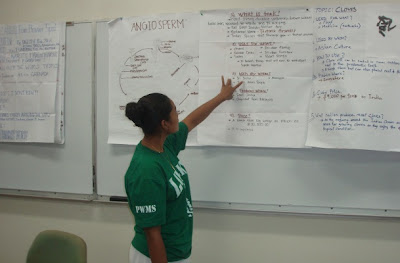
Yuleen covers teak. To the left is a poster on the life cycle of an angiosperm.

Marcy explains the many uses of cloves.

New tools arrived for pulling back the carpet of razor grass in the garden. A Collin's axe - a doll's best friend?
Posted by Picasa

Physci rolling marbles

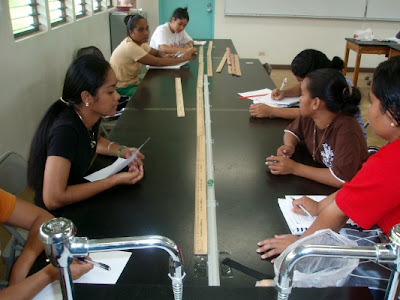
Laboratory six was a practical laboratory. The students were presented with a simple system. Their task was to measure the two variables and then write a report on the nature of the mathematical relationship between the variables. They were also tasked with determining if the system is a predictable system.


The students explored the relationship between the mass of a marble and the distance the marble rolls on a ruler track when released from a ramp of constant height h. Three marble sizes were used, plus BBs for a fourth sphere size. The tracks proved too short for the taws. Above a taw is in motion on the track.


Massing the marbles.


The tracks are aluminum rulers from a local office supply store.
Posted by Picasa

Social media usage by students revisited

An initial survey at the start of the term suggested that 83% of the students in MS 150 Statistics were using a social networking site. In that survey many students included sites from the broader definition of social media sites such as on line email sites. As a result I decided to resurvey using the term "social media."

I had also found that some students had opted not to answer the first survey due to fear of repercussions - students understand that there is a climate of disapprobation at the college in regards social media use by students. Since the first survey, the students have learned that I am engaging in finding educational applications of social media by joining a social media service.

As I noted in my blog, given the atmosphere of disapproval surrounding social media the college, I felt like I had "gone over to the dark side." My students, however, were now aware that I too was using social media. Seventy-four percent noted that they wanted faculty in social networking space, so my presence was not as unwelcome as I had once thought it might be.

In the first survey the students appeared to consider sites such as Yahoo to also be social networking sites, the students do not clearly distinguish between social networking and social media. Thus I suspect that my own use of social media may have been the larger impactor on the willingness of the students to share their own usage patterns.

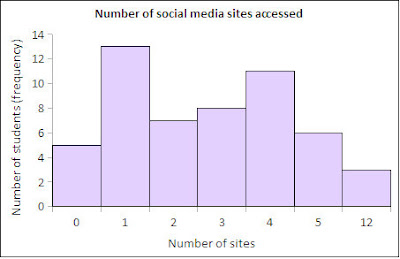
Where the first survey indicated that 83% of the students use social networking sites, 91% responded in the second survey to using social media sites. The students also responded with a far more detailed list of the sites being accessed. While five students (9%) did not choose to answer the survey, and thirteen (25%) listed only one site, 35 students (66%) listed two or more sites. Over half of the students, twenty-eight, access three or more social media sites. Three accessed six or more, with one listing twelve different sites.

The fifty-three students listed twenty-nine different social media sites. The "market share" of the top three social media sites among the statistics students was led by MySpace. Sixty-six percent of the students use MySpace, 45% use Bebo, and 36% use Tagged. Note that the numbers add to more than hundred as many students have two or more memberships. The surprise was in the diversity: students listed 15 sites for which they were the only member among the 53 students surveyed. Global social networking leader FaceBook has only a 13% share of the students surveyed.

Clearly social media is having a negative impact on the college's bandwidth. Anecdotally some students are effectively addicted to the sites and their usage level is impacting their ability to get schoolwork done, not unlike a substance abuse problem. Theoretically the college could seek to shut down all access to these sites. Yet once the students leave the college, how has the college then prepared the students to manage this technology?

Anything can become a waste of one's time. Talking on the telephone, email, television, and even committee meetings, if not time managed, will negatively impact one's productivity. College's have always risen to the occasion and assisted students with the task of learning to manage their time. Some students are struggling to balance the siren call of friends who posted a comment on their social networking site and the demands of a college education. Basic email efficiency techniques translate fairly well into social media space.

"Touch once, act on it, and file," is a useful approach to handling posts from friends. Using a "cut-and-paste" list of common responses can also be a time saver. Cut, paste, personalize, and post. Social media are simply another tool in the communication tool box. Learning polite ways to drop out of a chat is also a necessary skill. Many of the features of e-learning spaces such as asynchronous private group discussions and synchronous group chat facilities are already built into social media spaces.

Much of my effort in this series of explorations of new technologies is an effort to find new options for communicating with students in addition to existing communication pathways. Anecdotally, with midterm approaching, one technology does appear promising. Cell phone text messaging. This term I acquired a cell phone and provided the number to all of my students. In turn, 39% of the students shared their cell phone number with me.

I have received more inquiries for remote help with homework via SMS text messages than I ever received on my land line. I have not surveyed to determine the attraction for students, but one can surmise the reason students use text messages. Many have cell phones, few have computers. Homework is often being done away from a computer, possibly remote from a telephone. At least one student texted for homework assistance while her siblings pounded sakau in the nahs behind her. Text messages also avoid having to "speak to an elder" - a very real cultural barrier for some of the students. The students also know that they will not "disturb" me with a text message. A land line phone might wake me up should I turn in early, but I have made the students aware that I turn my cell phone off at night so they can attempt contact via cell phone without worrying about catching me at the wrong time.

New readings on faculty and parental ethics on social networking sites:
Social Networking Guidelines for School Employees
Parental faux pas on Facebook
How Not to Lose Face on Facebook, for Professors

Posted by Picasa

Wednesday, February 18, 2009

Escaping the silo

At present each social networking site is its own silo, you cannot invite friends who are on other social networking sites. Thus there are students at the college with five, six, even seven social networking site presences in order to keep up with all of their friends. The solution is a way to trade identities between sites, and FaceBook has taken a strong step in this direction by teaming up with OpenId. I ran off to apply for my own OpenID, only to learn that I already had one due to this very blog. So instead of "Let my people go" maybe the new rallying call will be "Let my friends roam!"

Friday, February 13, 2009

Physical science, ethnobotany

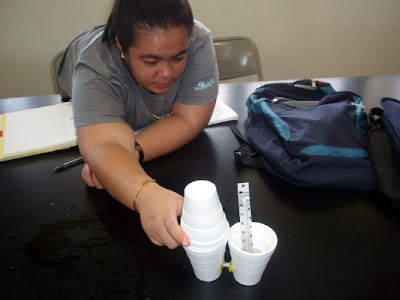
Physical science explored the heat conductivity of common hardware store bought materials. The thermometers were the only off-island item used in this laboratory.


The ethnobotany class visited the Pohnpei State Botanic Garden at Pwunso. Here the class posed for a class picture in front of a painted gum tree, Eucalyptus deglupta.


Field trips are a fun way to learn!


The professor expounds on a gymnosperm found only in the garden. The tree is thought to be a kauri pine, Agathis robusta.

Posted by Picasa

Tuesday, February 10, 2009

Christmas in February

When packages arrive by slow boat, Christmas gifts from family abroad can arrive in February.

Posted by Picasa

Monday, February 9, 2009

Social networking, privacy concerns, students, and elders

Social networking sites represent an unprecedented threat to the privacy (PDF) the students at the college. On the order of 83% of our students actively use social networking sites, sharing deeply personal information with friends in what is falsely perceived to be a private world. In the United States 93% of all students use social networking sites with 63% logging in daily, suggesting 83% may be an underestimate. The reality is that their personal data is being held by corporations motivated by marketing opportunities, data that is being used by the social networking site and third parties in way the social networking site user would never imagine.

The lesser of the privacy concerns is actually the corporation which owns the the social networking site (SNS). A far more subtle but vastly more serious privacy issue exists in SNS space: hugs, kisses, penguins, superpokes, flowers, and causes. Welcome to another brave new world with its own language and terminology.

SNS users can send other users "gifts" such as hugs and other intangibles. These are not physical items, and they do not cost anything. The "gifts" are typically little more than icons, some with extended social networking functionality. Other may take the form of what appear to be innocent quizzes, fun activities sent to the user by a trusted friend. The catch is that each of these is actually a third party software application. Clicking on "OK" when someone sends a user a "hug" authorizes the third party application full access to the users profile and data. The application may claim to be written by a high school class as a project at George's Bank high school, but there is no way to verify this. The application could be written by a sex offender in Vladivostok.

The SNS waiver is often in tiny light gray print, and is not visible from the screen on which you get the gift. Few users probably ever see the waiver language, "Facebook is providing links to these applications as a courtesy, and makes no representations regarding the applications or any information related to them. Any questions regarding an application should be directed to the developer."

When one agrees to "receive" a hug, superpoke, or to agree with a cause, the site does caution, "Allowing Causes access will let it pull your profile information, photos, your friends' info, and other content that it requires to work." Why an application such as causes would need access to photos and friends list is completely unclear, except that the application is massing a data for future use. The developers are an outside team, they will have ready to tap pool of people to fund and support a particular cause.

Some gifts actually cost real money, and one buys credits in SNS space typically using credit card to send these gifts. Users actually pay money to an unknown party for the privilege of being spied upon, yet few users ever come to this realization.

Applications are designed almost as a "honey pot" to attract users into using them. Some are labeled "causes." The cause may be a worthy cause, such as the "gift" that signifies a user supports the cause "Men who oppose the abuse of women." That is surely a worthy cause, how can one not say "OK" to that cause? The cause may be fully legitimate, some even have mechanisms that let one donate to the cause. Lil Green Patch (in FaceBook space) permits one to make donations that go to combat global warming, with a recent donation to The Nature Conservancy's Adopt and Acre program - a legitimate and worthy cause. The SNS places the burden of discernment on the user. Based on my limited experience, our students are ill equipped to make discerning decisions in SNS space.

There are a number of emerging trends that suggest cause for concern going forward for our students. Employers are increasingly turning to SNSs to evaluate candidates for jobs. The privacy waivers SNS users agree to in order to use FaceBook, MySpace, and Bebo, offer little protection to the SNS user. Uploaded photos and videos may be available to "non-friends" and third party applications could have full access to all uploaded photos and videos. A compromising image could cause an applicant to not be considered for a position. Within SNS space, there is no way at present to different "faces" in different contexts. No way to limit deeply personal material to one's closest friends, no way to maintain a "professional" face to mere acquaintances.

Just as troubling is that the SNS can retain images indefinitely with the potential for a compromising image to be misused at a later date. The SNS makes no assurance that images will expire out of the system, on the contrary, users usually expect images to remain. Yet even when a user "deletes" an image, there is no guarantee the SNS has not retained a copy of the image, or video.

The flip side is that users are increasingly using their social networks to find jobs and positions in their own field. A user typically has a broad range of friends in their own field, these have become a front line resource in their own career networking.

Another emerging trend is geo-locating (PDF) where a user opts in to physical tracking in the real world. The concern at present is that courts have held that employers can keep track of an employee's location, thus there appears to be legal precedent for tracking an employee using SNS space. The gray area is whether a user who has opted in can be tracked by an employer who has no policy on geo-tracking. Again, our students are ill prepared to make decisions in this area.

SNS sites also now track their users across sites, not just at the SNS site. Indeed, users like this feature. A user can buy a book at Amazon and have their SNS news feed home page tell their friends that they just bought that particular book. News sites like CNN allow a user to feed an article back to their SNS via services such as FaceBook Connect.

The upshot is that users may one day be tracked in both cyberspace and "meat space."

A glance at the college's Internet usage statistics shows clearly that SNSs are the elephant in the living room. Our students are voracious users of social networking sites. Wishing that SNSs would go away or that students will stop using them is to bury one's head in the sand. Education has a role to play.

In the hope that there is an academic use to SNSs, I recently became an SNS user. Just as in email space I found myself spending time debunking the urban legends that our students too readily believe in, I find myself in SNS space educating students about the ramifications of the actions they are taking in that space. SNS space lacks instructors, guides, elders who can play a role in helping students use this new medium wisely and intelligently. At the same time, because of the potential complications of the power relationship, I make a best attempt to follow the faculty ethics guidelines (guidelines are inside an SNS) published for operating in a social networking space.

Social networking sites, as with any new technology, represent both a risk and an opportunity. Fire can burn and fire can cook, few suggest that the solution to house fires is banning cooking. Micronesian societies understand the value of elders and their knowledge, the time has arrived for elders to participate in and contribute to the social networking phenomenon.

Recommended reading: 10 Privacy Settings Every FaceBook User Should Know

Sunday, February 8, 2009

Sunday

Merlyn Maheta Kilafwasru visits and joins the Sunday church goers.

Posted by Picasa

Saturday, February 7, 2009

Pohnpei Ladies Club Fun Run

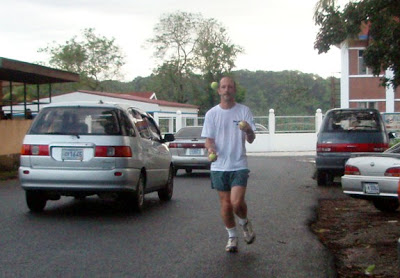
The Pohnpei Ladies Club fun run featured a first for Pohnpei running: two routes. For the walkers a roughly three kilometer jaunt up Kaselehlie to Elenieng, down to the Nett estuary past Pohnpei campus, northwest along the waterfront to Mesenieng, and back up to Spanish wall ball field. The runners went up Kaselehlie turning right headed for Mapusi on the weather station hill bypass. A right onto the circumferential road and then forking left up into Dolihner towards the Dolihner water tank. A left back down to Pohnpei Island Central School and then a straight shot back to Spanish wall ball field over weather station hill.


The new route was a refreshing change and is a favorite route of mine. Topping weather station hill one can see clear to the finish line, something not possible on a Palm Terrace start-finish run. Seeing the runners out in front strung out along Kaselehlie is both exhilarating and self-challenging. This also makes the final 500 meters all downhill and straight. At least one runner went down on wet pavement when a race to the finish hit speeds not possible on a Palm Terrace finish.

The route duplicates the "up" route off of a Palm Terrace five kilometer run which puts the distance at 4.93 kilometers by GPS. I usually finish right around 30 minutes, with beating 30 minutes something that takes some effort. Against the day that I run a 5k elsewhere, I try to ensure that I am running the full distance. To do this, I added a run over to the commission and back to the start as seen above. I finished in 28:12.


The night had included heavy rain, and the start was under drippy, gray, dark skies. This may have impacted attendance. I finished sixth on the five kilometer route, with my daughter about 700 meters behind me.


My son finished second on the three kilometer route in a duel for first place with a classmate of his. After the run I had a quick turn-around in order to get to my Saturday morning class.

Posted by Picasa

Thursday, February 5, 2009

Odd Portents

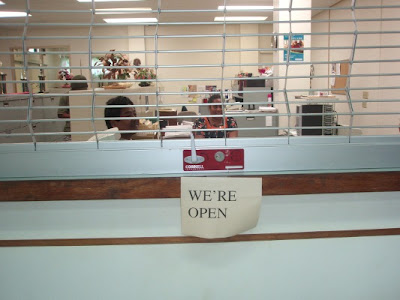
The sign generated a healthy debate. The security gate latching mechanism had failed. Technically the office was open. As a practical matter transactions were difficult. At a literal level, the gate was closed. Academics have all the linguistic fun in life.


The next morning dawned dark and stormy, windy February tropical rains. In the early hours of the morning the sun shot through a hole over Twemwentwemwensikir ridgeline and fastened a double rainbow onto a shaft of rain falling to the west of campus.


Later the students puzzled over how marbles know how many marbles hit the head of a line. Marbles in equals marbles out. Speed in equal speed out. But how do the marbles know what to do? Consider this from their perspective. At one point one group concluded that marbles can see but not hear. A few students trotted out words that they had heard in science, force being a favorite. None could define quite what a force was and how that ensured marbles in equaled marbles out.


One marble was launched from ramp top, a single one has been kicked out at image bottom. In the simplest systems are the most mysterious science.

Gates that are closed but marked open, double rainbows, and marbles that can apparently count.
Posted by Picasa

Wednesday, February 4, 2009

Working in the cloud: Google Docs

"My hard drive crashed and I lost all my email addresses. I've lost my all contacts with my friends," says a colleague to me.

Why were your friends on a hard drive? Keep your friends in the cloud.

"I came to your office, but you were not there," says a statistics student.

Why didn't you check where I was? My location updates are in the cloud.

"Do you have any pictures from that celebration?" asks a friend.

Of course, I keep those in the cloud.

"My home work is on my flash drive. I left the drive at home. Can I turn in the homework tomorrow?" asks a physical science student.

Why are your documents on physical media? Work on them and store them in the cloud. Google docs is a maturing office suite on line that is fairly functional even on limited bandwidth. Working only across a dial-up low bandwidth modem, 24 kbps, I was still able to put together a spreadsheet using data from an activity in physical science today.

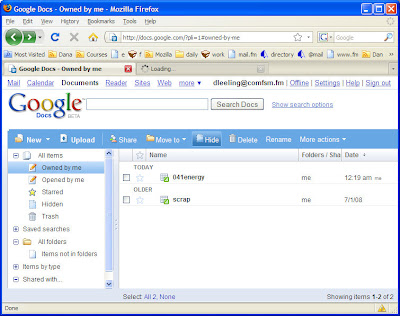
When Google docs opens you first have a basic file manager interface. The New button allows the creation of a word processing document, spreadsheet, or presentation.


Working on the spreadsheet is the same as Excel or OpenOffice.org Calc. There is no delay in cursor movement, although some updates may take a few seconds to convert from a function format to the numeric value. Note the use of a SQRT function below.


While the graph options remain far more limited that what Excel and Calc offer, basic graph types can still be created.


There is no support yet for showing a regression line on the graph, but the functions necessary for a lot of statistical calculations are available in the spreadsheet. The most glaring omission for an introductory statistics course is the lack of the TDIST, TINV, and TTEST functions. The NORMDIST and NORMINV would carry a student through chapter eight of eleven in my text.


Files can be exported and saved locally as OpenOffice.org .ods files, Excel .xls files, or as a .pdf file.

There are sharing options that allow one to share a document either with other Google users or simply with the world. My spreadsheet should be viewable by anyone on the planet at:
http://spreadsheets.google.com/ccc?key=pXIirREoOItaKkEVl50nBMA
I could have set the sharing to allow others to edit the file, I chose not to. But there are collaborative functions possible via shared editing.

Another option is to publish as a web page, which results in the following:
http://spreadsheets.google.com/pub?key=pXIirREoOItaKkEVl50nBMA

The former looks and feels like a spreadsheet, permitting spreadsheet like selection of columns or rows. Javascript is undoubtedly deeply involved. The later URL is a "static" HTML table and even an older browser should be able to render the page.

From an IT standpoint the only load is a bandwidth load. Google Docs requires only a functional, modern browser and a network that is up and running. The documents, viewable spreadsheets, and web pages are all stored in the cloud. Technically, on some server that Google has to maintain, not our IT crew.


The network is the computer when everything is in the cloud.
Posted by Picasa

Tuesday, February 3, 2009

Assessment: Preliminary item analysis data for statistics and physical science test one

MS 150 Statistics

Test one this term was substantively similar to test one last term permitting a term-on-term item analysis of student performance (fall 2008 versus spring 2009). Overall there was no change in performance as measured by an item analysis. There were, however, changes in performance within specific topic areas. The number correct (corr) refers to the number of students getting that item correct. The fall term had 45 students taking test one, this term the course has 57 students who took test one.

I s q Spring 2009 corr perc
Fall 2008
number correct
perc change
t01 2 1 level of measurement 33 0.58
25 0.56 0.02
t01 2 2 sample size 54 0.95
40 0.89 0.06
t01 2 3 minimum 57 1.00
43 0.96 0.04
t01 2 4 maximum 57 1.00
44 0.98 0.02
t01 2 5 range 56 0.98
40 0.89 0.09
t01 2 6 midrange 40 0.70
36 0.80 -0.10
t01 2 7 mode 53 0.93
41 0.91 0.02
t01 2 8 median 44 0.77
36 0.80 -0.03
t01 2 9 mean 45 0.79
33 0.73 0.06
t01 2 10 standard deviation 43 0.75
35 0.78 -0.02
t01 2 11 coefficient of variation 38 0.67
30 0.67 0.00
t01 2 12 width 40 0.70
36 0.80 -0.10
t01 2 13 frequency table 21 0.37
28 0.62 -0.25
t01 2 14 frequency histogram 20 0.35
26 0.58 -0.23
t01 2 15 shape of histogram 38 0.67
28 0.62 0.04
t01 2 16 inference 21 0.37
7 0.16 0.21
t01 2 17 z-score 20 0.35
13 0.29 0.06
t01 2 18 inference 29 0.51
17 0.38 0.13

Performance fell markedly and significantly on material from section 2.2 of the text, frequency tables and histograms. As a result, this material was reviewed in detail with the students. This material will be retested on the midterm.

The overall success rate of 69% for the spring term is identical to the success rate for the fall term and falls well within the historical range of 65% to 75%.

SC 130 Physical Science


Although the tests are not substantively similar term-on-term from fall 2008 to spring 2009, there was overlap in material for test one in the two terms. On overlapping material there was a modest overall gain of 6% as measured by item analysis. Thirty-three students took test one spring 2009, in fall 2008 twenty-eight students took test one.

q Spring 2009 corr perc
Fall 2008 correct perc perc
1 plot data 33 1.00


2 inference from graph 29 0.88


3 calculate velocity 16 0.48


4 infer acceleration 0 0.00


5 peripatetic 20 0.61
20 0.71 -0.11
6 list three fundamental qualities 32 0.97


7 list qualities required for motion 29 0.88
24 0.86 0.02
8 calculate volume 27 0.82
23 0.82 0
9 calculate density 20 0.61
16 0.57 0.03
10 inference from result 22 0.67
12 0.43 0.24
11 inference from graph 25 0.76
13 0.46 0.29
12 inference from graph 8 0.24
9 0.32 -0.08
13 write an equation from graph 17 0.52
16 0.57 -0.06
14 given x determine y from quadratic 6 0.18


15 calculate mean 27 0.82
11 0.39 0.43
16 identify outlier error 25 0.76
26 0.93 -0.17

An encouraging gain was seen in the ability of students to make an inference from material provided on the test. This term marks the first term that the course is working solely from the physical science text I worked on during 2008. The two percent gain in overall performance as measured by the item analysis from a 62% success rate to a 64% success rate is not significant and yet is encouraging.

The specific performance by question on test one provides guidance on areas of student weakness that will be addressed as the course moves forward. Of glaring note is that no student could make the inferential leap that a constant velocity implies a zero acceleration (question number four). This matter was reviewed when the test was returned to the students.

Sunday, February 1, 2009

Post-kava exercise recovery

In an earlier completely non-scientific study of my post-kava (Piper methysticum) exercise recovery as measured by minutes of running I determined that I needed six days before my average running duration returned to my long term average. That study included 154 days. I recently updated the data. With 217 consecutive days in the data set, recovery now appears to be even longer at seven days.


As noted in the original study, this inveighs against the concept that a once-a-week kava (called sakau here on Pohnpei) recovers his or her physical endurance within a couple days. This also suggests my own estimate of a four day recovery underestimates the impact of kavalactones.
Posted by Picasa